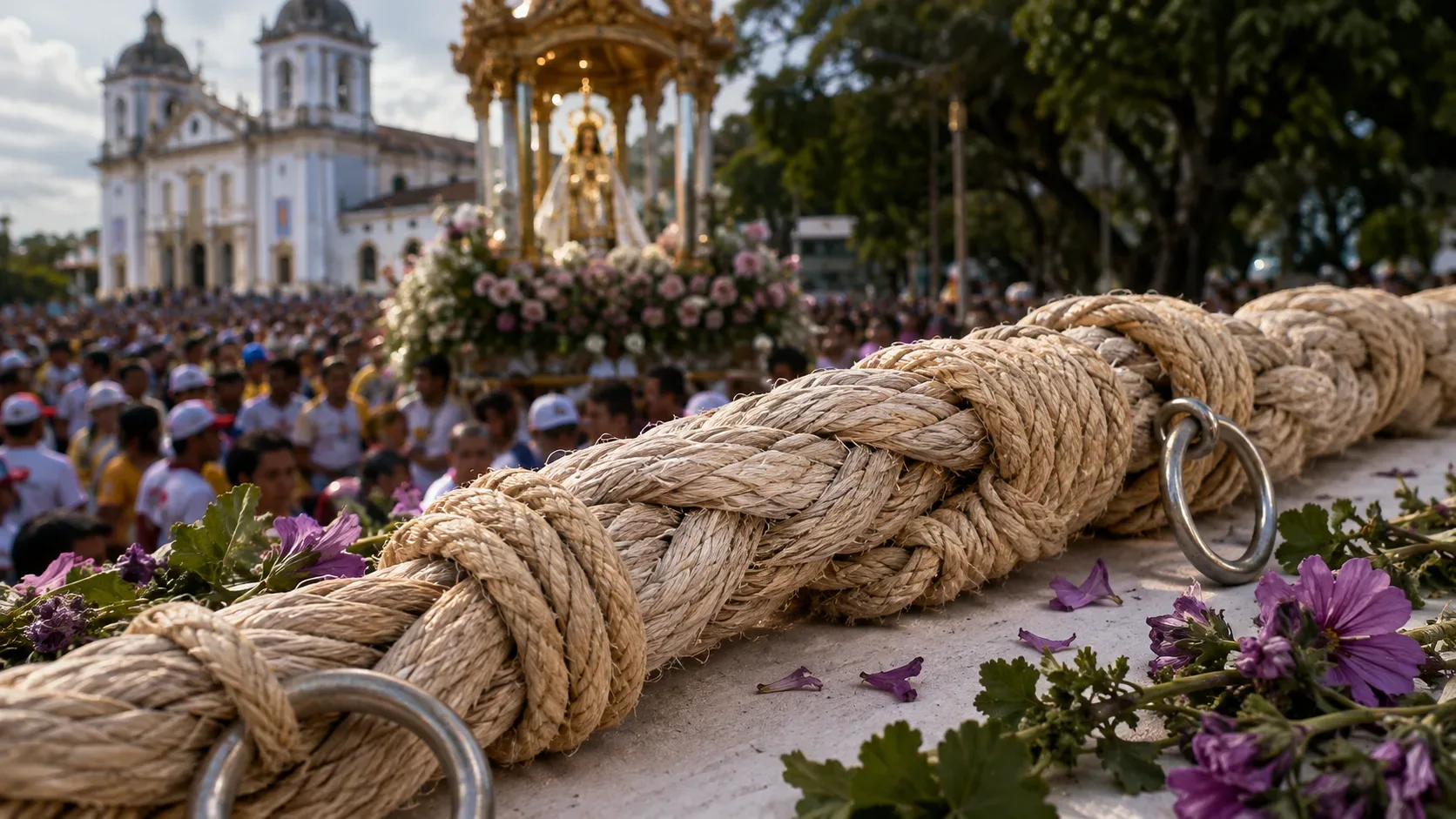
The Círio rope in 2026 is a system prepared specifically for the two largest processions of the Festa de Nazaré: the Trasladação and the Círio. According to the Diretoria da Festa de Nazaré (DFN), the set produced for 2026 totals 800 meters, divided into two 400-meter sections — one for each procession — with a diameter of 60 millimeters and 32 knots and rings. It is manufactured in Pará by Companhia Têxtil de Castanhal (CTC) using Amazonian malva fibers. The Círio organization published these specifications in March 2026.
What makes up the Círio rope system in 2026
| Element | How it appears in the system | Function described by official sources |
|---|---|---|
| Rope | Two 400 m sections, 60 mm in diameter | It is the element held by promesseiros and integrated into the system that accompanies the berlinda during the Trasladação and the Círio. |
| Stations | Five metal structures in the linear arrangement adopted since 2004 | They divide the rope into sections and help organize traction and the pace of the procession. |
| Knots and rings | 32 knots and rings in the set reported for 2026 | They form part of the rope's connection points to the stations; for 2026, the DFN announced reinforced connections. |
| Berlinda | The structure that carries the Pilgrim Image | It is the central procession element to which the rope system is connected in a planned manner. |
Stations, knots and rings: what is the difference?
The stations are not simple markings on the fiber. The official Círio symbols page explains that, since 2004, the rope has used a linear format divided by five metal stations, a change associated with procession organization and safety. These stations help distribute the system into sections and support traction and the pace of movement.
The knots and rings belong to another layer of the structure: they are attachment and connection components. For the 2026 production, the DFN reports 32 knots and rings and says these points received special attention, with reinforcement intended to improve load distribution and robustness. This explains why “five stations” and “32 knots and rings” are not competing figures: they describe different parts of the same system.
Simplified textual diagram: rope section → metal station → rope section → metal station → additional sections and stations → planned connection to the berlinda. Knots and rings appear at the attachment points that connect the rope to the stations. This diagram is explanatory only and does not represent scale, exact positioning or instructions for use in a crowd.
Why the 2026 rope is made from Amazonian malva
Until 2022, the rope used in the Círio and Trasladação was made from sisal and produced outside Pará. The change began in 2023, when CTC started locally producing a rope based on Amazonian malva fibers. For 2026, the organization kept this raw material and focused adjustments on the knots, rings and conservation procedures.
The rationale presented by the DFN and the manufacturer combines three factors. First, malva provides a softer feel, an important characteristic for a rope held by many hands for hours. Second, production brings a significant part of the supply and manufacturing chain into Pará. Third, malva is a natural and biodegradable fiber, which requires care in handling and storage after delivery.
The organization also states that about 300 rural producers participate directly or indirectly in the malva supply chain used for the rope. In the field, the process includes site preparation, planting, harvesting, retting, washing and drying. At the factory, the fiber is softened, carded, spun, twisted and transformed into the final rope. Approximately one metric ton of malva is needed for the 800 meters, and industrial production involves 83 employees. According to the official 2026 communication, the full process takes about one month.
Which processions use the rope?
The rope is not used in every procession in the Nazaré program. The DFN specifically states that the two 400-meter sections are intended for the Trasladação and the Círio. The official processions page describes the Trasladação as the Saturday-night procession on the eve of the Círio, carrying the Pilgrim Image toward Belém Cathedral along the reverse route of Sunday's main procession.
In other official processions, the image may be carried in different structures and under different arrangements. Therefore, saying that the “Círio rope” is part of the festival does not mean it appears in every procession on the calendar.
How the rope acquired its symbolic role
In the historical account maintained by the Diretoria da Festa de Nazaré, the rope became part of the Círio in 1885, after flooding from Guajará Bay hindered the berlinda and a rope was used so that the faithful could help pull it. A practical solution eventually became one of the celebration's most recognizable symbols.
Today, the organization presents the rope as a bond between Our Lady of Nazaré and devotees. Its symbolic meaning also belongs to the broader heritage of the Círio: Iphan has registered the celebration as Cultural Heritage of Brazil since 2004, and UNESCO recognized it as Intangible Cultural Heritage of Humanity in 2013. Iphan emphasizes that the Círio brings together devotional rituals, cultural expressions, solidarity and a sense of belonging.
What changed specifically for 2026
- Local production in Pará using Amazonian malva was maintained.
- The set remains 800 meters long, divided into two 400-meter ropes.
- The stated diameter remains 60 millimeters.
- The DFN reports 32 knots and rings in the set.
- The 2026 adjustments prioritize reinforced knots and rings, load distribution and conservation after delivery.
- Delivery of the rope is scheduled for September 2026.
A safe way to understand the rope's meaning
Understanding the rope as heritage and procession engineering is different from receiving instructions on how to enter it, hold it or compete for space in a crowd. This article describes the structure and meaning documented by official sources, but it does not provide guidance for behavior inside the rope. In high-density events, operational instructions should come from the Diretoria da Festa, the Guarda de Nazaré and the public authorities responsible for safety.