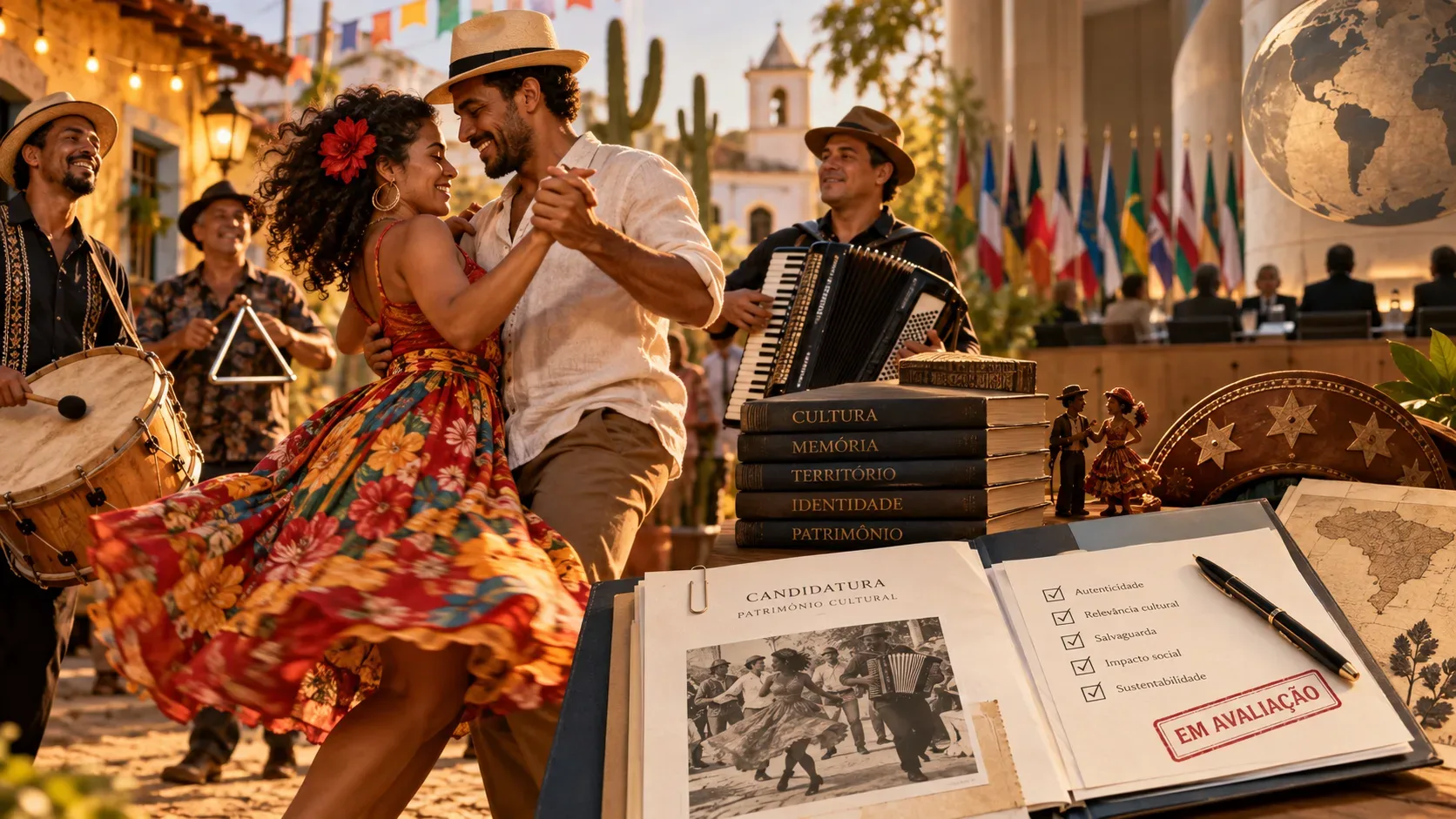
Brazil submitted to UNESCO, on 31 March 2026, the nomination file for Traditional Forró — linked to the cultural element registered in Brazil as the Traditional Matrices of Forró — for the Representative List of the Intangible Cultural Heritage of Humanity. This opened the international stage of the process; it does not mean that recognition has already been granted. Under UNESCO’s official timetable, files submitted by that date are part of the cycle for possible inscription in 2027.
The key is to understand what is actually being assessed. UNESCO is not choosing “the best rhythm” and it is not holding a popularity vote. To enter the Representative List, a nomination must demonstrate five criteria: that the element is intangible cultural heritage; that inscription can increase visibility, awareness and dialogue; that safeguarding measures exist; that communities participated broadly and gave their consent; and that the element is already included in an intangible-heritage inventory of the submitting country.
Nomination, evaluation and inscription are different stages
| Stage | What it means | What it does not yet mean |
|---|---|---|
| Nomination | The Brazilian State submits a file intended to show that Traditional Forró meets the criteria of the 2003 Convention. | There is no automatic international recognition. |
| Evaluation | The file is processed by the Secretariat and assessed by the Evaluation Body, which makes a recommendation to the Intergovernmental Committee. | A technical recommendation does not replace the Committee’s final decision. |
| Inscription | If the Committee approves it, the element is added to the Representative List of the Intangible Cultural Heritage of Humanity. | Inscription does not freeze the practice or make UNESCO the manager of forró. |
UNESCO stated that 31 March 2026 was the deadline for the 2027 cycle. The Brazilian heritage institute Iphan recorded the formal submission of the file by Iphan, the Ministry of Culture and the Ministry of Foreign Affairs. The most precise description today is therefore: nomination submitted in 2026, for possible inscription in 2027.
Which “forró” is being nominated
The nomination does not start from a generic definition of everything commercially labeled as forró. It is anchored in the cultural element Brazil registered in 2021 in its Book of Forms of Expression: the Traditional Matrices of Forró. In 2026, official communication also used the term Traditional Forró for the international nomination.
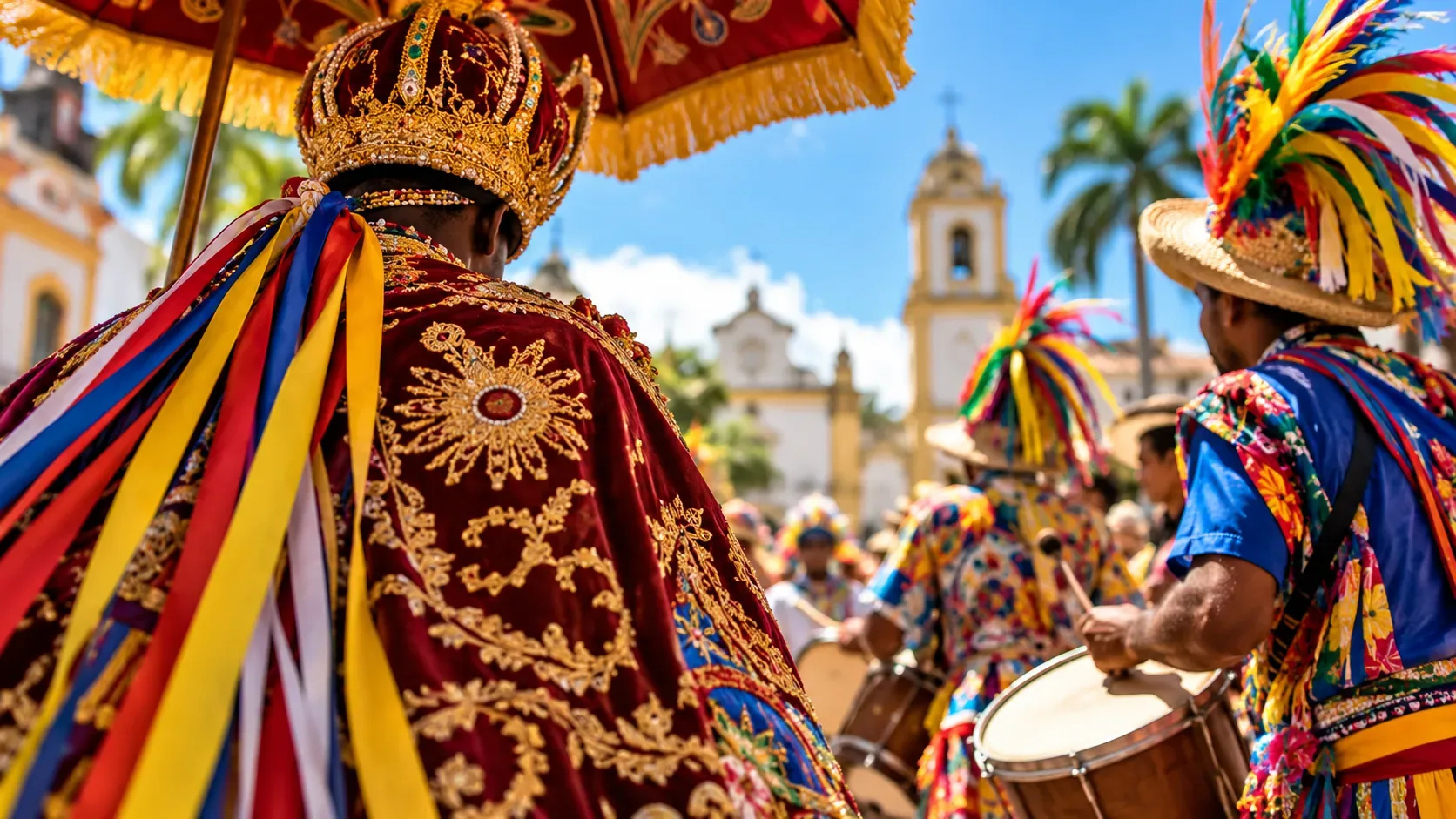
In Iphan’s public descriptions, this universe is presented as a form of musical and dance expression that originated in Brazil’s Northeast and spread across the country. References include baião, xote, xaxado, arrasta-pé, rojão and coco, together with practices associated with dances, festivities, festivals and celebrations. The emblematic sound of accordion, zabumba drum and triangle trios coexists with other formations and bodies of knowledge, including fiddle masters and pífano bands.
This matters because intangible heritage is not simply a playlist. The Iphan record for the cultural element describes a universe combining musical and dance performance, gatherings, celebrations, knowledge, objects, networks of producers and bearers, and modes of transmission. The public “Forró do Mundo” presentation reinforces that breadth.
At the same time, the public documentation about the Brazilian registered element must be distinguished from the full content of the international file. Iphan stated that the submitted dossier contains historical information and elements intended to show compliance with UNESCO’s requirements, but responsible reporting should not invent page-level details, annexes or specific commitments that are not available in the sources consulted.
The five criteria UNESCO assesses
The official rules for the Representative List organize the assessment into five criteria, known as R.1 to R.5:
| Criterion | What UNESCO requires | How it relates to the forró case |
|---|---|---|
| R.1 | Show that the element is intangible cultural heritage under the Convention. | Brazil has recognized the Traditional Matrices of Forró as intangible cultural heritage since 2021, with nationwide scope. |
| R.2 | Explain how inscription can increase the visibility of intangible heritage, awareness of its significance and dialogue, while reflecting cultural diversity and human creativity. | Iphan says the dossier highlights forró’s contribution to respect for cultural differences. Popularity alone is not enough. |
| R.3 | Present safeguarding measures capable of protecting and promoting the element’s continuity. | The Traditional Matrices of Forró have had a national Safeguarding Plan since 2024, with short-, medium- and long-term actions. |
| R.4 | Demonstrate the broad participation of the communities, groups or individuals concerned and their free, prior and informed consent. | Iphan described the nomination process as participatory, involving Associação Balaio Nordeste, safeguarding forums and community and state representatives. |
| R.5 | Demonstrate that the element is included in an inventory of intangible cultural heritage in the submitting State. | The Brazilian registration was entered in the Book of Forms of Expression on 9 December 2021. |
These criteria correct a common misunderstanding: UNESCO does not assess only “historical importance” or fame. The file has to connect living identity, community participation, documentation, safeguarding and the public effect of inscription.
Safeguarding is the practical side of recognition
For intangible heritage, safeguarding does not mean preserving a single untouched version. The 2003 Convention itself treats heritage as something transmitted and constantly recreated by communities in relation to their environment, history and ways of life. The challenge is to maintain the conditions that allow the practice to remain meaningful to its bearers and to be transmitted.
In Brazil, the Safeguarding Plan for the Traditional Matrices of Forró, published in 2024, organizes the work into four areas:
- Economic sustainability and professional recognition: actions related to working conditions, recognition and the continuity of people who make a living from and produce forró.
- Social mobilization and inter-institutional coordination: strengthening forums, networks, partnerships and shared management.
- Research and documentation: producing and updating knowledge about practitioners, territories, trajectories, collections and transformations.
- Dissemination and heritage appreciation: circulation of information, heritage education and broader public recognition of the cultural element.
This plan matters to the nomination because criterion R.3 demands more than a declaration of cultural appreciation. UNESCO looks for concrete measures that support the viability of the heritage over time. If inscription occurs, the safeguarding commitment does not end with a ceremony or with entry on the list; it becomes part of the element’s ongoing follow-up.
Participation by forró communities is not a bureaucratic detail
Criterion R.4 puts communities at the center. According to Iphan, the documentation submitted in 2026 was consolidated by the institute’s technical teams in coordination with Associação Balaio Nordeste and coordinators of Forró Safeguarding Forums from several states, including states outside the Northeast. Before submission, the process included a public hearing and mobilization involving masters, associations, producers and community representatives.
In 2025, Iphan also mentioned a petition with more than 1,300 signatures as part of the mobilization process. That number, however, should not be treated as a “score” that guarantees approval. UNESCO assesses whether participation was broad and whether there is evidence of free, prior and informed consent and genuine involvement in preparing the nomination and safeguarding measures.
What international recognition would mean
If the Intergovernmental Committee decides to inscribe the element in 2027, the principal effect will be the addition of Traditional Forró to the Representative List of the Intangible Cultural Heritage of Humanity. The purpose of this list is to increase the visibility of intangible heritage, raise awareness of its significance and encourage respectful dialogue about cultural diversity.
In practice, inscription can increase forró’s international profile, strengthen arguments for safeguarding policies, encourage cooperation and research, and draw more public attention to masters, musicians, dancers, producers, venues, festivities and networks that sustain the tradition. But possibility should not be turned into a guarantee: inscription by itself does not guarantee automatic funding, artists’ income, bookings, tourism or protection from every risk of distortion and precarious working conditions.
Nor is the process about selecting one “official” and immutable version of forró. The Convention is built around living heritage. What should remain recognizable are references, community ties, knowledge and the conditions for continuity — not a frozen snapshot of one period.
What already exists before UNESCO’s decision
The international nomination does not start from zero. Forró already has a foundation of heritage recognition and policy in Brazil:
- the Traditional Matrices of Forró were registered as Cultural Heritage of Brazil on 9 December 2021;
- the element has nationwide scope, although its roots and historical references are strongly connected to Brazil’s Northeast;
- there is a Safeguarding Plan published in 2024 and developed with social participation;
- the nomination passed through Brazilian institutions before international submission and was formally delivered to UNESCO on 31 March 2026.
An eventual international inscription would therefore not replace the Brazilian registration or the safeguarding work already under way. It would add an international layer of visibility and commitment.
What to watch through 2027
To follow the process without confusing expectation with a decision, watch three types of updates: publication and any completion of the nomination file in UNESCO’s system; the recommendation produced by the Evaluation Body; and, finally, the decision of the Intergovernmental Committee in the 2027 cycle. Until that decision, the accurate wording is “forró nominated for the Representative List”, not “forró already recognized by UNESCO”.
Institutional sources: Iphan — 2026 nomination submission; UNESCO — inscription criteria and procedure; UNESCO — 2027 cycle timetable; Iphan — Safeguarding Plan.