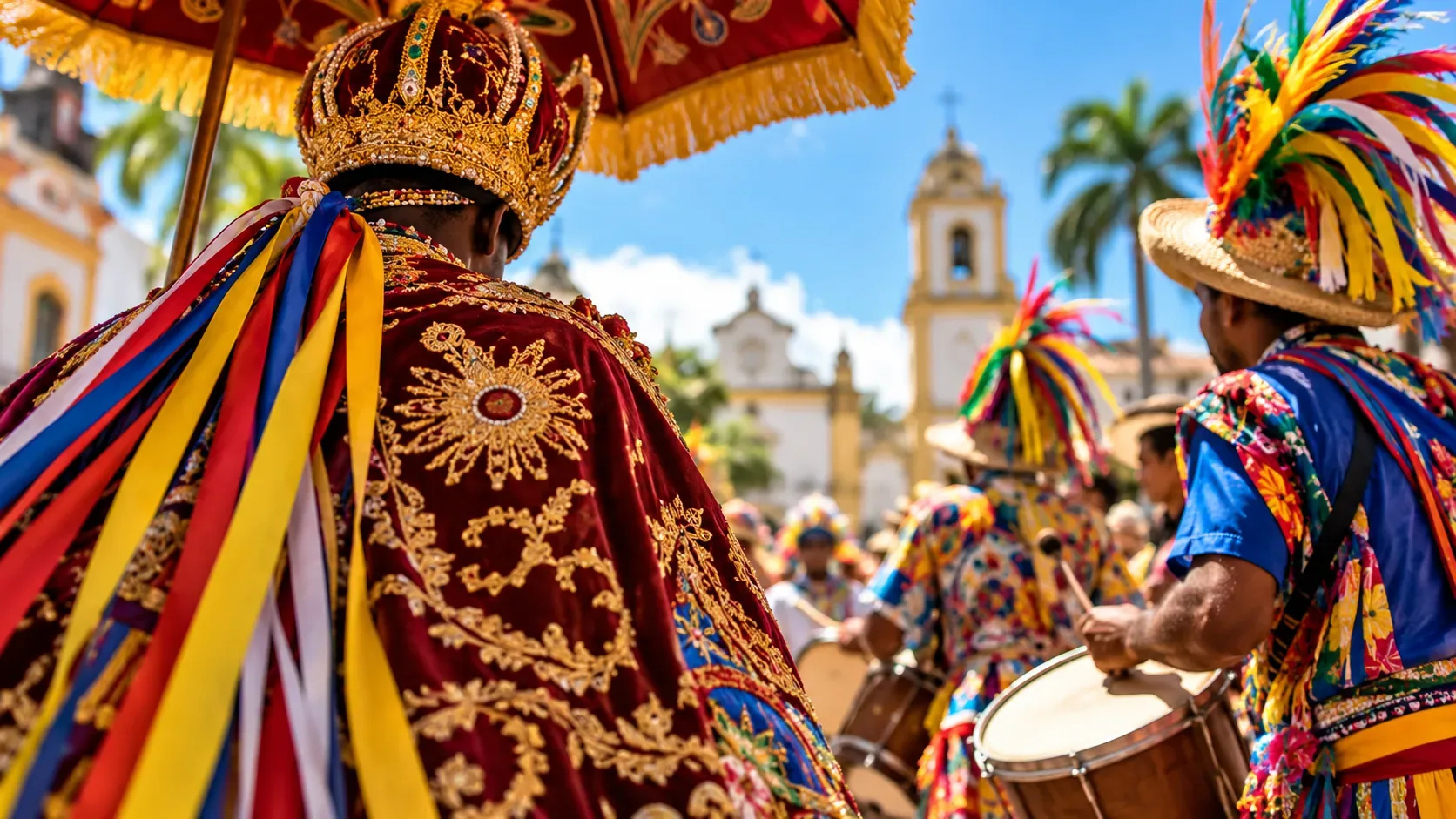
Maracatu Nação and Maracatu de Baque Solto are distinct traditions from Pernambuco, not merely two musical variations of the same procession. Maracatu Nação, also called Maracatu de Baque Virado, is historically linked mainly to the Recife Metropolitan Region, to memories of the coronations of kings and queens of Congo, and to a percussion ensemble that accompanies a royal court. Maracatu de Baque Solto, also known as Maracatu Rural, Maracatu de Orquestra or Maracatu de Trombone, has strong historical ties to the northern Zona da Mata and to workers in the sugarcane economy, combining percussion, wind instruments, improvised poetry and characters such as the caboclo de lança.
Comparing the two traditions requires more than opposing “city” and “countryside.” Their areas of practice overlap, groups circulate, and their processions share some elements, such as king, queen, dama do paço and calunga. At the same time, musical organization, historical memory, performance logic and internal vocabulary show that they are forms of expression with their own trajectories. Both were registered by Iphan on December 3, 2014, in Brazil's Registry Book of Forms of Expression.
Main differences between Maracatu Nação and Baque Solto
| Aspect | Maracatu Nação | Maracatu de Baque Solto |
|---|---|---|
| Other common name | Maracatu de Baque Virado | Maracatu Rural, de Orquestra, de Trombone or de Baque Singelo |
| Territorial and historical reference | Present mainly in the Recife Metropolitan Region, with links to the history of coronations of kings and queens of Congo and to urban Black communities | Strongly associated with the northern Zona da Mata, sugarcane estates and work in the sugar economy from the late 19th to the early 20th century |
| Musical formation | Predominantly percussion-based batuque, with alfaias, gonguês, taróis, caixas, mineiros and ganzás | Terno combining percussion and wind instruments, including tarol, surdo, ganzá, cuíca, gonguê, trombones, trumpets, saxophones and clarinets |
| Musical leadership | The mestre batuqueiro leads the rhythm and the toadas | The mestre do apito directs tempo, dance and verses, with a strong presence of improvised loas |
| Procession | Royal court with king, queen, damas do paço, princes, princesses, baianas and other characters; the calunga has a central symbolic role | Procession includes caboclos de lança, caboclos de pena, baianas, dama do paço with a calunga, king, queen and comic figures, among other characters |
| Prominent elements | Integration of royal court, batuque, toadas, ancestry and religious dimensions | Caboclo de lança, vigorous choreography, brass and percussion, masters' poetry and sambadas |
| Periods of greatest visibility | Carnival, plus rehearsals, celebrations and community practices throughout the year | Carnival and, to a lesser extent, Easter; sambadas and rehearsals take place during the year |
| Federal registration | Cultural Heritage of Brazil since December 3, 2014 | Cultural Heritage of Brazil since December 3, 2014 |
Maracatu Nação: royal court and baque virado
In Maracatu Nação, procession and music form an inseparable whole. Iphan describes each nação as having a percussion body, called the batuque, and a procession of characters associated with the representation of a royal court. The term “baque virado” refers to the rhythmic identity of this formation and also serves as another name for the tradition itself.
The batuque may include alfaias, gonguês, taróis, caixas de guerra, mineiros and ganzás. The exact lineup and way of playing do not have to be identical across all nações, because each group maintains its own forms of organization and transmission. The mestre batuqueiro leads the ensemble, while the toadas connect music, memory and community life. In Iphan descriptions, songs may address everyday life, ancestry and traditions transmitted orally.
Visually, the procession evokes a court with king, queen, damas do paço, princes, princesses, baianas and other characters whose presence varies by group. The calunga, a doll carried by a dama do paço, is one of the most emblematic elements. It should not be understood as a simple prop: it belongs to a dimension of ancestry and sacred meaning that helps explain why the public performance does not exhaust the significance of maracatu.
Connections with Afro-Brazilian religions and Jurema Sagrada appear in Iphan documentation as important parts of the history and experience of many groups. This does not mean that every nação has identical religious practices. The key point is that rehearsals, processions, toadas, objects, gestures and preparations may carry community and spiritual meanings that cannot be reduced to Carnival spectacle.
Maracatu de Baque Solto: caboclo de lança, terno and loas
Maracatu de Baque Solto has a history strongly related to the northern Zona da Mata of Pernambuco and the world of sugarcane labor. Iphan records that the oldest maracatus were formed on sugar estates by rural workers, including cane cutters, from the late 19th to the early 20th century. Over time, the tradition also circulated through the Recife Metropolitan Region and other places reached by migration and by the cultural influence of the Zona da Mata.
Its musical formation differs from that of Nação because it combines percussion and wind instruments. Official descriptions mention tarol, surdo, ganzá, cuíca and gonguê, as well as trombones, trumpets, saxophones and clarinets. This ensemble is often called the terno. The mestre do apito guides the course of the performance and coordinates music, dance and poetry.
Poetry is structural to Baque Solto. Masters sing loas, rhymed and often improvised verses that may deal with personal experiences, challenges, traditions and everyday subjects. During sambadas held throughout the year, masters may engage in poetic exchanges and new participants learn the practices of the brincadeira. For that reason, Baque Solto cannot be described only as a rhythm: it brings together music, dance, poetry, performance, religiosity and social life.
In the procession, the most recognizable character is the caboclo de lança, with an embroidered gola, bells, decorated lance and vigorous movements. Caboclos de pena, baianas, a dama do paço with a calunga, king, queen and comic figures may also appear, depending on the group's organization. The encounter between these characters, the terno and the loas creates a theatricality of its own, different from the royal-court logic of Maracatu Nação even when some roles and symbols have similar names.
What the name “maracatu” brings together and what it does not make identical
Both traditions belong to Pernambuco's cultural universe and share connections with Carnival, Afro-Brazilian matrices, processions, royal characters and dimensions of religiosity. They are also community practices transmitted across generations rather than fixed cultural products. These points help explain why both are called maracatu and why they may appear side by side in festivals, safeguarding policies and studies of intangible heritage.
But sharing the name does not make one a version of the other. The musical difference is an obvious sign: Nação is structured around a percussion batuque associated with baque virado, while Baque Solto combines percussion and winds and gives a central role to the mestre do apito and the loas. The procession also organizes its symbols in its own way. In Nação, the royal court and the calunga stand at the center of a composition that evokes Black memories and coronations of kings and queens of Congo. In Baque Solto, the caboclo de lança, the masters' poetry and the history linked to sugarcane workers strongly shape the identity of the brincadeira.
Why “urban versus rural” is an insufficient explanation
Territorial association helps explain historical formations, but it should not become a rigid border. Iphan characterizes Maracatu Nação as a tradition found mainly in the Recife Metropolitan Region and Baque Solto as an expression especially associated with the northern Zona da Mata and areas under its influence. At the same time, the documentation itself records circulation to other municipalities and presence in the metropolitan region.
Thus, “urban” and “rural” work better as contextual clues than absolute definitions. Maracatu Rural does not cease to be Baque Solto when it performs in Recife, and a nação cannot be explained only by the fact that it parades in an urban setting. Territory, community, memory, repertoire, group organization and religious relationships provide a more precise comparison.
Vocabulary for distinguishing the two traditions
- Baque virado: a term associated with the sound and rhythmic identity of Maracatu Nação; “Maracatu de Baque Virado” is therefore another name for the tradition.
- Baque solto: the name of the form of expression also known as Maracatu Rural, characterized by its own combination of rhythm, poetry, dance and procession.
- Batuque: in the context of Maracatu Nação, the body of percussionists that accompanies the procession.
- Terno: in Baque Solto, the musical ensemble combining percussion and wind instruments.
- Calunga: a doll carried by the dama do paço; it appears in descriptions of both traditions, with meanings that must be understood in the context of each group.
- Caboclo de lança: an emblematic Baque Solto character, recognized by the gola, bells, decorated lance and bodily performance.
- Loa: a verse sung by the master in Baque Solto, often rhymed and improvised.
- Sambada: an important Baque Solto gathering involving music, poetry, learning and interaction among brincantes throughout the year.
Living heritage, not a frozen model
The registration of both traditions as Cultural Heritage of Brazil in 2014 recognizes their importance, but it does not turn tradition into an unchanging rulebook. Iphan's own descriptions emphasize continuity, transmission, community practices and transformation over time. There are differences among groups within the same tradition, changes in repertoire, territorial circulation and distinct ways of teaching and organizing the brincadeira.
The most faithful comparison, therefore, identifies recurring structures without erasing the autonomy of individual groups. Maracatu Nação and Baque Solto may share characters and symbols, but they have histories, sounds and ways of organizing the procession that justify treating them as distinct forms of heritage. Listening to masters and participants, observing the context of each group and recognizing religious and community meanings are essential to avoid reducing either tradition to costume, rhythm or Carnival attraction.