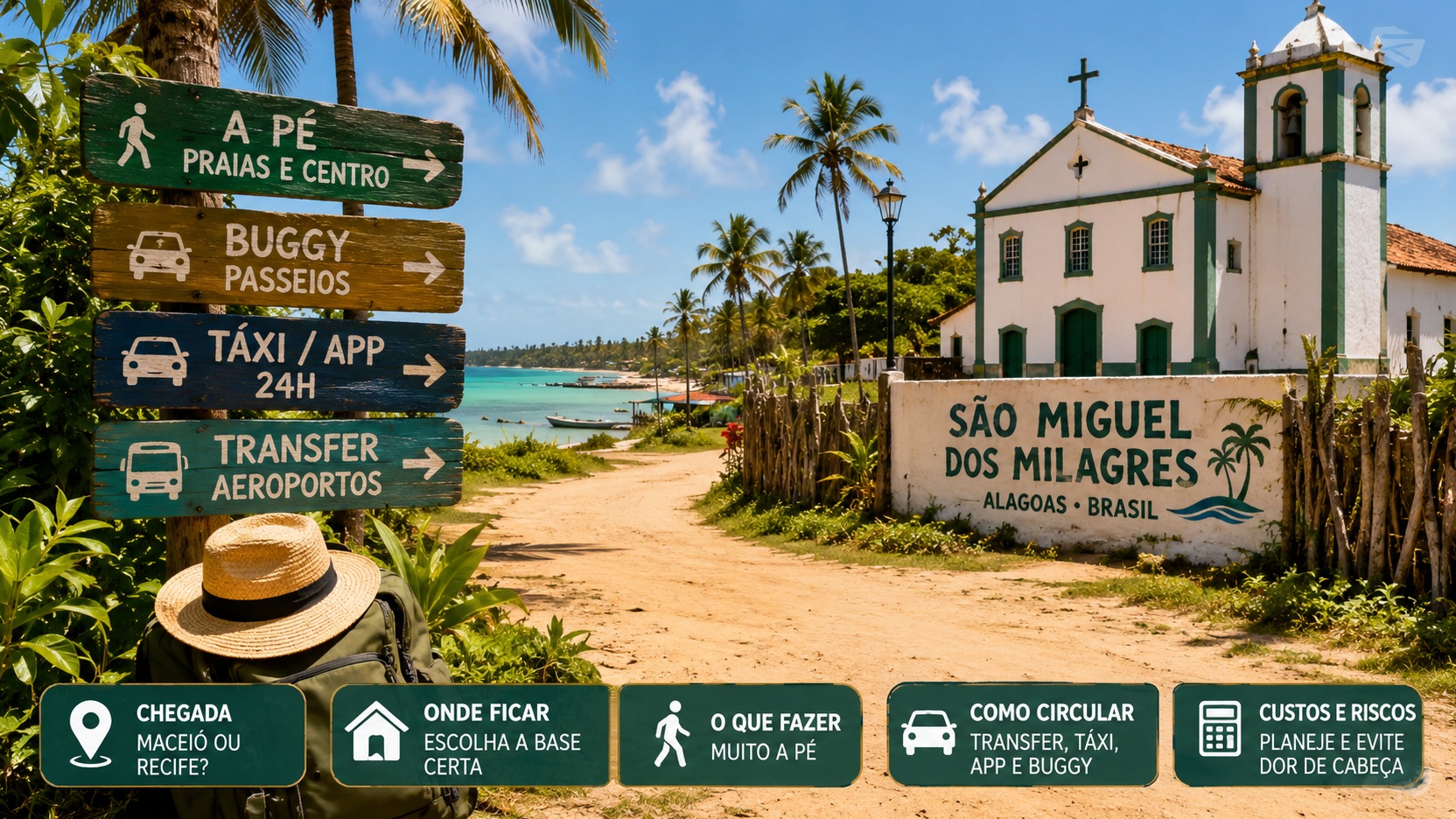
Yes, you can travel to São Miguel dos Milagres without a car. But the trip works better when you exchange the idea of “asking for transportation whenever you need it” for a simple logistical design: arriving with the first leg sorted, staying at a base that concentrates on the beach and services, booking important trips in advance and leaving the app as support, not as the only guarantee.
This difference is decisive because the destination is spread out, the beaches and inns are in different centers and the supply of drivers does not have the same density as in a capital city. Uber itself informs that the app works in São Miguel dos Milagres 24 hours a day, seven days a week, but warns that the time until departure may be longer than in large cities. In other words: “there is Uber” does not mean “a car will appear in a few minutes when I want to go back”.
The short answer: it's doable without a car, as long as you choose the right trip
The safest configuration for those who don't drive is to stay in an area with restaurants, market and beach within walking distance, use a transfer or arranged driver to the airport and essential routes, and book tours that already include the necessary travel. In this design, the rental car is no longer essential.
The most fragile configuration is to choose an isolated inn just based on the photo, plan to have dinner each night in distant places, want to visit several points of the Ecological Route on the same day and assume that the application will solve each section on demand. It may work, but the trip depends on waiting, availability and variable fares precisely at times when you least want to improvise.
Arrival: Maceió tends to make traveling without a car much simpler
Maceió Airport: less road and more contingency options
For those who disembark at Zumbi dos Palmares International Airport, in Maceió, the logistics are much shorter. In the consultation carried out on August 15, 2026, the Uber route page reported a historical average of 100 kilometers, around 1 hour and 55 minutes and an average price of R$260 between the airport and São Miguel dos Milagres. The company emphasizes that actual price, duration and availability vary depending on time, traffic and demand.
As a reference for private transfers, offers consulted for the Maceió–São Miguel dos Milagres stretch appeared from around R$470 and also around R$550, depending on the supplier, vehicle and service conditions. For two or more people, it is worth comparing the total cost of the transfer with the app's estimate at the arrival time, considering the benefit of having a driver waiting at arrivals.
If your flight arrives late, if you have children, a lot of luggage or if you don't want to risk waiting at the airport, the pre-booked transfer is worth it. If you arrive during the day and accept some variability, the app may be cheaper. The important thing is not to decide this only after landing.
Recife: it works, but it turns arrival into a journey
Recife may make sense when the airfare is much better, when the itinerary also includes Pernambuco or when the flight schedule compensates. For a trip exclusively to São Miguel dos Milagres, however, the transfer is much longer. Private services consulted in August 2026 worked with approximately 3 to 3 and a half hours of road and values in the range of R$550 to R$600 per vehicle in examples available online.
The road distance indicated by route services is close to 195 to 200 kilometers, practically double the stretch from Maceió. This increases arrival time and, above all, makes the return to the airport more sensitive to delays. An early flight leaving Recife requires a large margin and transportation confirmed in advance.
There is the possibility of combining a bus to Porto Calvo with a taxi or local transfer. Real Alagoas serves Porto Calvo in its network, and route aggregators show connections from Recife. As it was not possible to confirm, in the research, an updated official timetable for setting up the entire connection, this alternative should be treated as an option to be checked directly with the bus, not as the basis for a trip purchased in the dark.
Where to stay: accommodation decides whether “without a car” will be easy or tiring
Porto da Rua is the most practical base for reducing transport calls
For those who want to minimize travel, Porto da Rua is usually the most functional point. The town has more commerce, restaurants, inns and services than more isolated parts of the municipality. There are also accesses to the beach and points connected to tours. In recent accommodation sources and guides, Porto da Rua appears repeatedly as the center with the greatest structure for travelers.
This does not mean that everything is on the doorstep of any inn. Before booking, open the map and check the exact address. An accommodation described as “Porto da Rua” may be located far from the commercial center or access you intend to use. For a trip without a car, the correct question is not just “is it in Porto da Rua?”, but “can I have dinner, buy water and get to the beach without having to rely on running?”.
São Miguel Beach and central area can also work
The region of Praia de São Miguel dos Milagres and the center can be a good second location when the chosen inn is close to restaurants and when its main tours offer pick-up nearby or pick up at the accommodation. The municipal center concentrates public services and local commerce, while the beach has accommodation in different price ranges.
The same rule applies here: the actual location of the inn weighs more than the name of the neighborhood on the booking platform. An excellent accommodation, but far from what you intend to do at night, can transform small outings into obligatory runs.
Toque, Riacho and isolated inns require another strategy
Praia do Toque, Praia do Riacho and more reserved stretches can be great for those who want peace and quiet and want to spend more time at their own accommodation. Without a car, they work best when the inn offers a restaurant, bicycle, transfer, partnership with drivers or facilities for calling transportation.
If your idea is to go out to dinner in different places every night, visit several centers and return late, an isolated inn increases dependence on third parties. In this case, ask for examples of prices and driver contact details used by guests before booking. This information is worth more than finding out on the spot that the restaurant you want is somewhere you don't want to walk in the dark.
What you can really do on foot
Walking works best for activities concentrated on the same base: going to the beach, getting around town, getting to nearby restaurants and making short trips during the day. There are stretches where it is also possible to walk along the strip of sand between neighboring beaches, as reported in recent guides about Toque, São Miguel and Porto da Rua.
This should not be confused with a continuous and comfortable urban network for pedestrians. Strong sun, rain, tide, soft sand, lack of sidewalk in some sections and longer distances make the walk unsuitable for carrying suitcases or fitting in scheduled appointments. In practice, walking reduces the number of runs; does not replace all shifts.
Build a toolbox, not a single dependency
Transfer solves the sections you can't miss
Airport, return flight and very early or late departures are the best candidates for a pre-booked transfer. The main gain is not just comfort: it is reducing the risk of not finding a driver at a critical time.
When requesting a quote, inform the airport, date, expected landing time, flight number, exact accommodation, number of people and luggage. For your return, confirm whether the company monitors traffic and travel time or whether it only works with the schedule requested by you.
Taxi and local driver provide predictability on short journeys
Even with an app available, it is worth having at least one taxi contact or driver recommended by the inn. In small destinations, direct contact with those who already know the region can be more useful than repeating requests at times of low supply.
Agree the price in advance when possible and confirm whether the price is per segment, per wait or per period. If you're going to dinner far away, it's often better to plan your return trip rather than end the night testing availability on different apps.
Uber is useful, but it must be used as a support layer
Uber claims to operate in São Miguel dos Milagres 24 hours a day and allows you to request trips on demand. The same page warns that departure times may be longer than in larger cities and advises that when the feature is available, it is possible to book in advance.
This makes the app good for comparing prices, solving simple races and creating a second option. For a flight, a tour with a strict schedule or a night return from a remote location, the safest plan is to have something confirmed and use the app as an alternative.
Buggy is a regulated tourist tour, not a substitute for a taxi
São Miguel dos Milagres has specific municipal regulations for the Buggy-Tourism service. Municipal Law 617/2023 created the service and Decree 066/2024 regulated the sale of tours. The decree also established official boarding points, including locations in Porto da Rua, Praia do Toque, Praia de São Miguel dos Milagres and Praia do Riacho.
In the 2024 document, the value of the tour was set at R$300 for up to four passengers, with a system of tourist identification bracelets. In August 2026, an operator consulted advertised a tour lasting approximately 2 hours and 30 minutes for R$360. As services, itineraries and rules can be updated, use these numbers for reference only and confirm the price and authorization of the provider before paying.
The important point for a trip without a car is another: buggy can concentrate several beaches and stops in a single tour, reducing the need to book separate trips. But it must be purchased as a tourist activity, with a regular provider, and not assumed as urban transport available for any journey.
How much to reserve for car-free transportation
Arrival and departure in Maceió
Use as an initial reference the history of around R$260 per ride on Uber between Maceió Airport and São Miguel dos Milagres, knowing that the price may change. For private transfers, the quotes found in the research started at around R$470 and reached around R$550 in comparable examples. Round trips, therefore, can represent an important part of the budget and deserve to be calculated before choosing the flight.
Arrival and departure in Recife
For Recife, the private offers consulted were around R$550 to R$600 per route for a passenger vehicle in available examples. As the route is longer, the savings on airfare need to compensate not only for the difference in transportation, but also for the additional hours on the road.
Local travel
There is no single public tariff that allows you to create a reliable budget for a taxi, local driver or app within the municipality. The most realistic method is to use the exact address of the accommodation and ask for three or four concrete quotes before booking: hotel to the restaurant you want to visit, hotel to the tour point, hotel to a beach outside your base and hotel to the transfer departure point.
With these four values, you can quickly find out if apparently cheap accommodation will generate a hidden transport expense. This calculation is often more useful than looking for a generic “daily average.”
The return plan must be finalized before the tour begins
The departure usually receives more attention because it happens right after the flight. The way back is where a trip without a car can be vulnerable. If your flight leaves Maceió in the morning, book the driver with time off and confirm the day before. If you leave Recife, the margin must be even greater due to the distance and travel time.
If you intend to use Uber Reserve, check in the app whether the reservation is actually available for your guesthouse address. Uber itself informs that the possibility of scheduling may not be available in all departure locations. A screen showing “app available in city” does not replace confirmation of your specific route.
Also have a plan B: transfer contact, local driver phone number or hotel recommendation. The cost of a pre-arranged alternative is small compared to the risk of missing a flight.
Feasibility matrix to decide before booking
High viability
The trip is highly viable without a car when you arrive in Maceió, stay in Porto da Rua or another address with a beach and food nearby, book a transfer to the airport, take one or two tours with defined boarding and use an app or local driver only for exceptions.
Average viability
The trip is of medium viability when the inn is more isolated, but offers a restaurant and can organize transfers; when you arrive in Recife, but with a transfer already closed; or when you want to visit some restaurants and beaches outside the base, but agree to book rides in advance.
Low viability
Logistics become fragile when the accommodation is isolated and without food, the flight arrives or leaves at a critical time, the itinerary depends on several beach changes per day and all rides would only be requested on time. In this combination, not driving stops being just a feature of the trip and becomes a continuous source of uncertainty.
What to ask the inn before paying for the reservation
Send a simple and objective message. Ask if there are restaurants and markets that can be reached on foot, how long the walk to the beach takes, which drivers or taxis serve the accommodation, if they pick up in Maceió or Recife, if there are average prices for Porto da Rua, Toque and Praia de São Miguel, and how guests usually return from restaurants at night.
Also ask which tours are picked up at the inn and which ones require you to arrive at a boarding point. In the case of a buggy, confirm that the provider works within municipal regulations. In a few minutes, these answers show whether the accommodation is prepared to receive those traveling without a car or whether it expects every guest to have their own vehicle.
São Miguel dos Milagres without a car works when the itinerary has fewer moving parts
The trip doesn't need a rental car to be good. Need coherence between airport, accommodation and routine. For most travelers who don't drive, Maceió reduces the complexity of arrival; Porto da Rua reduces the amount of local travel; transfer or scheduled driver protects sections that have a timetable; and app, taxi and buggy complete what is missing.
The mistake is to first put together a list of scattered places and only then ask how to get to each one. Do the opposite: choose a base that covers most of the day on foot, confirm two or three essential trips and only then close your accommodation. Thus, “traveling without a car” stops being an improvisation and becomes just a different way of organizing the Route of Miracles.