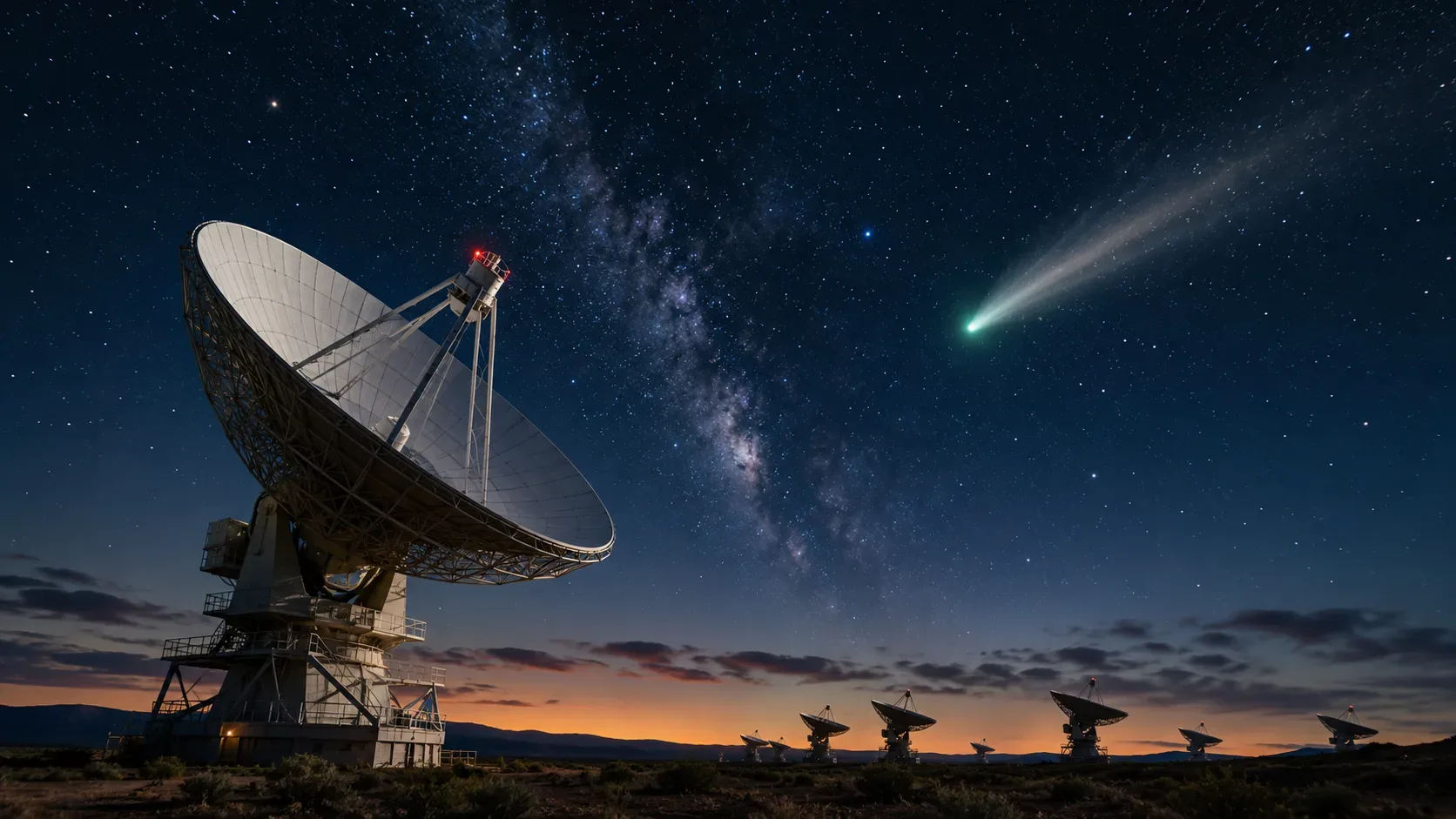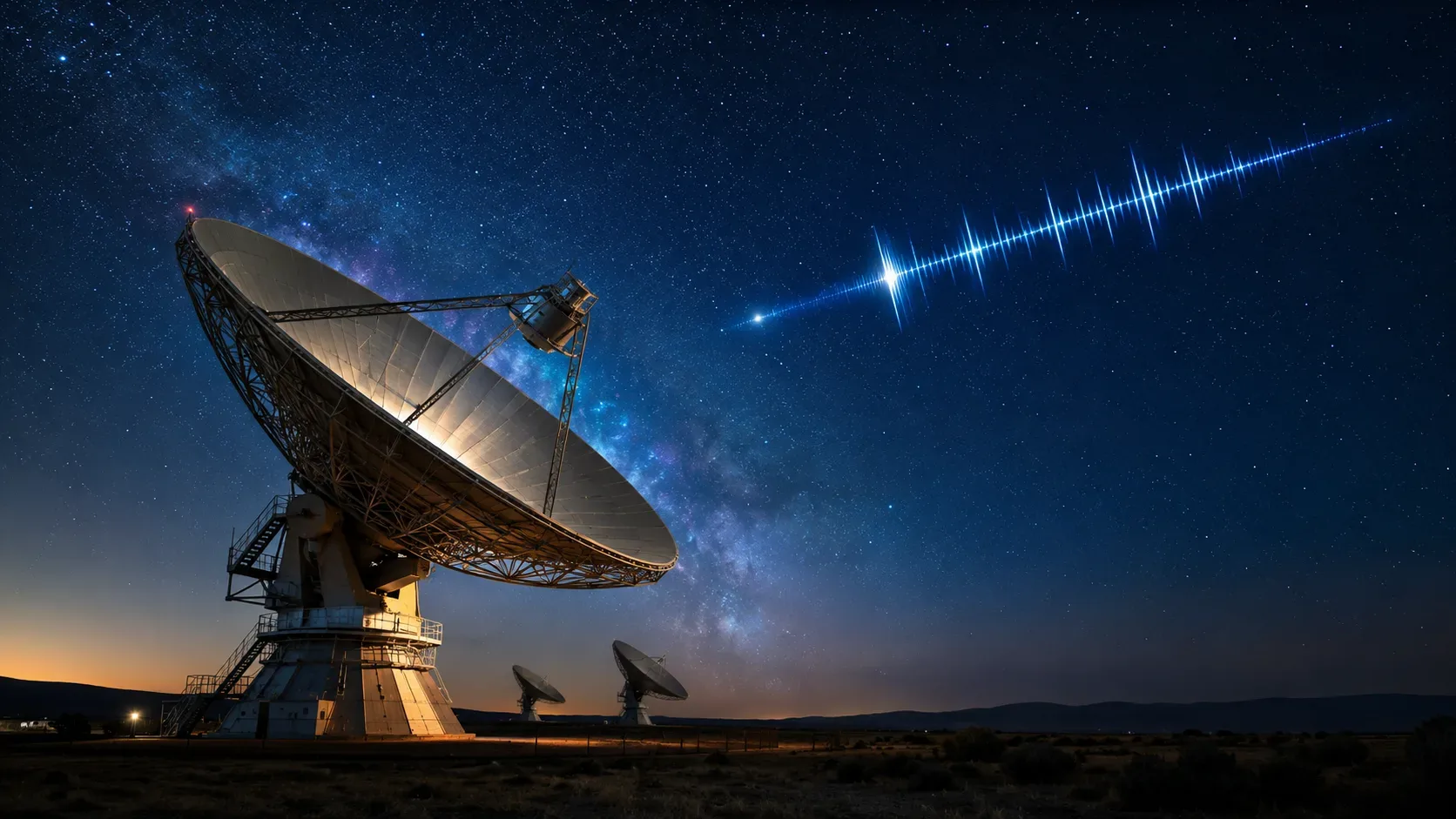
On August 15, 1977, a radio telescope in Ohio recorded an intense, narrow radio emission coming from the direction of the constellation Sagittarius. The event appeared only once, crossed the observation field for 72 seconds and left the sequence 6EQUJ5 on the paper.
Days later, when reviewing the pages printed by the computer, volunteer astronomer Jerry Ehman circled the six characters with a red pen and wrote a spontaneous reaction next to it: “Wow!”. The comment became the name of one of the best-known episodes in the history of the search for extraterrestrial intelligence.
The Wow! It is interesting because it brought together characteristics sought in possible technosignals: it was strong, it occupied a narrow frequency band, and its intensity grew and diminished as if a fixed source in the sky was crossing the telescope's beam. But none of this demonstrated that it was an alien transmission.
The observation was not repeated, was not simultaneously confirmed by another instrument, did not contain a decodable message and continues without a conclusive explanation. Nearly five decades later, it remains a historical candidate, not a confirmed detection of extraterrestrial intelligence.
What happened on the night of August 15, 1977
The signal was captured by the Ohio State University Radio Observatory, known as Big Ear. Unlike an antenna that continuously follows a point in the sky, Big Ear performed transit scans: it remained pointed at a band and let the Earth's rotation carry celestial sources through its beams.
The system operated automatically. At approximately 11:16 p.m. Eastern Daylight Time, there was no team monitoring the signal in real time. The computer collected the data and recorded it on paper. Ehman likely found the sequence while reviewing the material on August 19, a few days after detection.
The receiver divided a band of frequencies into 50 channels, each 10 kilohertz wide. In each cycle, the system integrated approximately ten seconds of observation and consumed another two seconds to process and print the results. Therefore, each character in the sequence represents a successive interval of approximately 12 seconds.
As the entire observed episode fit into six records, the most faithful reconstruction is not exactly “minute by minute”, but in six 12-second frames.
The 72 seconds reconstructed
| Relative time | Registration | Intensity indicated |
|---|---|---|
| 0 to 12 seconds | 6 | Between 6.0 and 6.999 standard deviations above the baseline |
| 12 to 24 seconds | E | Between 14.0 and 14.999 |
| 24 to 36 seconds | Q | Between 26.0 and 26.999 |
| 36 to 48 seconds | U | Between 30.0 and 30.999 — the peak |
| 48 to 60 seconds | J | Between 19.0 and 19.999 |
| 60 to 72 seconds | 5 | Between 5.0 and 5.999 |
The numbers and letters show a rapid climb to the peak marked U, followed by a fall. According to Ehman's technical explanation, the six points fit very well to the expected shape of a source crossing the antenna's sensitivity pattern. The tests he carried out obtained correlations greater than 0.99 with mathematical models and with the measured patterns of the Big Ear's two beams.
This is relevant because irregular local interference could present oscillations unrelated to the geometry of the telescope. The curve of Wow! it appeared, instead, to follow the expected movement of a point source through the beam.
Still, the profile does not identify the nature of the source. It simply indicates that the signal behaved in a manner compatible with something located in a fixed direction in the sky — or with exceptional interference capable of reproducing this behavior.
What the sequence 6EQUJ5 really means
The sequence 6EQUJ5 is not a word, an alien code, or an encrypted message.
It was created to save paper space. The computer needed to represent the intensity of each channel using a single character. Values from 1 to 9 were printed as numbers. Above 9, the letters entered: A represented 10, B represented 11 and so on.
On this system:
- E corresponds to 14;
- Q corresponds to 26;
- U corresponds to 30;
- J corresponds to 19.
The values are not a direct multiplication of signal power by background noise. They represent intensity ranges measured in standard deviations above a baseline calculated continuously by the system.
A sequence of symbols transmitted through space was also not recorded. The six characters were produced on Earth by the program that summarized the intensity received.
Data had limited temporal and spectral resolution. There is no recognizable modulation pattern in them from which words, numbers or any intentional content can be extracted. What survives in the record is essentially an intensity curve over a narrow frequency band.
Did the signal last exactly 72 seconds?
Not necessarily.
The 72 seconds correspond to the period during which the signal was recorded while the region passed through one of the telescope's beams. A continuous source would also produce a curve with a limited duration, as it would enter the most sensitive field of the antenna, reach the center, and leave it.
The Big Ear had two beams that observed the same strip of sky approximately three minutes apart. A stable celestial source should, in principle, cross both. The Wow! it was recorded only once, and the preserved data do not allow us to determine with certainty which of the two beams captured it.
If the origin were a fixed source in the sky, some possibilities would be:
- emission began after the source crossed the first beam;
- finished before she reached the second;
- changed frequency or direction;
- it was a transitory event;
- some instrumental or propagation aspect only affected one passage.
Therefore, the data shows that the observed detection lasted 72 seconds. They do not reveal when the emission began or how long the source remained active outside the telescope's sensitive field. Ehman himself considered this intrinsic duration a question impossible to resolve definitively with the available record.
Why the sign attracted so much attention
It was narrow
The event appeared concentrated in a channel of approximately 10 kilohertz. In radio astronomy, natural emissions often occupy wider bands, while a technological transmitter may produce a very narrow carrier.
This makes the signal width interesting, but not exclusive to technology. The record merely establishes that the emission was narrower than or comparable to the channel resolution; it does not provide a detailed measurement of its internal structure.
It was close to the hydrogen line
The signal appeared in the 1,420 megahertz region, close to the so-called 21-centimeter line of neutral hydrogen. Since the first debates about SETI, this region has been considered a natural range for searches because hydrogen is abundant and its signature is known to any civilization capable of radio astronomy.
But the proximity of the line also makes astrophysical explanations related to hydrogen itself plausible. Being on this frequency does not equate to demonstrating an intelligent choice.
The curve matched the beam
The rise and fall of 6EQUJ5 resemble the response expected when a compact source passes through the central region of the antenna. This is one reason why the case has resisted simple explanations based on random noise or ordinary interference.
Never appeared again
Big Ear remained in the same declination range for weeks and returned to survey the region in later years. Other campaigns used instruments such as META, the Very Large Array, the Hobart radio telescope and the Allen Telescope Array. None recovered an equivalent signal.
A peer-reviewed study published in 2022 brought together about 192 hours of follow-up observations by the META, Hobart, and Allen Telescope Array. The analysis concluded that an artificial source of random repetition cannot yet be mathematically excluded, but the negative results create significant tension for this hypothesis.
Interesting candidate is not confirmed evidence
| Interesting candidate | Confirmed evidence |
| An instrument records an anomaly compatible with what is sought | Other instruments confirm detection independently |
| The signal has unusual properties | Artifacts, interferences and natural explanations are tested and excluded |
| There is an approximate position in the sky | Location and source are accurately determined |
| The event occurs once | The phenomenon repeats itself or leaves enough data for verification |
| May be technology compatible | It presents characteristics that require a technological origin |
The Wow! remained in the first column. It was a legitimate event in the data and warrants investigation, but it did not pass the necessary steps to become evidence.
A single observation does not allow us to definitively distinguish between a rare natural emission, an unusual interference, an instrumental effect or a transient technological transmission. Science needs independent verification, and Wow! never provided them.
The most recent natural hypotheses
Over the decades, explanations involving terrestrial interference, satellites, reflections, comets and different astrophysical phenomena have been proposed. None reached consensual confirmation.
Since 2024, researchers from the Arecibo Wow! project, linked to the Planetary Habitability Laboratory at the University of Puerto Rico in Arecibo, have been investigating a hypothesis based on small, cold clouds of neutral hydrogen.
The group found narrow, weaker signals associated with these clouds in the Arecibo Observatory archives. The proposal is that a transient energy source — such as a magnetar flare or a soft gamma-ray repeater — could have temporarily stimulated the hydrogen emission, producing a narrow, intense flash similar to Wow!.
The hypothesis would explain why the event:
- appeared close to the frequency of hydrogen;
- there was a narrow lane;
- it seemed to come from the sky;
- it was intense;
- was not repeated in subsequent searches.
But it is not yet a proven solution. Maser or superradiant emissions in the hydrogen line have not been conclusively confirmed in astrophysical environments, and the explanation depends on the observation of other comparable events.
What changed with the reanalysis of the files
In August 2025, the Arecibo Wow! published a preliminary reanalysis of historical documents from the Ohio program. The work proposed more precise positions for the origin, a peak flux density greater than 250 janskys and a frequency of 1,420.726 ± 0.005 megahertz, different from the classical value normally associated with the signal.
These numbers should be presented with caution. On August 5, 2026, the document available on arXiv was still the first version of a preprint, with the indication that it would be submitted to the Astrophysical Journal after incorporating comments. Revisions, therefore, are relevant to guide new searches, but they still do not definitively replace historical estimates.
The update also does not identify the source. It reduces and shifts the two possible regions in the sky, but the uncertainty caused by the Big Ear's two beams continues to exist.
Then the Wow! Did it come from aliens?
The scientifically correct answer is: we don't know what produced the signal, but there isn't enough evidence to attribute it to aliens.
An extraterrestrial technological origin cannot be eliminated by argument alone. At the same time, she does not receive special treatment. It needs to compete with natural and instrumental hypotheses and produce verifiable predictions.
The Wow! it did not present a message, it was not repeated, it was not confirmed by another observatory during the event and it did not lead to the identification of a technological source. Calling the episode an “alien message” turns a remote possibility into a conclusion that the data does not support.
Its scientific value lies elsewhere. It shows how a good candidate can meet several expected characteristics and still remain below the standard needed for a breakthrough.
The legacy of 72 seconds
The Wow! remains famous not because he proved that there is another civilization transmitting to Earth, but because he condensed into a single printed page the central challenge of SETI: how to distinguish a real technosignal from anything that can imitate it.
Today, modern searches attempt to avoid the same limitation through coordinated observations, digital storage, real-time analysis, and comparison between geographically separated instruments. If a similar event is captured simultaneously by different observatories, it will be possible to verify its origin with a speed that the Big Ear did not have in 1977.
Meanwhile, 6EQUJ5 remains a portrait of an incomplete detection: strong enough to require investigation, too singular to allow confirmation, and too limited to tell of its own origin.
Receive new stories about SETI, technosignals, and the cases where science needed to separate a possible discovery from a premature conclusion.