If an observatory finds something that looks like an artificial signal from space, the next step is not to announce “aliens” or ask for an immediate response. The updated statement by the International Academy of Astronautics (IAA), dated June 1, 2026, starts with a less spectacular and more difficult task: turning a candidate into reliable evidence. The 2026 version replaces the 2010 statement and expands the rules for verification, public reporting, data preservation, and governance after a potential discovery.
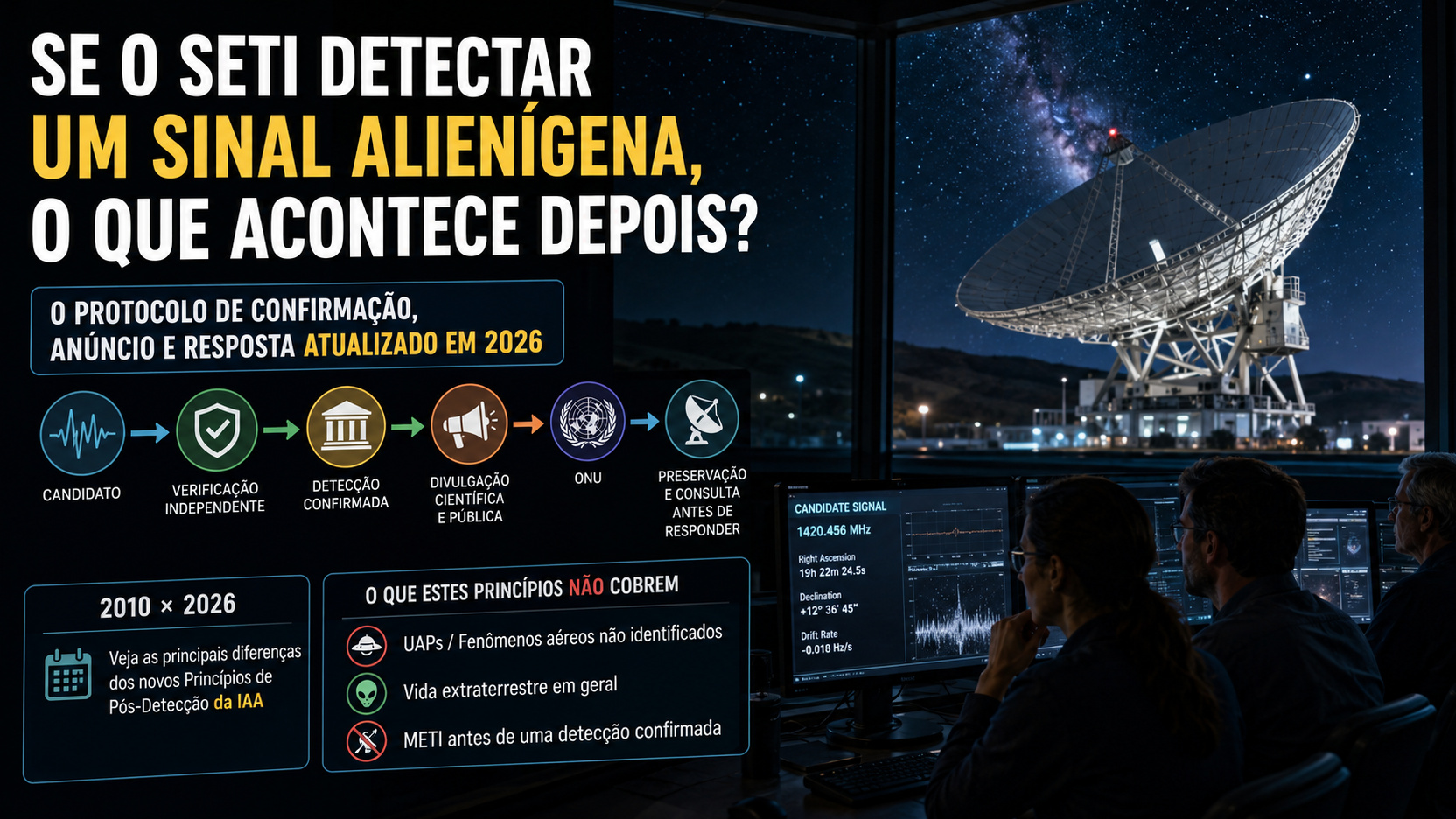
In practice, the expected flow is this: a candidate emerges, other teams try to verify it independently, researchers assess whether there is sufficient consensus to treat it as credible evidence of extraterrestrial intelligence, the conclusion is communicated openly to the public, the scientific community and the Secretary-General of the United Nations, the data and frequencies are preserved and, only after an international consultation, could a possible response be discussed. The document does not create a world government of first contact, but it establishes a standard of scientific conduct to prevent a discovery of this scale from depending on a single person or institution.
What counts as a detection for this protocol
Although the popular image of SETI is that of a radio telescope picking up a message, the 2026 statement uses a broader scope. It deals with technosignatures: observable evidence of extraterrestrial technology, such as narrowband radio signals, laser emissions, excess infrared associated with large-scale energy use, astronomical anomalies compatible with megastructures or even artifacts.
This matters because not every technosignature would be a “message” directed to Earth. The protocol is about evidence of intelligence and technology beyond Earth. The declaration itself excludes from its scope extraterrestrial life in general and unidentified anomalous phenomena in the Earth's atmosphere, UAPs.
Candidate is not discovered: independent verification comes first
When a possible detection appears, the central obligation is to try to authenticate and substantiate it. The IAA recommends that this be done with the discoverer's resources and in collaboration with other investigators. Ideally, checking should include independent observations or examinations at multiple facilities, by more than one organization and with different instruments and methods.
This detail answers the question “who confirms?”. There is no single agency in the text with a final stamp of “alien signal confirmed”. Confirmation is treated as a distributed scientific process. Other observers need to be able to examine the evidence, test alternative explanations, and see if the phenomenon survives different instruments, teams, and methods.
The statement also recognizes that this step may take time. A candidate may be incomplete, ambiguous, or simply disappear upon further observation. Follow-up may not produce a definitive conclusion. Therefore, the existence of an interesting candidate does not equate to a discovery of extraterrestrial intelligence.
When the detection is treated as confirmed
The 2026 text links confirmation to completion of the verification stage and the consensus of the other researchers involved, to a degree of certainty that the discoverers consider credible. This does not mean absolute certainty. In science, “confirmed” here functions as a level of evidence robust enough to justify a public and formal conclusion, with the data and the analysis process exposed to scrutiny.
After this threshold, the statement requests a peer-reviewed verification report. This report should include the underlying data, the analysis process, the results of verification attempts, conclusions and interpretations, and, if any, any informational content detected. Open publication of verification data is encouraged.
When the public should be informed
The 2026 version does not require that every verification attempt be published in real time. It says there is no obligation to make verification efforts public before the discovery is confirmed. At the same time, it does not establish a secrecy regime. If a candidate is already circulating and there are rumors, communication about ongoing observations and analysis may be necessary to provide reliable information.
If a candidate technosignature that has already been reported turns out to be non-extraterrestrial, that conclusion must be disclosed promptly and clearly. Speculative or unconfirmed claims should also be identified as such.
When verification reaches the level of a credible detection of extraterrestrial intelligence, the guidance changes: the discoverers or their institutions must communicate the conclusion promptly, completely and openly, to the public, the scientific community and the Secretary-General of the United Nations. The discoverer or his institution must have the opportunity to make the first public announcement.
2026 communication also protects researchers
An important change from the ancient text is recognizing that the discovery would occur in an environment dominated by social media, continuous coverage, synthetic content and disinformation. The statement says that individual researchers may decline direct or ongoing engagement with the press and social media, as long as they do their best to ensure that their institution continues to provide scientific updates.
Institutions must also take appropriate measures for the safety of researchers and protect them from negative professional repercussions. At the same time, they must respond quickly, accurately and honestly to reasonable requests from news outlets, social media platforms and other public media outlets. The logic is to separate the institutional obligation to inform from the idea that each scientist involved needs to remain permanently exposed.
Who should be informed after confirmation
In addition to the public, the scientific community and the UN Secretary-General, the formal verification report must be forwarded to relevant organizations. The statement cites the IAA itself, the International Astronomical Union, the Committee on Space Research of the International Science Council, the International Institute of Space Law, the International Telecommunication Union, the United Nations Committee on the Peaceful Uses of Outer Space, the Office for Outer Space Affairs and other relevant UN bodies.
This design does not place the UN as the laboratory that confirms the discovery. Verification remains scientific. The role of the United Nations appears in communicating a confirmed detection and, later, in international consultations on a possible response.
What happens to the data, code and signal frequency
A confirmed detection should not be dependent on an observatory computer or a single file. The declaration calls for the data, analysis methods, and code to be preserved and disseminated to the international scientific community through publications, meetings, conferences, repositories suitable for long-term archiving, and other appropriate means.
The document goes further and recommends that data be stored in a secure, resilient and accessible way for replication and new analysis. As far as possible, they should be in at least two repositories located in different geographic regions. The use of recognized international repositories and open formats is encouraged.
If the evidence is an electromagnetic signal, frequency band protection also comes into play. The declaration calls for seeking international agreement to protect appropriate frequencies through the extraordinary procedures existing within the International Telecommunication Union. The idea is to prevent future human interference from destroying or complicating the possibility of continuing to observe the phenomenon.
Who takes care of post-detection
The 2026 version calls for the IAA SETI Committee to maintain a Post-Detection Subcommittee. Its role is to assist and advise on issues that may arise following a confirmed detection and to support scientific and public analysis of the wider implications of the discovery.
This group must have international representation and bring together science, ethics, law, social sciences and communication, including experts in science and risk communication. The IAA is also committed to supporting the subcommittee's engagement with social media platforms and news organizations to facilitate the circulation of accurate and reliable information.
The subcommittee, however, is not presented as a sovereign authority to decide for all humanity. It is an advisory and coordination mechanism within the IAA structure.
Can anyone respond to the signal?
The 2026 rule is clear on a regulatory level: until appropriate international consultations have been completed, no response should be sent. SETI practitioners must cooperate with consultations designed to decide whether a response should exist and, if so, what its content would be. The document says that these consultations should take place through the United Nations and other broadly representative international bodies.
There is, however, an important limit. The statement itself states that the specific procedures for these consultations still need to be set out in a separate agreement, statement or arrangement. Therefore, the protocol establishes the principle of “not responding before consulting”, but does not deliver a ready-made mechanism with voting, quorum, representatives and final authority.
The SETI Institute also highlights that these protocols are not legally binding under international law. In practice, this means that there is no automatic global system capable of physically preventing unilateral transmission. What exists is an international scientific standard that considers it inappropriate to respond alone to a confirmed detection before a broad consultation.
2010 × 2026: what really changed
Verification has become more explicit and distributed
The 2010 declaration already required the discoverer to try to demonstrate that the best explanation was extraterrestrial intelligence, ruling out natural or anthropogenic phenomena, and provided for independent confirmation. The 2026 version more accurately describes the expectation of multiple facilities, more than one organization, different instruments, and different methods. It also explains the role of consensus among the researchers involved.
Pre-commit communication has become less binary
In 2010, parties informed prior to public announcement were advised not to announce discovery until the credibility of the evidence was determined. In 2026, the text says there is no obligation to disclose verification before confirmation, but admits that updates may be necessary to dispel rumors and provide correct information. It also requires that a discarded hypothesis, if it has already been disclosed, be corrected promptly.
Social networks, misinformation and scientists' safety entered the protocol
The 2010 document was not written for today's environment of social networks, generative artificial intelligence and instantaneous content circulation. The 2026 review includes risk communication, relationships with social platforms and news outlets, the researcher's right to reduce exposure to the media, and the institutional duty to care for their safety.
Reporting and archiving have become more detailed
The 2010 text already required permanent registration and scientific access to data. The 2026 version adds more operational requirements: peer-reviewed verification report, underlying data, analysis process, methods and code, secure storage, at least two repositories in different geographic locations, and preference for open formats.
The institutional list has been reorganized
In 2010, the protocol mentioned the IAU's Central Bureau for Astronomical Telegrams, communication to relevant national authorities and a list of international bodies. In 2026, the focus becomes the open announcement to the public and the scientific community together with the communication to the UN Secretary-General, followed by the formal submission of the report to an updated set of organizations, including COPUOS and UNOOSA.
The no-response rule was maintained and gained a more explicit path
The central idea was not born in 2026. The 2010 text already said that no response should be sent before appropriate international consultations. The update maintains this principle and adds that consultations should take place through the United Nations and other broadly representative international bodies. The concrete procedure remains pending a separate instrument.
What the 2026 principles don't cover
The first exclusion is extraterrestrial life in the broadest sense. A possible biosignature of microbes on Mars or in the atmosphere of an exoplanet, for example, is not automatically the subject of this protocol. The document is focused on extraterrestrial intelligence and technosignatures.
The second exclusion is UAPs in the Earth's atmosphere. The statement makes this separation explicitly. Therefore, rules for investigating unidentified aerial phenomena cannot be inferred from this text.
The third exclusion is METI performed before a confirmed detection, that is, the decision to deliberately transmit messages to possible extraterrestrial intelligences without there first being a confirmed signal. The final note of the statement says that this is a separate and distinct topic.
There is also a deliberate gap: the principles do not define who, in legal and political terms, would have final authority to “speak for the Earth”. They determine that any response awaits international consultations and indicates the UN and representative bodies as a forum, but leaves the specific procedure for a future agreement.
The full flow, no science fiction
If a candidate survives the technical checks, the next step is to expand the independent verification, not to speed up the announcement. If the evidence reaches sufficient consensus among investigators, an open public and scientific communication follows, accompanied by notice to the UN Secretary-General and a verification report to the relevant organizations. Data, methods and code must be preserved; the phenomenon must continue to be monitored; and if there is a radio frequency involved, you should try to protect it internationally.
Only then comes the question that usually dominates the popular imagination: to respond or not to respond. The 2026 protocol does not decide the answer. He decides something earlier and more important for governance: no SETI practitioner should submit a response before a broad international consultation. In other words, confirming the discovery is a scientific problem; advertising requires transparency and coordination; responding is a decision that the document itself recognizes as greater than any single observatory.