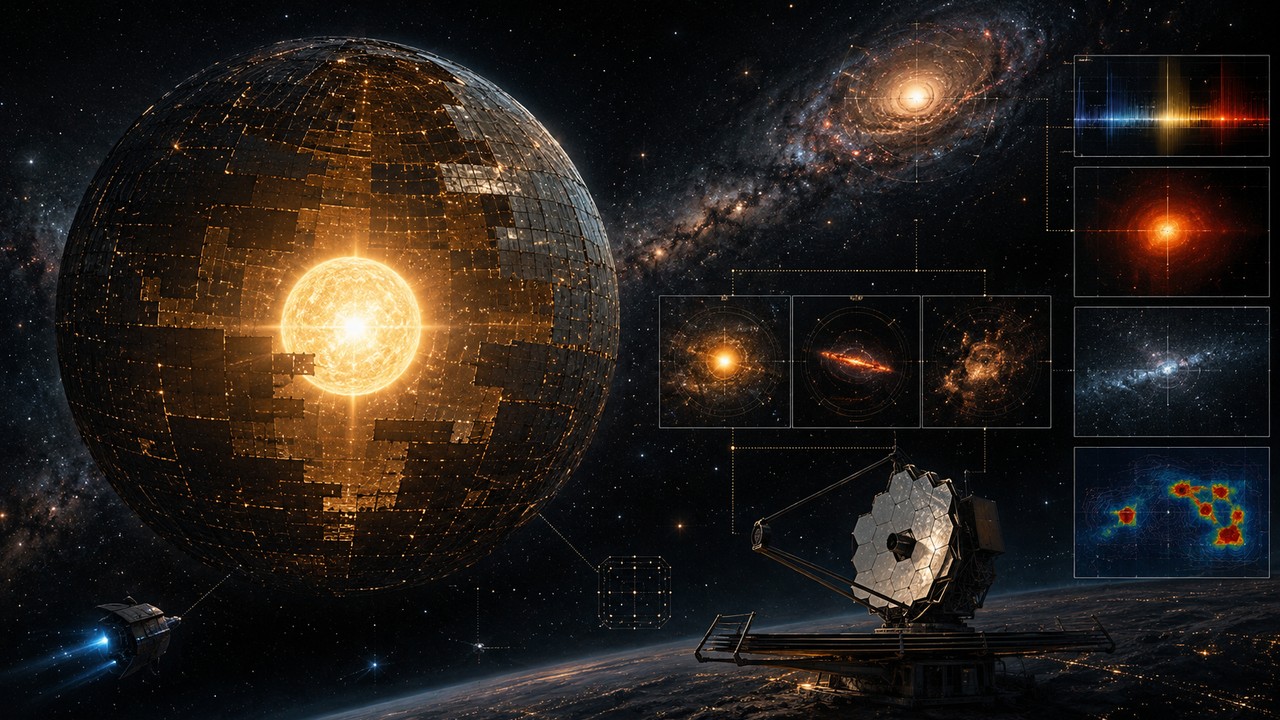
A Dyson sphere is, yes, treated by astronomy as a possible technosignal, but this does not mean that a confirmed Dyson sphere exists. What researchers are looking for is a physical effect that large-scale technology could produce: a star appearing dimmer in part of the spectrum while an unusual portion of its energy reappears as infrared radiation. The challenge is that dust, young stars, circumstellar disks, distant galaxies and simply mixing sources in the same pixel can produce similar signals.
This difference between “compatible signal” and “technology detection” is the heart of the problem. Project Hephaistos showed how a modern search can start with millions of stars, narrow the sample down to a few unusual objects, and still discover later that some of the best candidates were background galaxies mistaken for nearby stars. In July 2026, results with the James Webb Space Telescope (JWST) resolved two such cases. In August, a paper accepted by the Monthly Notices of the Royal Astronomical Society (MNRAS) reinforced, with archival data and astrometry, that line-of-sight contamination is a central threat for this type of SETI.
Why would an energy-consuming civilization produce waste heat
The basic idea doesn't depend on imagining a perfect solid shell around a star. “Dyson sphere” works as a label for hypothetical structures capable of intercepting an important fraction of starlight. If a technology absorbs energy and uses it for habitats, computing, propulsion, or other activities, the energy does not disappear: in conventional physical scenarios, some of it needs to be rejected back into the environment, usually at longer wavelengths.
That's why infrared matters. An ordinary star has a predictable energy distribution based on its temperature and luminosity. If part of the visible or near-infrared light is intercepted and re-emitted by cooler material, an excess in the mid-infrared appears. A partial structure would also leave part of the star visible, creating a combination
particularly interesting: apparently normal stellar photosphere at short wavelengths and additional thermal emission at longer wavelengths.
This is a potential technosignal, not a unique signature. Dust heated by the star itself does something very similar. A distant dust-rich galaxy, projected almost exactly behind the star, could also add infrared flux without contributing much visible light. Astronomy, therefore, cannot leap from infrared excess to “extraterrestrial engineering”. It must first prove that natural and instrumental explanations fail.
What Gaia, 2MASS and WISE see when they are combined
The gain from Project Hephaistos comes from the combination of surveys that observe different bands of the spectrum. Gaia measures optical light and, importantly, provides very accurate parallax and proper motion. This helps you know whether the object is really a nearby star and allows you to place its spectral energy distribution on a physical luminosity scale. 2MASS covers the near infrared, in the J, H and Ks bands. WISE extends the curve to the mid infrared, with bands around 3.4, 4.6, 12 and 22 micrometers.
In the search published in 2024 by Project Hephaistos II, the focus was precisely on the W3 and W4 bands of WISE, at 12 and 22 micrometers, where a cold thermal excess can stand out. The team worked with stars up to 300 parsecs away and compared combined photometry from Gaia, 2MASS and AllWISE with partial Dyson sphere models. The goal was not to “see the megastructure,” but to test whether the entire shape of the energy distribution was compatible with a star whose light was partially intercepted and reprocessed.
Parallax is especially useful because it reduces some false positives. An isolated quasar, for example, does not behave like a nearby star with consistent parallax. But there is a pitfall that the team itself highlighted: parallax does not solve the case where there is a true star in the foreground and an infrared galaxy in almost the same line of sight. Gaia measures the star; WISE, with much coarser angular resolution in the long bands, can sum the star and galaxy as if they were a single source.
How five million stars became seven candidates
The 2024 article is useful because it shows that the search was not a simple selection for “red object”. The initial catalog gathered about five million stars within 300 parsecs. Requiring detection in W3 and W4 reduced this set to approximately 320,000 sources. The team then fitted Dyson sphere models to photometry and retained just over 11,000 cases with a fit close enough to what was expected.
Then came contamination filters. A convolutional neural network was trained to recognize sources in nebular regions, because young stars shrouded in dust and nebulosity are frequent false positives. Other indicators from Gaia and WISE were used to look for signs of natural origin of the excess. A signal-to-noise ratio cutoff eliminated fragile measurements. Finally, optical, near-infrared, and mid-infrared images were visually inspected to detect blends and problematic neighbors.
The sequence documented in the article went from about five million to 320,000, then 11,243, 5,732, 5,137, 368, and finally seven candidates. All were M dwarfs. The decisive point, however, is written in the paper itself: photometry alone is essentially incapable of proving the existence of a Dyson sphere. The correct result of that screening was “targets worthy of follow-up,” not “seven megastructures found.”
Why dust and background galaxies are such convincing false positives
Dust is the classic copycat because it absorbs light and re-emits it thermally. Young stars may be surrounded by disks and nebulosity; more mature systems may have debris disks. In both cases, the spectral distribution may gain an infrared tail. That's why Hephaistos looks for signs of youth, variability, H-alpha emission, nebulosity and other clues that make a circumstellar explanation more plausible.
Background galaxies are even more treacherous when the telescope has low angular resolution. In the W3 and W4 bands, the WISE PSF is approximately 6 and 12 arcseconds wide. Two sources separated by a few arcseconds can enter the same measure. If the star dominates in the optical and short infrared, while a very red galaxy dominates at 12 and 22 micrometers, the combined catalog creates exactly the kind of curve that attracts attention in a search for residual heat.
An important case appeared in 2025. High-resolution radio observations showed that the source associated with candidate G had characteristics of an active background galactic nucleus. There was no detectable radio emission at the position of the M dwarf. The study also found that WISE's long emission was displaced relative to the star, reinforcing that the excess came from the extragalactic object and not from a structure around the star.
This example changed the way we looked at other candidates. Instead of just asking “does the photometry look like a Dyson model?”, it has become essential to ask “does the center of the infrared emission actually coincide with the position of the star when we correct for its proper motion?” This is a seemingly small difference, but it is precisely the type of test that separates a catalog anomaly from a phenomenon physically associated with the star.
What the 2026 studies found when looking for contamination
In 2026, the team of Tongtian Ren and collaborators analyzed nine candidates from the Hephaistos ecosystem using Gaia positions propagated for the time from AllWISE observations, mid-infrared centroids, and archival deep images in the optical and near-infrared. The version accepted by MNRAS in August found strong evidence of contamination in candidates B and C, suggestive evidence in A and more ambiguous evidence in E, F, H and J. D and I did not exhibit, in that archival diagnosis, obvious signs of contamination.
The mechanism was exactly what was expected for a blend. In some fields, the position of the W3/W4 excess deviated from the predicted position of the star. In others, deeper images revealed a faint object near the target, invisible or barely evident in shallower surveys. The most worrying class of contaminants are Hot Dust-Obscured Galaxies, or Hot DOGs: extremely red galaxies, with a lot of heated dust, faint in the optical and very bright in the mid-infrared. Placed by chance behind an M dwarf, they can create a “waste heat star” that does not physically exist.
The work itself highlights a limit of astrometry: if the background galaxy is aligned almost perfectly with the star, the displacement between centroids may be too small to reveal mixing. In these cases, deeper images help, but the definitive answer may require higher angular resolution in the mid-infrared itself.
JWST showed why higher resolution changes diagnosis
This is exactly what happened with candidates D and E. A Project Hephaistos IV study, released in July 2026, used JWST's MIRI instrument to obtain mid-infrared images and spectra. Webb separated, about an arcsecond from the M dwarfs, background objects that WISE had mixed in with the stars.
In candidate D, the background object has a redshift of approximately 0.9 and a spectrum compatible with a Hot DOG. In candidate E, the background galaxy is at approximately redshift 0.4, has an extended morphology with bright regions and a spectrum consistent with an intense and dusty star-forming galaxy. In MIRI images, stars dominate more in the 5.6 micrometer filter, while galaxies gain importance at 10 and 15 micrometers. This spatial shift with wavelength directly exposes source confusion.
In other words, the JWST did not “fail to find a Dyson sphere” due to the simple absence of a signal. It showed where the signal that previously seemed interesting was coming from. This is a much stronger refutation: the infrared excess can be attributed to extragalactic sources separate from the stars. For D and E, the hypothesis of a megastructure around the M dwarfs is no longer necessary to explain the observation.
What a truly convincing detection would look like
Robust detection would have to survive multiple independent levels of testing. First, the spectral energy distribution would need to show a thermal excess compatible with reprocessing a relevant portion of the stellar luminosity. Then, the star would have to appear mature and common enough to narrow down explanations such as a protoplanetary disk, nebulosity, or young activity. The excess would also need to remain spatially associated with the star when positions, proper motions, centroids, and deep images are compared.
Next would come the high resolution stage. If the infrared emission splits into a star and a nearby galaxy, the candidate falls. If it remains coincident with the star, spectroscopy and observations in other bands can look for signatures of dust, gas, debris disk, active galactic nucleus or other known physics. Submillimetre observations with ALMA, for example, can test cold dust scenarios; high-resolution radio can reveal a background AGN; JWST can separate sources that WISE mixes and obtain spectra in the mid-infrared.
Even a perfectly coincidental excess without an immediate natural explanation would still not automatically be technology. The scientific standard would be to look for physical consistency, repeatability, and independent evidence that eliminates competing hypotheses. The more extraordinary the interpretation, the more important it becomes to demonstrate that the signal is not born from the instrument, the catalogue, an incorrect association or a rare astrophysical class that is still little known.
So, is the Dyson sphere science or fiction?
The megastructure remains hypothetical, but the search is real observational science. Astronomers publish models, define detectable signatures, scour public catalogs, build filters against false positives, and set aside telescopes to track the strangest cases. Project Hephaistos is an especially clear example because it documents all of these steps and, at the same time, shows why “candidate” is not synonymous with “discovery.”
The results for 2025 and 2026 make the story less spectacular, but scientifically more interesting. Several excesses that seemed difficult to explain now have signs or confirmations of contamination by background objects. This does not make the search useless. On the contrary: it reveals which flaws in resolution, astrometry and selection need to be controlled for a future
candidate is much more difficult to explain by chance.
The correct question, therefore, is not whether a photograph ever showed a Dyson sphere. It is whether there exists a source whose energy, position, spectrum and behavior remain technologically compatible after dust, stellar youth, disks, background galaxies, blends and measurement problems have been rigorously tested. As of August 2026, there is no confirmed detection of this type. There is a methodology increasingly capable of telling why a promising signal was not what it seemed. This is exactly the work needed before any technosignal can be taken seriously.