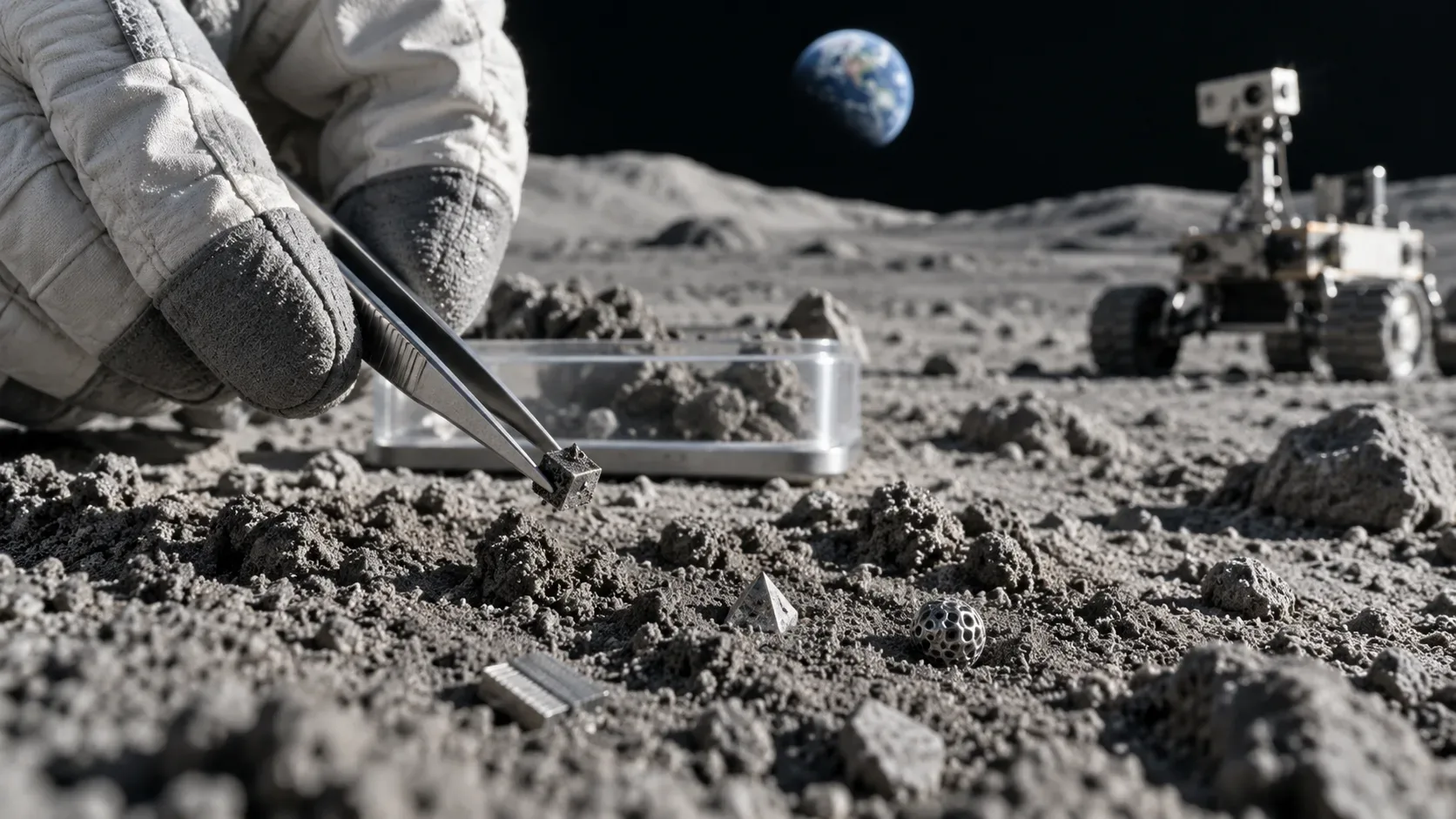
A study publicized by the SETI Institute on September 8, 2026 proposes an unusual way to search for technosignatures: examine lunar regolith for microscopic particles with properties that could indicate technological manufacture. The idea does not start from a detection. It turns an older hypothesis — that artificial fragments might travel through interstellar space and become preserved on airless bodies — into a quantitative problem that can be tested with lunar samples.
The most important point when interpreting the work is to separate hypothesis, method, and evidence. The paper, available as a preprint and still under peer review, calculates conditions under which technological particles could survive interstellar travel, reach the Earth-Moon system, mix into lunar soil and, in principle, be recognized with modern materials-analysis techniques. It does not report the discovery of any extraterrestrial particle.
What the new study proposes looking for
The authors Lewis J. Pinault, Brian C. Lacki, Ian A. Crawford and Andrew P. V. Siemion examine a micron-scale class of material technosignature: very small, potentially artificial grains that could result from technological activity and circulate through the Galaxy either unintentionally or, in another scenario, be deliberately sent toward the Solar System.
The concept builds on earlier proposals to search the Solar System for extraterrestrial artifacts, but shifts the focus from large structures, probes or installations to tiny particles. Instead of asking only “is there an artificial object on the Moon?”, the question becomes: does a well-characterized volume of regolith contain any grain whose morphology, composition or microstructure is not adequately explained by known natural processes?
The preprint treats this as particulate technosignature material and models two regimes:
- undirected dispersal: durable technological debris could escape stellar systems and become part of the interstellar dust population;
- deliberate delivery: a civilization could intentionally release particles toward the inner Solar System, greatly increasing the chance of local deposition compared with random dispersal.
Why the Moon matters for this hypothesis
The Moon is attractive as an archive because it lacks a thick atmosphere, oceans and Earth-like active tectonics that continuously recycle the surface. Over billions of years, its regolith has collected impact material and particles arriving from space. That does not mean lunar soil is an untouched archive: impacts, radiation, sputtering and regolith mixing alter grains. The study explicitly incorporates some of those processes to estimate what might survive and where a search could make sense.
This difference from Earth is central. A very old material technosignature could be harder to preserve here, where erosion, water, atmosphere and crustal recycling erase or transform records. On the Moon, some refractory materials may have a longer preservation window, although they would still need to survive interstellar travel and arrival impacts.
How a microscopic particle could reach lunar regolith
The study models interstellar transport including gas drag, sputtering and different phases of the interstellar medium. In the latest arXiv version of the preprint, the authors conclude that refractory particles with characteristic radii of about 0.3 micrometers may, under specific conditions, cross kiloparsec-scale distances over 100 million to 1 billion years.
This does not mean any artificial grain could make the trip. Solar radiation pressure and heliospheric filtering remove or deflect much of the possible phase space. The scenario depends on a small fraction of particles reaching the Earth-Moon system at relative velocities low enough to offer some possibility of surviving impact.
The hypothesis therefore faces several physical filters before laboratory analysis even begins: the material would have to be produced, escape its system of origin, survive the interstellar medium, enter the Solar System under favorable conditions, hit the Moon without being completely destroyed, and remain recognizable inside regolith that is continually reworked.
How the search could work in a lunar sample
The proposal is not simply to look for “odd geometric shapes.” The described strategy is multimodal: use computer vision to triage very large numbers of grains and then apply materials-forensics techniques to anomalous candidates. The SETI Institute mentions microscopy, tomography, spectroscopy, nanoscale materials characterization and AI-assisted image analysis.
A plausible workflow would be:
- characterize the sample's origin, age and geological context;
- map the normal distribution of minerals, impact glasses, agglutinates and other natural regolith components;
- use automated imaging to flag particles outside that expected distribution;
- examine candidate chemistry, internal structure, crystallinity, isotopic properties and surface features;
- compare every anomaly with natural processes and possible human contaminants before making any technological interpretation.
The scientific value lies in that final step. A visual anomaly by itself would not be a technosignature. Natural materials can produce regular shapes, pores, alloys, glasses and unusual textures. Space missions also introduce their own materials and contaminants. An extraordinary claim would require multiple independent lines of evidence and strict control of sample provenance and custody.
What makes the hypothesis falsifiable
Falsifiability here does not mean that one negative result would settle the question “do technological civilizations exist in the Galaxy?”. It means the model makes quantitative predictions about how much material should appear in a given volume of regolith under particular assumptions.
In version 4 of the preprint, the authors estimate that a null detection in about one cubic meter of regolith could already exclude a specific class of scenarios in which Sun-like stars disperse, on average, more than about 0.10 Earth mass in long-lived artificial particles over Galactic history. That number is not a general limit on “how many aliens exist.” It depends on assumptions about production, particle size, survival, transport, deposition and regolith mixing.
This is an important point: a null result is still a scientific result. If no candidate survives the analysis pipeline, the experiment can constrain the amount of technomaterial compatible with that set of assumptions. Larger samples, different sites and more sensitive techniques could tighten or reshape those limits.
What a positive result would have to demonstrate
Finding a “strange” grain would only be the beginning. To gain weight as a technosignature, a candidate would need to withstand alternative explanations. Necessary questions would include:
- can the composition be produced by geological processes, impacts, space weathering or meteorites?
- does the microstructure match any material used in spacecraft, instruments, adhesives, lubricants or laboratory procedures?
- is there an isotopic signature or combination of elements that is difficult to generate naturally?
- does the internal structure show manufacturing, functional layers or redundant patterns incompatible with mineral growth?
- can the result be reproduced by independent laboratories using samples with reliable chain of custody?
Even a highly unusual combination of properties would not justify jumping directly to “extraterrestrial origin.” Terrestrial contamination, mission materials and rare natural processes would have to be excluded first. That is why the study is best understood as a search-and-test design, not as a discovery announcement.
Which missions could test the proposal
The SETI Institute release cites future samples and analyses associated with programs such as NASA's Artemis and China's Chang'e, as well as commercial lunar exploration. The point is not that any of these missions has already formally adopted a search for microscopic technosignatures. Rather, well-documented lunar material returned to Earth or analyzed in situ could eventually be subjected to this kind of protocol.
For that purpose, context and contamination control would matter as much as the microscope. A grain with poorly documented provenance is far less informative than a particle collected from a known layer, site and sampling procedure. Missions that sample diverse locations could also allow comparisons among regions with different exposure histories.
The study did not find aliens
What it found: a quantitative route for testing a hypothesis about microscopic technological particles in lunar regolith.
What it did not find: alien particles, extraterrestrial artifacts, proof of ancient civilizations or evidence of visitation to the Moon.
The SETI Institute itself emphasizes that the work “reports no evidence of extraterrestrial technology.” The September 8 release presents the study as a move from speculation toward a potentially testable search. On that date, the preprint was under review at the International Journal of Astrobiology; version 4 on arXiv had been revised on August 18, 2026 in response to reviewer comments.
What this changes for technosignature research
The most interesting contribution of the work is to broaden SETI's search space. Radio and laser searches generally look for manifestations that may be transient and depend on geometry, timing and source behavior. Material technosignatures offer another possibility: search for physical residues that, if they exist and are durable, could remain long after the activity that produced them ended.
That does not make the approach more likely to succeed, only complementary. The statistical challenge is enormous because regolith contains vast numbers of natural particles and any expected artificial signal could be extremely rare. The gain is in turning a vague idea into measurable parameters: grain size, transport distance, survival, sampled volume, laboratory sensitivity and false-candidate rate.
For readers, the practical conclusion is simple: the new study does not ask anyone to believe there are aliens on the Moon; it asks whether an experiment can be designed to search for one specific kind of trace and still learn something when nothing is found. That separation between hypothesis and evidence is precisely what can make a speculative proposal scientifically useful.
Sources
- SETI Institute — Researchers Propose Searching the Moon for Microscopic Technosignatures, September 8, 2026.
- Pinault et al. — Micron-Scale Technosignatures: How a Cubic Metre of Lunar Regolith May Begin to Constrain the Number of Past Technological Civilisations in the Galaxy, arXiv:2606.24028, version 4 revised August 18, 2026.