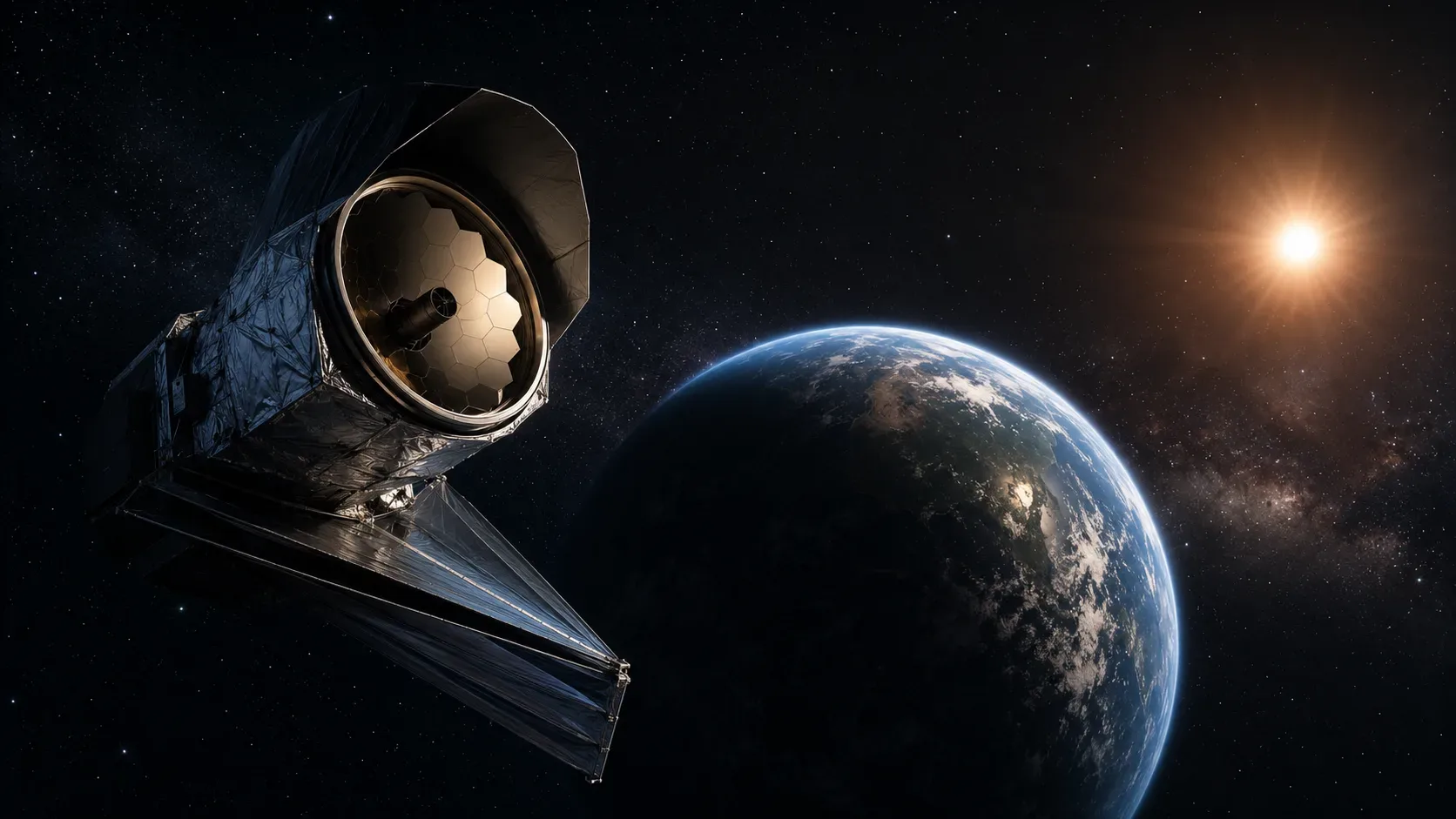
NASA wants the Habitable Worlds Observatory to do something no previous space observatory has been specifically designed to do: look for signs of life on planets around other stars. But before deciding how this telescope should be built, the agency still needs to reduce uncertainty about the very worlds it intends to observe.
This is the objective of the new Habitable Worlds Observatory Precursor Science Investigations (HWO-PSI), element D.8 of the ROSES-2025 program. The call funds research capable of influencing HWO design and architectural decisions while the concept is still in early pre-formulation. Expressions of intent, or NOIs, are mandatory and expire on September 10, 2026; Full proposals are due by October 26, 2026.
The HWO is not yet a mission with a final project closed. NASA works with different architectures and describes its central objective as identifying and directly imaging around 25 potentially habitable worlds, using spectroscopy to investigate their atmospheres for possible biosignatures.
The question now comes before the search for life: what do we need to know to build an observatory capable of carrying out this search without relying on faulty scientific assumptions?
The call is not simply to build technology
The distinction made by NASA itself helps to understand the timing of the project. Precursor science is research capable of changing decisions about mission architecture or requirements before the formulation phase. Preparatory science, on the other hand, helps plan observations or interpret data when the observatory is already more defined.
HWO-PSI was created for the first category. The call excludes proposals whose main objective is to develop instrumentation or technology and also specific studies of HWO instrument concepts, which belong to other elements of ROSES. The interest here is in scientific questions whose answers could change the observatory's decisions.
This turns seemingly abstract questions — like the frequency of Earth-like planets or the amount of dust around nearby stars — into engineering problems. If these numbers are very different from current estimates, they change the achievable sample size, required observing time, and even telescope performance requirements.
How many temperate rocky planets are there really?
One of the biggest uncertainties is the so-called η⊕, or eta-Earth: the frequency of rocky planets roughly the size of Earth located in the habitable zones of Sun-like stars.
NASA's Exoplanet Exploration Program Science Gap List, updated in March 2026, classifies η⊕ as a critical parameter for HWO design. According to the document, published estimates still vary by almost an order of magnitude depending on the methods and assumptions adopted.
This matters because the scientific plan does not assume that an Earth is waiting next to every observed star. The survey envisioned for the HWO involves approximately 100 nearby habitable zones, from which it is intended to arrive at a sample of about 25 spectroscopically characterized temperate rocky worlds. NASA considers necessary throughput simulations that incorporate both the frequency of these planets and associated uncertainties.
If such worlds are less common than expected, an observatory needs to search more systems, reach more difficult targets, or increase its efficiency to arrive at a scientifically robust sample. If more common, other architecture and mission timing tradeoffs may change.
So knowing how many “Earths” there are is not just a question that HWO will try to answer in the future. It is also necessary information to size the mission itself.
It is necessary to know more about the stars that will be observed
Finding a nearby, Sun-like star is not enough to make it a good target.
The preliminary highest priority list for NASA's exoplanet program brings together 164 Tier 1 stars, but knowledge about many of these systems is still incomplete. Dimly bright stellar companions, brown dwarfs, or giant planets can make direct imaging difficult or dynamically alter regions in which a small planet could maintain a stable orbit.
For this reason, NASA points to the tracking of weak companions, time series of radial velocity and astrometry, better orbits in multiple systems and simulations of the stability of habitable zones as pioneering science. It is also necessary to find suitable reference stars for calibrating coronagraphic observations.
There is an important subtlety: not every characterization of a star needs to occur now. NASA's own document classifies certain detailed measurements of the physical, chemical and radiation environment properties of stars as preparatory science, which can continue in the years leading up to an eventual launch. HWO-PSI prioritizes what can really change architectural decisions in the short term.
Masses and orbits are still a difficult problem
Even if a point of light is detected next to a star, correctly interpreting that world requires more than a spectrum.
Mass helps constrain the planet's composition and provides context for interpreting the atmosphere. The orbit informs how much stellar energy it receives and whether the observed position actually corresponds to a trajectory compatible with a habitable region.
For Earth-like worlds around Sun-like stars, these measurements are extremely difficult. NASA cites the case of an Earth analogue around a star like the Sun, which would produce a variation in radial velocity on the order of 9 centimeters per second. The star's own activity can generate much larger signals and mask the planet.
The exoplanet program considers it necessary to clarify, later this decade, what combination of extremely precise radial velocity and astrometry will be able to provide masses and orbits for the planets that the HWO will find or characterize. The question even includes the possibility of the HWO itself performing very high precision astrometry or relying on measurements obtained by other instruments.
It is an example of pioneering science that does not necessarily need to “discover a new Earth”. Knowing how far existing techniques can go — and where they fail to work — already reduces project risk.
Dust can be confused with what the telescope is looking for
There is yet another obstacle around the stars: exozodiacal dust, a distant equivalent of the dust that produces zodiacal light in the Solar System.
For observations of small planets, this dust acts as a source of noise. Under certain conditions, it can be much brighter within a telescope's resolution element than the planetary signal itself. Structures in the dust cloud can also produce concentrations of light that can confuse the search for planets.
NASA wants to reduce uncertainty about the amount and distribution of this dust particularly around nearby stars that may be included in the HWO survey. The problem directly affects the mission's time budget: higher levels of exozodi may require longer integrations, harm the quality of the spectra or make the survey consume a larger fraction of the observatory's operational life.
Here again, astronomy and engineering meet. Better estimation of background dust allows testing HWO architectures with more realistic scenarios rather than scaling the telescope from an idealized environment.
Before recognizing life, one must know what it could look like
HWO aims to break down the light reflected by planets and look for chemical features in their atmospheres. NASA itself cites gases such as oxygen and methane among possible important evidence in the search for life. But no molecule, taken in isolation and outside the planetary context, serves as an automatic verdict.
The 2026 scientific list devotes an entire gap to observable biosignatures and their false positives. Non-biological processes can produce some substances of interest; In other scenarios, an inhabited planet might show weaker signals than we would expect from modern Earth.
This uncertainty already has consequences for the design of the telescope. Models of atmospheres need to indicate which wavelengths are most informative, what spectral resolution will be needed, and what signal-to-noise ratio allows competing hypotheses to be distinguished. NASA even mentions interest in the region close to 0.25 micrometers, where there is a characteristic related to ozone, as one of the cases that could influence the spectral coverage limits of the HWO.
There are even more basic gaps. Interpreting a spectrum depends on knowing precisely how atoms, molecules and aerosols absorb or scatter light. For some species and wavelength ranges, laboratory data still has limitations. The ExEP states that improvements in these properties can define HWO spectroscopy requirements, especially in the near ultraviolet.
In other words, it is not enough to build a sensitive instrument. It is necessary to know in advance what information it needs to be able to measure so that a possible sign of life can be differentiated from lifeless chemistry.
Scientific answers could change the telescope itself
NASA is still studying different architectures for the HWO. The published exploratory concepts include telescopes measuring approximately 6 meters and 8 meters, with different optical configurations, and the agency highlights that these models do not necessarily represent the final design. The choice involves compromises between openness, stability, sensitivity and instrument performance.
This is why the precursor program arrives before the architecture is frozen.
A better estimate of η⊕ changes the prediction of how many planets the observatory might find. The amount of exozodiacal dust alters exposure times. Knowledge about multiple stars modifies the useful list of targets. The strategy for obtaining masses and orbits determines which external measurements will need to accompany the HWO. And the study of biosignatures influences wavelength coverage, resolution and spectral sensitivity.
The problem is not simply developing enough technology to see a very faint planet next to a very bright star. It's about ensuring the observatory is designed to look for the right signals, in the right systems, and with enough information to interpret them.
HWO-PSI attempts to reduce risk before decisions become expensive
On August 7, 2026, opportunity D.8 appears as open in the NSPIRES system. Notice of Intent is required by September 10, 2026 at 11:59:59 PM Eastern Daylight Time, and a proposal that has not been preceded by an NOI by the deadline will be returned without evaluation. Sending the NOI, on the other hand, does not oblige the researcher to present the complete proposal.
Administrative detail reveals scientific urgency. HWO is precisely in the period in which new information can still interfere with architectural choices. Later, much of this research will continue to be useful, but it will no longer have the same power to change fundamental decisions.
The search for life, therefore, begins long before a future observatory points to its first exoplanet. It starts with figuring out which assumptions about planets, stars, dust, and atmospheres are solid enough to support the telescope that will do this search.