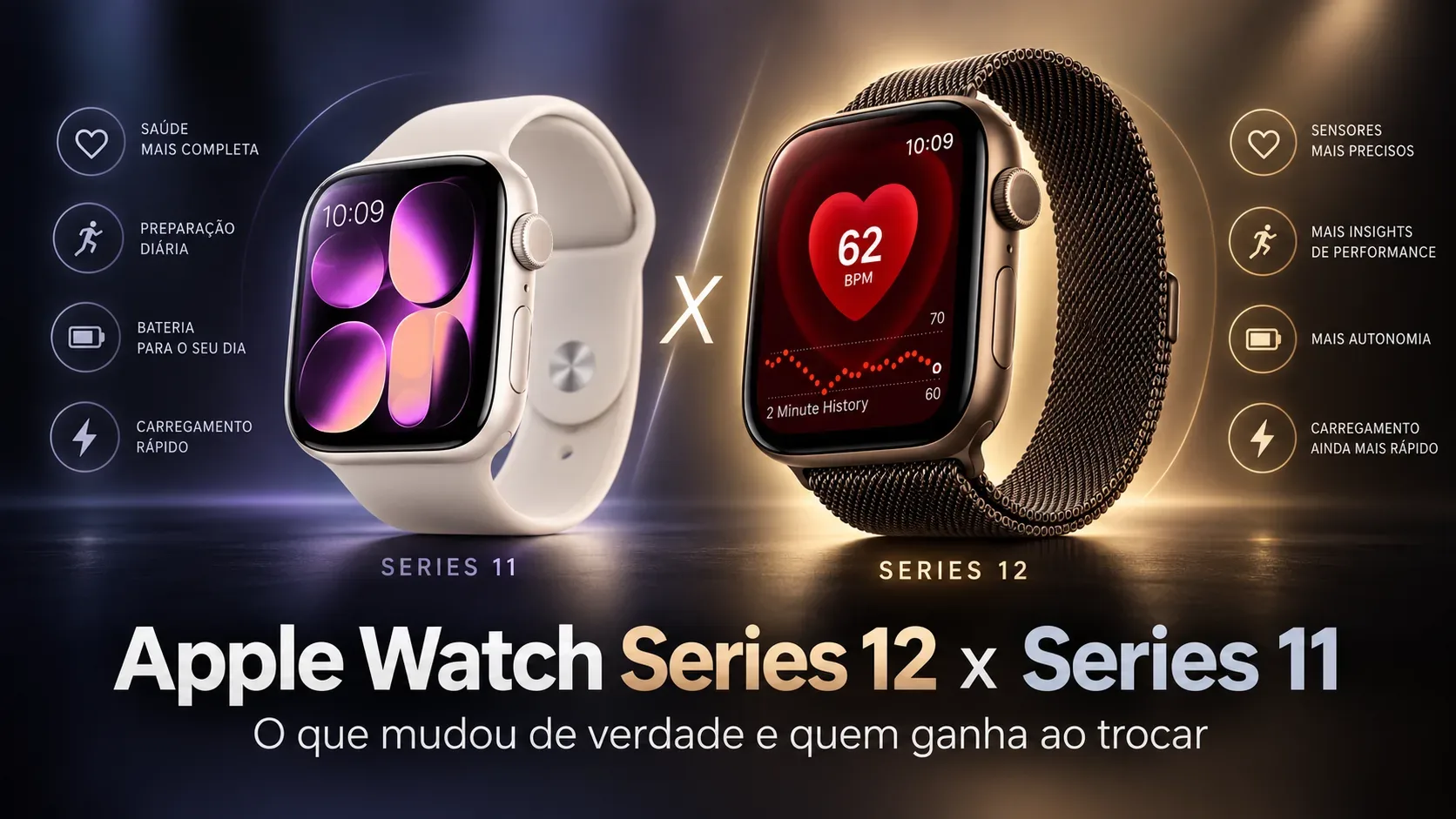
Apple Watch Series 12 is a more meaningful update than a simple name change suggests, but that does not mean every Series 11 owner should upgrade. The biggest change is the new Health Sensing System, which increases the frequency of heart-rate and heart-rate variability (HRV) measurements and enables the new Readiness score. There is also faster charging, longer outdoor-workout battery life, the S11 chip, and new case options. On the other hand, normal-use battery life is still officially rated at up to 24 hours, peak display brightness remains 2,000 nits, and many important health and safety features were already available on Series 11.
For someone buying a first Apple Watch, Series 12 is usually the more complete choice when the price gap versus remaining Series 11 stock is small. For someone who already owns a Series 11 in good condition, upgrading makes more sense when the new health metrics, Readiness, faster charging, or longer battery life during long workouts address a specific need.
Series 12 vs. Series 11: the differences that actually matter
| Area | Apple Watch Series 11 | Apple Watch Series 12 | Practical impact |
|---|---|---|---|
| Chip | S10, 64GB | S11, 64GB | S11 supports the new health system and Audio Intelligence features; storage does not increase. |
| Heart sensors | Electrical heart sensor and third-generation optical heart sensor | New Health Sensing System with updated optical and electrical heart sensors | This is the foundation for more frequent cardiac measurements and new insights. |
| Heart rate and HRV | Measurements already used by health, sleep, and workout apps | Background heart-rate readings every five seconds and much more frequent HRV measurements, according to Apple | Produces denser data for recovery and all-day tracking. |
| Readiness | Not listed as a Series 11 feature | New Readiness app/feature with a 0-to-10 score | Helps put workouts, sleep, recent load, and vitals into context. |
| Everyday battery life | Up to 24 hours; up to 38 hours in Low Power Mode | Up to 24 hours; up to 38 hours in Low Power Mode | There is no jump in the headline everyday-battery claim. |
| Outdoor workout | Previous-generation reference used by Apple | Up to 10 hours, 25% more than the previous model | A more meaningful gain for long training sessions than for routine daily use. |
| Fast charging | 15 min for up to 8 h of normal use; 5 min for up to 8 h of sleep tracking | 15 min for up to 12 h of normal use; 5 min for up to 10 h of sleep tracking | Short charging windows are easier to fit in before leaving or going to bed. |
| Display | LTPO3 OLED, up to 2,000 nits, 1-nit minimum | LTPO3 OLED, up to 2,000 nits, 1-nit minimum | The basic brightness experience does not change. |
| Glass and materials | Strengthened Ion-X on aluminum models; sapphire on titanium | Ceramic Shield 2 on aluminum; sapphire on titanium and ceramic; new ceramic case | Series 12 expands material choices and improves Apple's stated front-glass durability on aluminum models. |
| Body | 42 or 46 mm; 9.7 mm thick | 42 or 46 mm in aluminum/titanium; 9.7 mm thick | Series 12 is 1 mm wider in equivalent sizes and slightly heavier in aluminum GPS models. |
The biggest leap is in health and recovery
Apple redesigned the sensing side of Series 12 around what it calls the Health Sensing System. In practice, the watch measures background heart rate every five seconds and increases the frequency of HRV readings substantially. Apple also separates recovery HRV from a broader HRV view and adds a daytime vitals view.
Those data points feed the new Readiness feature. The score runs from 0 to 10 and takes recent activity, training load, vitals, and sleep quality into account. The important point is understanding what it is — and what it is not. It is a context tool for planning the day and training; it does not replace medical evaluation and does not turn a single reading into a diagnosis.
For someone who already uses Series 11 mainly for notifications, payments, basic workouts, and sleep tracking, the change can feel incremental. For someone who tracks recovery, trains frequently, and actually reviews HRV, load, and vitals, this is the most substantial difference of the generation.
The 24-hour battery claim is unchanged — but charging is better
Both models are officially rated for up to 24 hours of normal use and up to 38 hours in Low Power Mode. Buying Series 12 expecting dramatically longer everyday battery life can therefore create the wrong expectation.
The gain appears in two situations. First, Apple rates Series 12 for up to 10 hours during an outdoor workout, 25% more than the previous model. Second, fast charging is more useful: 15 minutes moves from up to 8 hours of normal use on Series 11 to up to 12 hours on Series 12. For sleep tracking, five minutes of charging moves from up to 8 to up to 10 hours.
In practice, that favors people who wear the watch day and night and need to use small charging windows. Still, the actual battery health of a used Series 11 matters a lot: a degraded battery can make the older watch feel much worse than its original official figures.
Similar design, but not everything became smaller or lighter
Series 12 keeps the visual language of Series 11 and the main 42 mm and 46 mm case sizes, but there are subtle physical changes. On aluminum and titanium models, width increases from 36 to 37 mm on the 42 mm size and from 39 to 40 mm on the 46 mm size, while thickness stays at 9.7 mm. On aluminum GPS models, weight rises from 30.3 to 32.2 g on the smaller model and from 37.8 to 39.5 g on the larger one.
Display area is also slightly smaller: from 989 to 970 mm² on the smaller size and from 1,220 to 1,196 mm² on the larger size, while resolution remains 374 × 446 and 416 × 496 pixels, respectively. It is a small difference, but it shows that a “new generation” does not improve every measurement.
In return, Series 12 adds Ceramic Shield 2 to aluminum models and brings back a ceramic case option in Pearl White and Night Blue. For buyers who care about finish and durability, that is a more concrete distinction than the overall appearance, which remains familiar.
The S11 chip matters, but it does not make S10 obsolete
Series 11 uses S10; Series 12 moves to S11. Both have 64GB of storage. In the new model, S11 supports the expanded health system, more accurate step tracking, and Audio Intelligence features. Some of those features depend on software and regional or language availability, so it is worth checking Apple's official page before buying for one specific capability.
That also means Series 11 remains strong for common tasks. It already offers an always-on display, ECG where available, sleep tracking, sleep apnea and hypertension notifications where supported, fall detection, Emergency SOS, 5G on cellular models, and up to 24 hours of battery life. Upgrading is not the same as moving from an “old” watch to a completely new one.
Who really benefits from upgrading?
Someone buying a first Apple Watch
Series 12 is the simpler default when prices are close because it has the newer hardware and should have the longer future support window. Series 11 remains attractive if it is heavily discounted and Readiness, more frequent cardiac measurements, faster charging, and new materials are not priorities.
A Series 11 owner with a watch in good condition
In most cases, waiting is reasonable. Official everyday battery life is the same, the display keeps similar peak brightness, and the core feature set is still modern. Upgrading is easier to justify when you know why you want the new health system, use the watch heavily for training and sleep, or need more efficient short charging sessions.
Someone focused on health and recovery
This is the profile that benefits most from Series 12. More frequent heart readings, expanded HRV, Readiness, and daytime vitals create a richer context layer. Even so, those data should be used as personal tracking information rather than as a diagnosis.
Someone focused on battery life
For normal use, both are still rated at up to 24 hours. Series 12 is more attractive for outdoor-workout endurance and charging speed. If the current problem is simply an aged Series 11 battery, compare the cost of battery service with the cost of replacing the entire watch.
Someone who can wait
If Series 11 is healthy, works well, and you do not need the new metrics, waiting is a rational choice. The new generation improves several details at once, but it does not change the basics enough to make the previous generation inadequate.
Price and availability: compare the real deal, not just the generation
Apple introduced Series 12 on September 9, 2026, opened pre-orders the same day, and announced in-store availability beginning September 18. In Brazil, the announced starting price is R$5,499 — the same starting price Apple announced for Series 11 at its 2025 launch. As Series 11 shifts mainly to remaining inventory and third-party retail, the decision depends on the actual discount available.
A practical rule: if Series 11 is only slightly cheaper, Series 12 tends to offer better long-term value. If the Series 11 discount is substantial and the new health features are not a priority, the previous generation still delivers almost all of the core Apple Watch experience.
Before buying or upgrading
- Check whether the health features you want are available in your country and for your use profile.
- Verify iPhone and watchOS requirements, especially if the purchase is tied to Apple Intelligence or Siri AI features.
- Compare your Series 11 battery health with the endurance of a new device.
- Include the resale or trade-in value of your current watch, not just the full Series 12 price.
- Avoid deciding on one spec alone: Readiness, charging, sensors, and materials matter differently to different users.
Verdict
Apple Watch Series 12 is a real upgrade, mainly for health, recovery, and charging convenience. But for someone who already owns a Series 11 in good condition, it is not a mandatory upgrade: official everyday battery life is unchanged and the core experience remains very similar. The best reason to upgrade is genuinely wanting the new health and Readiness data, or making better use of long workouts and short charging windows. For new buyers, Series 12 is the more complete option; for satisfied Series 11 owners, waiting remains a solid choice.
Sources and caveats
- Apple Newsroom: Apple Watch Series 12 introduction
- Apple: Series 12 technical specifications
- Apple: Series 11 technical specifications
- Apple Newsroom: Apple Watch Series 11 introduction
- MacRumors: Series 11 vs. Series 12 buyer's guide
Battery estimates vary with usage, network conditions, settings, and other factors. Health, Apple Intelligence, and Siri AI features may vary by region, language, and eligibility.