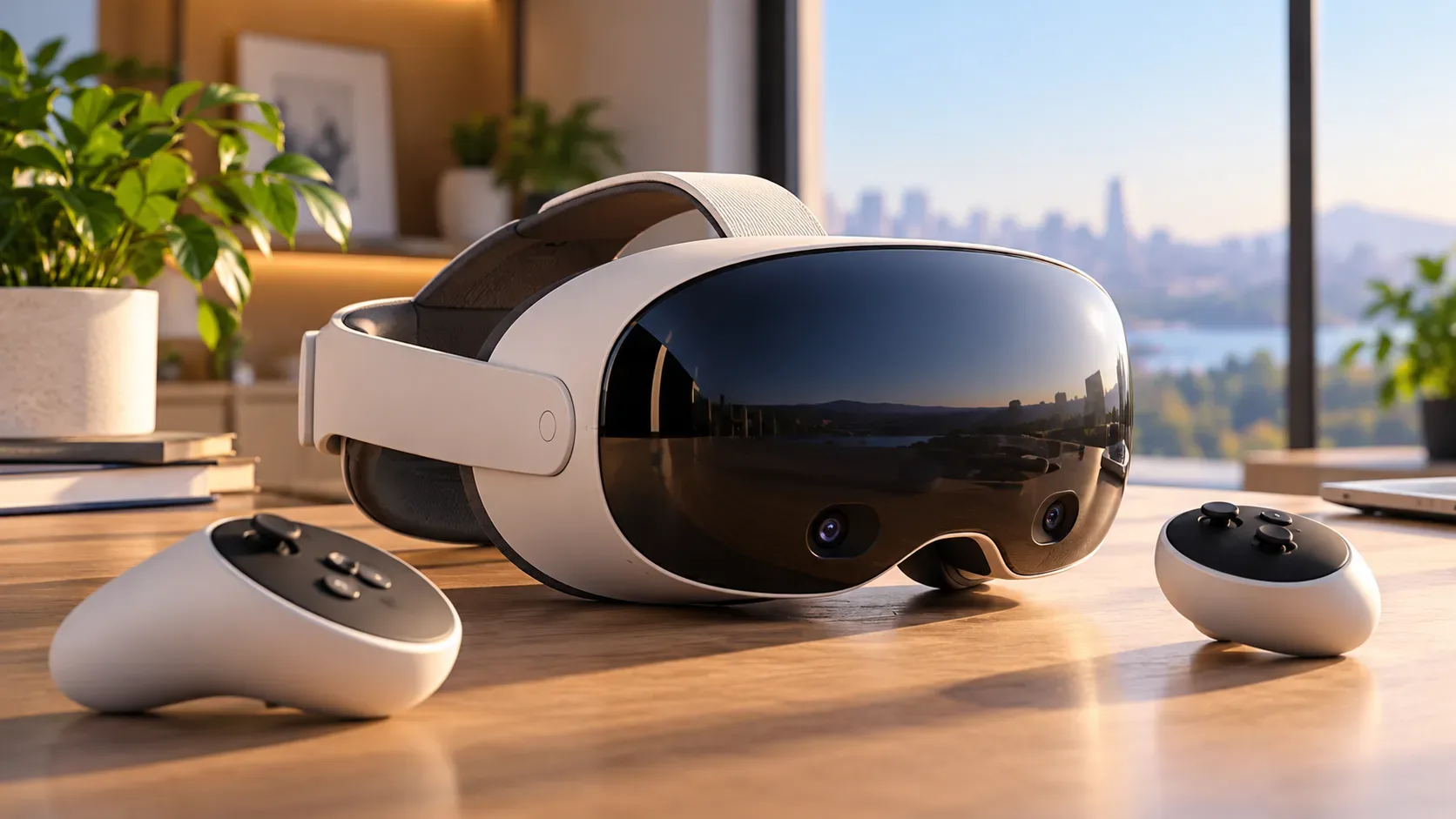
Meta VR Glasses were introduced at Meta Connect 2026 as the company's most advanced virtual reality device to date. Meta says the product is scheduled to arrive in spring 2027, with a starting price of $1,299.99. As of September 28, 2026, this is still a future launch: the official announcements reviewed do not provide an exact on-sale date or Brazil-specific pricing and availability.
What Meta has already confirmed
| Item | Announced information | What it means |
|---|---|---|
| Starting price | $1,299.99 | The official price was announced in US dollars. It is not a confirmed Brazilian retail price. |
| Launch window | Spring 2027 in the Northern Hemisphere | This is a seasonal window, not a release date with a specific day. |
| Glasses weight | About 100 grams | Meta says this is about one fifth the weight of Meta Quest 3. The external module stays off the face. |
| Display | 5K Infinite Display with micro-OLED panels and 37 pixels per degree | Meta also lists compact pancake lenses and Dolby Vision. |
| Compute | Snapdragon Reality Elite | The processor sits in the external module rather than the main glasses frame. |
| External module | Compute, battery and storage in a puck connected by an optical tether | The module can clip to a pocket, belt or bag, reducing weight on the face. |
| Battery | Up to 3 hours of continuous high-resolution media playback | Meta also announced 45 W fast charging for the puck. |
| Primary inputs | Eyes, hand gestures and voice | Core interaction was presented without requiring physical controllers. |
| Workspace | One large virtual screen or multiple screens, with surface input | A flat surface can act as a virtual keyboard and touchpad, while full-color passthrough keeps the environment visible. |
The 100-gram figure refers to the glasses, not the whole system
The roughly 100-gram weight is one of the headline specifications, but it needs to be read together with the two-part architecture. The glasses hold the sensors, display and audio, while compute, battery and storage are moved to an external module connected by an optical tether. That design is how Meta shifts heavier components away from the face.
The official materials reviewed do not state the total system weight when the glasses, cable and puck are combined. It would therefore be inaccurate to treat 100 grams as the weight of everything the user carries while using the device.
What the 5K Infinite Display description means
Meta describes the display system as a 5K Infinite Display built on micro-OLED panels, with an angular density of 37 pixels per degree. The company also specifies ultra-compact pancake lenses designed for the product, plus Dolby Vision support and Dolby Atmos spatial audio integrated into the frames.
The announcement does not publish a conventional pixel resolution per eye. The 5K label should therefore remain Meta's official display name rather than being converted into a per-panel resolution the company has not disclosed.
How the compute module works
Meta VR Glasses use an external puck connected to the glasses through an optical tether. The puck houses compute, battery and storage and can clip to a belt, pocket or bag. Meta says the system is powered by Qualcomm's Snapdragon Reality Elite.
For battery life, the published figure is up to three hours of continuous high-resolution media playback, with support for 45 W fast charging. That runtime was announced for this specific media scenario and should not be treated as a universal estimate for every app, game or productivity workflow.
Storage capacity was not detailed in the announcements reviewed. The storage is located in the puck, but these sources do not provide a capacity table or configuration pricing.
Workspace: multiple screens and a surface used for input
The productivity concept centers on a private workspace with one large virtual display or several screens. Meta says a desk or another flat surface can be used as a keyboard and touchpad through its surface input system, without requiring a physical keyboard solely for that workflow.
Full-color passthrough lets the user keep seeing a desk, phone and surroundings while virtual screens remain active. Meta also says other devices can be connected so their displays can be extended into the virtual environment.
The announcements reviewed do not provide a complete compatibility list covering computers, phones, operating systems, ports or accessories for this display-extension feature. The feature itself is confirmed, but detailed compatibility should not be assumed yet.
Eyes, hands and voice are the main inputs
Meta presented eye tracking and natural hand gestures as the primary interaction methods, along with voice through Meta AI integrated into the operating system. Examples include opening apps, playing media, rearranging the workspace and searching without picking up a controller.
For gaming, the company says more than 75 titles will be available at launch that can be played solely with hand gestures, while Xbox Cloud Gaming will provide access to hundreds more games through streaming. This does not mean every existing game will automatically work without controllers.
Is it a Meta Quest replacement?
Meta itself describes VR Glasses as an addition to, not a replacement for, Meta Quest devices. The glasses run the same operating system, Store, payment platform and SDKs as the Quest ecosystem, but they use a different physical design and interaction model.
For someone comparing a purchase or replacement, that distinction matters because the 2027 product is not being positioned simply as a lighter Quest 3. Meta's announcement emphasizes comfort, immersive media, a private workspace and eye-and-hand control, while the Quest line remains part of the company's VR ecosystem.
Price, timing and Brazil: what is still unconfirmed
The announced price is $1,299.99 and the launch window is spring 2027 in the Northern Hemisphere. In the official materials reviewed, Meta has not yet provided an exact release day, a full country list, pricing in Brazilian reais or Brazil-specific availability.
Those sources also do not provide final storage capacities, total system weight, complete box contents or a closed compatibility list for the display-extension feature. Because the product has not launched yet, these unanswered points should remain separate from the specifications that have already been announced.
What can already inform a purchase or replacement decision
The starting price in US dollars, 2027 launch window, approximate glasses weight, external-puck architecture, 5K micro-OLED Infinite Display, Snapdragon Reality Elite processor and multi-screen workspace concept are already defined. Those are the concrete facts available for comparing the device with needs around comfort, productivity and media use.
What cannot yet be finalized is the total cost in Brazil, local availability, exact release date, storage configurations and full compatibility with external devices. Until Meta publishes those details, a direct conversion into a Brazilian retail price or a definitive list of compatible computers would be an extrapolation.