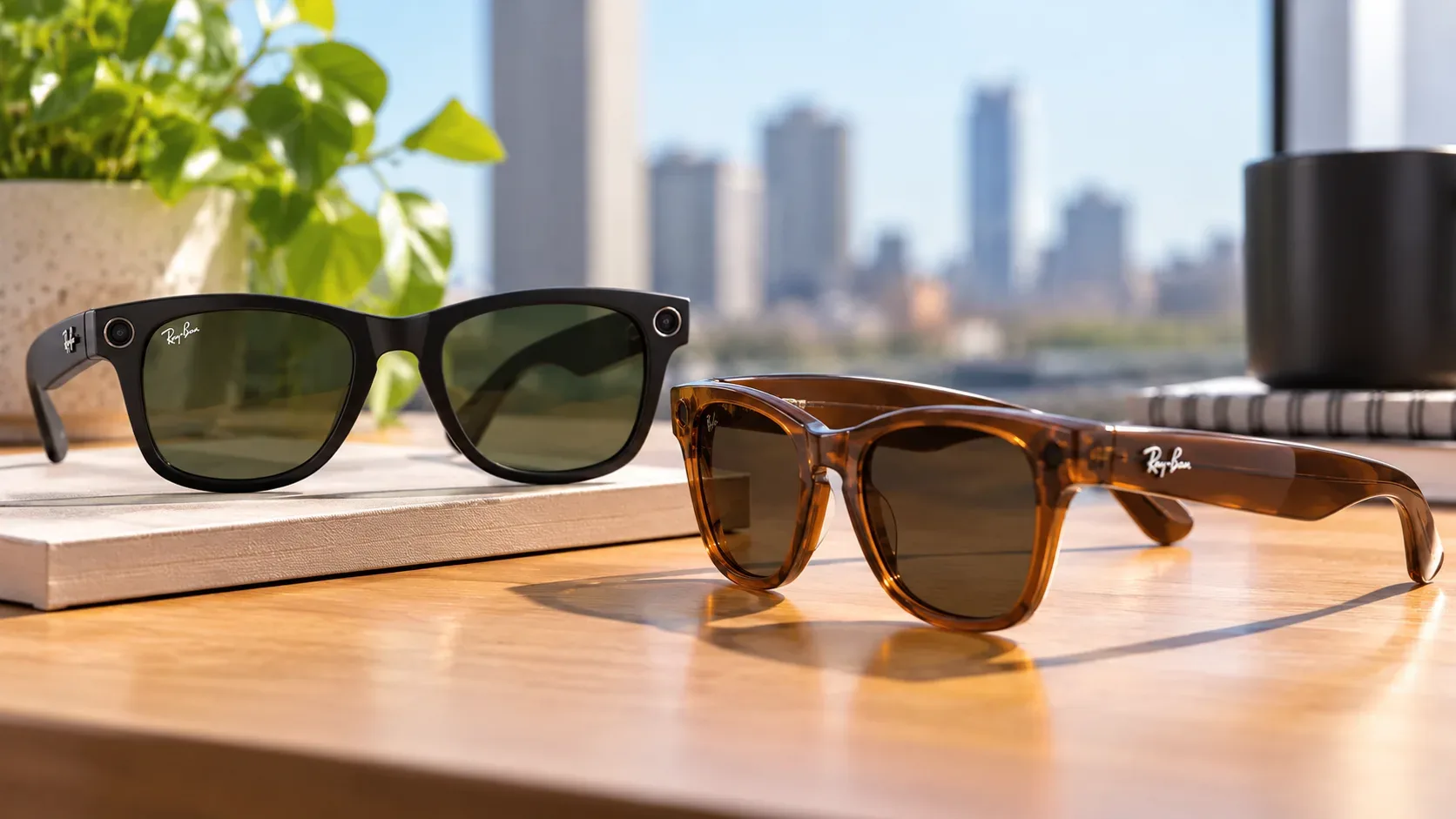
Direct answer: Ray-Ban Meta Audio is the new Meta and EssilorLuxottica option for people who want open-ear audio, calls and Meta AI in glasses without a camera. Meta opened US pre-orders on September 23, 2026, with a starting price of $349 and announced that shipments begin on October 13. Removing the camera supports a lighter design at 43 grams and a claimed battery life of up to 12 hours per charge, compared with up to 9 hours for the camera-equipped Ray-Ban Meta Gen 3.
What Ray-Ban Meta Audio offers
The Audio line keeps the sound and voice-assistant side of Meta's smart-glasses experience. According to the official announcement, it is designed for listening to music and podcasts, taking calls and talking with the AI assistant without holding a phone. The speakers use an open-ear design, so they are built into the temples instead of sealing the ear canal like in-ear earbuds.
The most important distinction is what the product leaves out: a camera. That separates Ray-Ban Meta Audio from Ray-Ban Meta Gen 3, which includes a 12 MP camera, 3K Ultra HD video recording and features that depend on computer vision. Without a camera, Audio cannot take photos, record video or handle commands that require the AI to inspect what is in front of the wearer.
Meta also emphasizes a slimmer and lighter design. The announced weight is 43 g, and the frames include professionally adjustable temple tips, adjustable or swappable nose pads and over-extension hinges. The line comes in two frame styles, Clubmaster and Burbank, across 23 color and lens combinations, with support for a wide range of optical prescriptions.
Pre-order, price and October 13 shipping
Pre-orders opened on the announcement date, September 23, 2026. The official US starting price is $349. That is an entry price: frame and lens choices such as Transitions, polarized or prescription lenses can raise the final total. Ray-Ban's US store already shows Meta Audio configurations above the starting figure.
Meta said the glasses ship starting October 13. That date should be read as the beginning of the shipping window, not a guarantee that every pre-order will arrive that day. When checked on September 28, 2026, a US Ray-Ban Burbank configuration page showed a later estimated delivery date, indicating that the actual schedule depends on the variant, stock, lenses and delivery address.
It is also important to separate the US dollar price and North American schedule from any future Brazilian availability. Meta's Brazilian version of the announcement describes the product and its main specifications but does not publish a price in Brazilian reais or a Brazilian sale date for Ray-Ban Meta Audio. The $349 price and October 13 shipping date therefore should not be presented as Brazilian launch information without a separate confirmation.
Ray-Ban Meta Audio vs. camera-equipped Ray-Ban Meta
| Item | Ray-Ban Meta Audio | Ray-Ban Meta (Gen 3) |
|---|---|---|
| Camera | None | 12 MP |
| Photos and video | No capture | Photos and video up to 3K Ultra HD |
| Visual AI features | Cannot inspect a scene through a camera | Can use the camera for compatible Meta AI features |
| Glasses battery | Up to 12 hours per charge | Up to 9 hours per charge |
| Charging case | Up to 48 additional hours | Up to 50 additional hours on current Gen 3 product pages |
| Weight | 43 g, the figure Meta announces for the Audio line | Varies by frame and size; Meta does not publish one single line-wide weight in the announcement |
| US starting price | $349 | $449 |
| Availability at announcement | Pre-order, with shipping starting October 13 | Available from September 23, 2026 |
| Styles | Clubmaster and Burbank, 23 combinations | Wayfarer, Aviator and Zena, 27 combinations |
What changes in practice without the camera
The core tradeoff is straightforward: Meta Audio preserves the audio and voice-assistant experience while giving up visual capture. For music, podcasts, calls and Meta AI interactions that rely only on voice and audio, the product remains hands-free. For recording what the wearer sees, creating photos and videos or asking the AI to interpret visual details, a camera-equipped model is still required.
In return, Audio has the longer announced runtime of the two products compared here: up to 12 hours, three hours more than Gen 3's up to 9 hours. Its 43 g weight also reinforces the all-day-wear positioning. It is not simply a cheaper Gen 3, however, because the functional difference is structural. The $100 gap between starting prices comes with the complete removal of the camera system.
The starting price is not the price of every configuration
The $349 figure is the floor for the line. Ray-Ban sells multiple lens and frame combinations, and some US product configurations are listed at higher prices, such as $429 for certain options. That matters when comparing Audio with Gen 3 because the $100 difference between starting prices can shrink after a buyer selects specific lenses.
Both families also support prescription lenses in compatible configurations. For someone planning to use the glasses as an everyday pair, lens choice, frame size and fit can affect the final purchase as much as the electronics.
How to read the October 13 date
Meta uses October 13 as the date when Ray-Ban Meta Audio shipments begin. It does not mean every pre-order will be delivered on that date. Individual estimates can change with the selected combination and order logistics. For a pre-order purchase, the safest reading is to combine the official shipping-start date with the estimate shown in the cart or on the selected configuration page.
Bottom line
Ray-Ban Meta Audio creates a clear split in the family: audio, calls and AI without a camera on one side, and camera-equipped Ray-Ban Meta for buyers who also want image capture and visual features on the other. In the United States, Audio starts at $349, entered pre-order on September 23 and has an announced shipping start of October 13. Its main announced hardware advantages are the 43 g weight and up to 12 hours of battery life, while its defining limitation is the complete absence of visual capture.