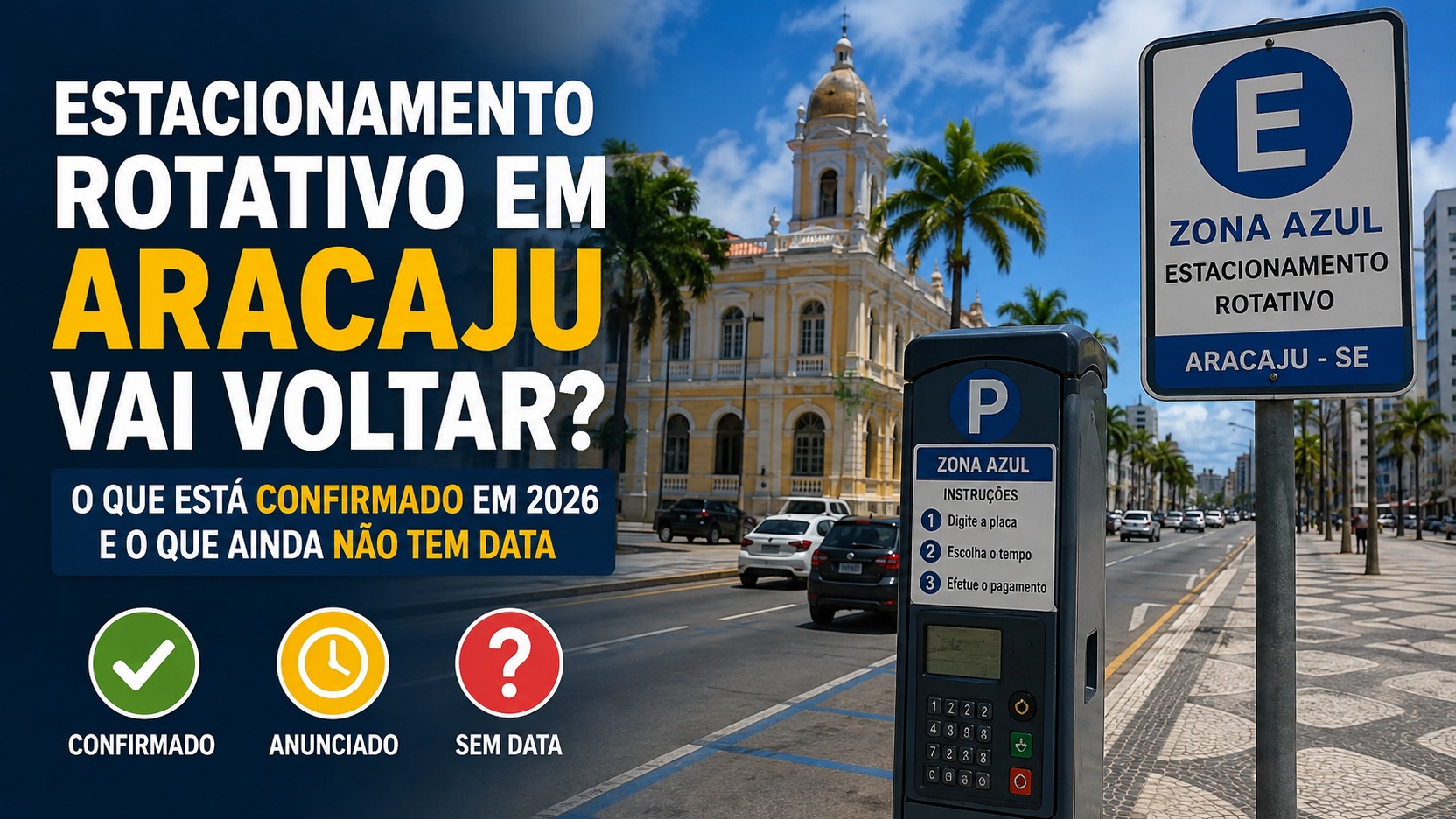
Until August 21, 2026, the safest answer is this: Aracaju has a public planning decision to implement rotating parking again, but the official material located does not prove that a new paid system for general use is already working. Nor was it found, in the documentary survey carried out for this article, a current official start date, a new tariff, a definitive list of streets, a current application or a new operating contract that would allow the former Blue Zone to be treated as reactivated.
The difference is important because internet searches still lead to municipal pages from 2015 and 2016 with values, streets, length of stay and applications from that phase. This data helps reconstruct the history of the service, but should not be used as if it were the rules of 2026.
What is confirmed in 2026
PPA 2026-2029 mandates the implementation of rotating parking
The strongest confirmation is in Municipal Law No. 6,287, of December 30, 2025, which established the Aracaju Multi-Year Plan for 2026-2029. In program 0193, for Urban Mobility, the objective of “implementing rotating parking” expressly appears. The same program includes an indicator called “percentage of the rotating parking implementation process”.
This places the theme within the municipality’s official planning. It's not just an interview speech or a business entity proposal: it's an objective set out in the current PPA.
But the PPA does not function as a notice of the start of the service. It organizes programs, objectives, actions and budget references for several years. The presence of rotating parking in the plan shows that implementation is a public goal, but does not, in itself, inform which day charging will begin, who will operate the system, what the fare will be or on which streets the rule will apply.
The City Hall's Strategic Planning also provides for study and implementation
The City Hall's Strategic Planning 2025-2028 reinforces the same direction. Within the Municipal Transport and Traffic Superintendency, SMTT, there is a specific project called “Rotary Parking” with two objective goals: to carry out a study to identify the locations and carry out the implementation.
This document helps you understand the institutional stage. Before there is a fully operational system, there is still a location definition stage and an implementation stage. Therefore, municipal planning itself separates the project from the daily operation of the service.
The old concession was valid until April 2025
In SMTT's financial statements for 2024, contract No. 0031/2015 appears as an onerous concession for the implementation, operation, maintenance and management of paid rotating parking in Aracaju. The registration indicates validity from April 23, 2015 to April 23, 2025.
This data is relevant because it explains why old pages cannot be automatically treated as current regulations. The contractual structure that supported that service cycle had its own deadline. For the reader of 2026, the fact that an old official address remains accessible on the internet does not prove that the same model, the same prices or the same conditions continue to be valid.
In May 2026, ACESE asked for the return of rotating parking
On May 13, 2026, City Hall published news about Mayor Emília Corrêa's meeting with the new board of directors of the Commercial and Business Association of Sergipe. Among the demands presented by ACESE was expressly the “return of rotating parking” to increase movement in the Center.
The formulation is an important institutional indication of the practical situation at that time. If the entity was asking for the service to return in May 2026, it makes no sense to treat the pages from 2015 and 2016 as sufficient proof that the old system continued to operate normally.
What was announced, but did not become a confirmed current date
At the end of 2025 there was a more concrete expectation. A local report published on December 4 of that year attributed the information to the SMTT superintendent, Nelson Felipe, that the terms of reference were ready, that the tender was expected for the beginning of 2026 and that, if the schedule progressed, implementation could take place between March and April. The report also mentioned Centro, Siqueira Campos and São José and described a solution with an application and technological supervision.
This announcement is useful for understanding the administration's intention, but cannot be retroactively transformed into an official operating date. March and April passed, and in May ACESE was still charging for the return of rotating parking. Until the closing date of this article, no subsequent act was found in an official source that confirmed that that schedule had come to fruition.
Therefore, the correct information is not “the rotary will return in March or April”. It is correct to say that there was an expectation published for the first half of 2026, but it should not be treated as a current deadline without subsequent confirmation from the City Hall or SMTT.
Timeline: from the old system to current planning
2015: implementation of Rotativo Aju
In July 2015, City Hall announced the implementation of a new rotating parking lot in the Center. The initial phase included vacancies in the Center, in São José and in Siqueira Campos, with operations based on vehicle registration, credit sales and applications. The model was presented as an alternative to old parking meters from previous generations.
The pages from that time also disclosed prices and length of stay. In official publications from 2015 and 2016, for example, there was a rate of R$1.50 per hour for a passenger vehicle and a maximum limit of two hours in certain spaces. These numbers belong to the context of that system and are not a price list for 2026.
2016: expansion and consolidation of old rules
In 2016, SMTT announced new vacancies and continued to promote the use of the application and points of sale. It is precisely this content that still appears easily in search engines. For those searching today, the risk is to find a true, albeit old, official page and conclude that the rule is still current.
A page being official does not mean that all of its content remains valid indefinitely. Date, contract and context need to be checked together.
2023: the return was already discussed
In November 2023, ACESE and SMTT discussed rotating parking in the Center again. At the time, the resumption was treated as a medium-term measure and linked to the preparation of a new notice. This shows that the discussion about return did not just arise in 2026.
2025: the registered term of the old concession ends and the new project enters planning
The contractual registration of the 2015 concession points to the end of April 23, 2025. In the same cycle, the 2025-2028 Strategic Planning started to bring a specific rotating parking project, with study of locations and implementation.
In December 2025, the announcement came that the terms of reference would be ready and that the bidding could move forward at the beginning of 2026. A few days later, Law No. 6,287 consolidated the objective of implementing the service in PPA 2026-2029.
2026: there is a decision to implement, but the operational elements are missing
In the first half of 2026, rotating parking appears simultaneously as a formal objective of the PPA and as a demand still presented by traders. This set of documents supports a more precise conclusion: there is a public decision to implement, but practical reactivation should not be assumed without corresponding operational acts.
What is not yet proven for the driver
There is no current rate confirmed in the located material
The values of R$ 1.50, R$ 3.00 and R$ 1.00 that appear on old pages belong to the model published in the last decade. It is not safe to use these prices as a reference for 2026. A new system may maintain, correct or reformulate the tariff structure, and this needs to be disclosed in a current act.
Old streets do not form an automatic current list
Centro, São José and Siqueira Campos appear repeatedly in the history and also in more recent announcements of intention. Even so, a list of streets published in 2015 should not be converted into an official map for 2026. The Strategic Planning itself foresees a study to identify the locations, which indicates that the current definition needs to be formalized.
Application and payment method require new confirmation
The Rotativo Aju and E-AJU appear on historical pages. The new project was also publicly described as technological. This does not authorize the driver to install an old application, purchase credit on an outdated channel, or assume that the previous payment system has been reactivated.
The reliable signal will be a recent communication from the City Hall or SMTT informing the name of the application or platform, payment channels, registration rules and date from which the charge becomes effective.
Operator, contract and start order have yet to appear
To say that the service has actually returned, there needs to be more than planning. The reader should look for the publication of a corresponding bid or contract, possible contract signing, implementation of signage, tariff announcement and, mainly, an official communication from
start of operation.
In the survey carried out until August 21, 2026, no new contract or service order was found on the official pages searched that clearly allows us to state that general use rotating parking has already started charging again in Aracaju.
Blue Zone is not the same thing as a special vacancy
The absence of confirmation of a new rotating parking lot does not suspend other parking and traffic rules. In May 2026, for example, SMTT published specific guidance on credentials for vacancies aimed at the elderly, pregnant women and people with disabilities.
These special vacancies have their own rules and do not depend on the return of the Blue Zone. Likewise, no parking signs, loading and unloading areas, corners, bus stops and other traffic restrictions continue to comply with the signage and applicable legislation, regardless of whether there is a charge for rotating parking.
This separation avoids another common mistake: concluding that, if the Blue Zone is not active, any vacancy in the central region becomes free of rules.
How to recognize that rotating parking is truly back
First sign: current publication from City Hall or SMTT
The announcement must indicate that the implementation has moved beyond the planning phase and into operation. The communication must include the start date, areas served and practical guidance for the driver.
Second signal: current billing rule
Rate, maximum length of stay, tolerance, vehicle categories and any allowance must be in a current document or communication. It's not enough to find this data in a news story from 2015 or 2016.
Third signal: signaling and compatible payment channels
The street must be identified in accordance with the current system, and the user must have an official means of activating the space or paying the fare. Application, QR Code, point of sale, parking meter or other solution should only be considered valid when released by the public authorities in the new cycle.
Fourth sign: identifiable operator and supervision
A paid system needs to make it clear who operates, who supervises and how citizens consult questions or dispute problems. This also helps differentiate true municipal service from informal third-party billing.
So, will rotating parking in Aracaju return?
What the documents allow us to state on August 21, 2026 is that the City Hall included the implementation of rotating parking within its official planning. The PPA 2026-2029 records this objective, and SMTT's Strategic Planning provides for the study of locations and implementation. Therefore, there is a documentary basis to say that the municipality intends to execute the project.
What is not confirmed is the current operation. The start date, fare, definitive streets, application, operator and charging conditions still need contemporary official disclosure. Until this happens, the 2015 and 2016 pages should be read as a history of Rotativo Aju, and not as a user manual for 2026.
For those who need to park in the Center today, the rule of thumb is simple: follow the signs on the road and the general traffic rules, but don't assume that an old Zona Azul rate is valid just because it appears on an old official page. When the new rotary comes into operation, the City Hall and SMTT will need to communicate the updated service conditions.