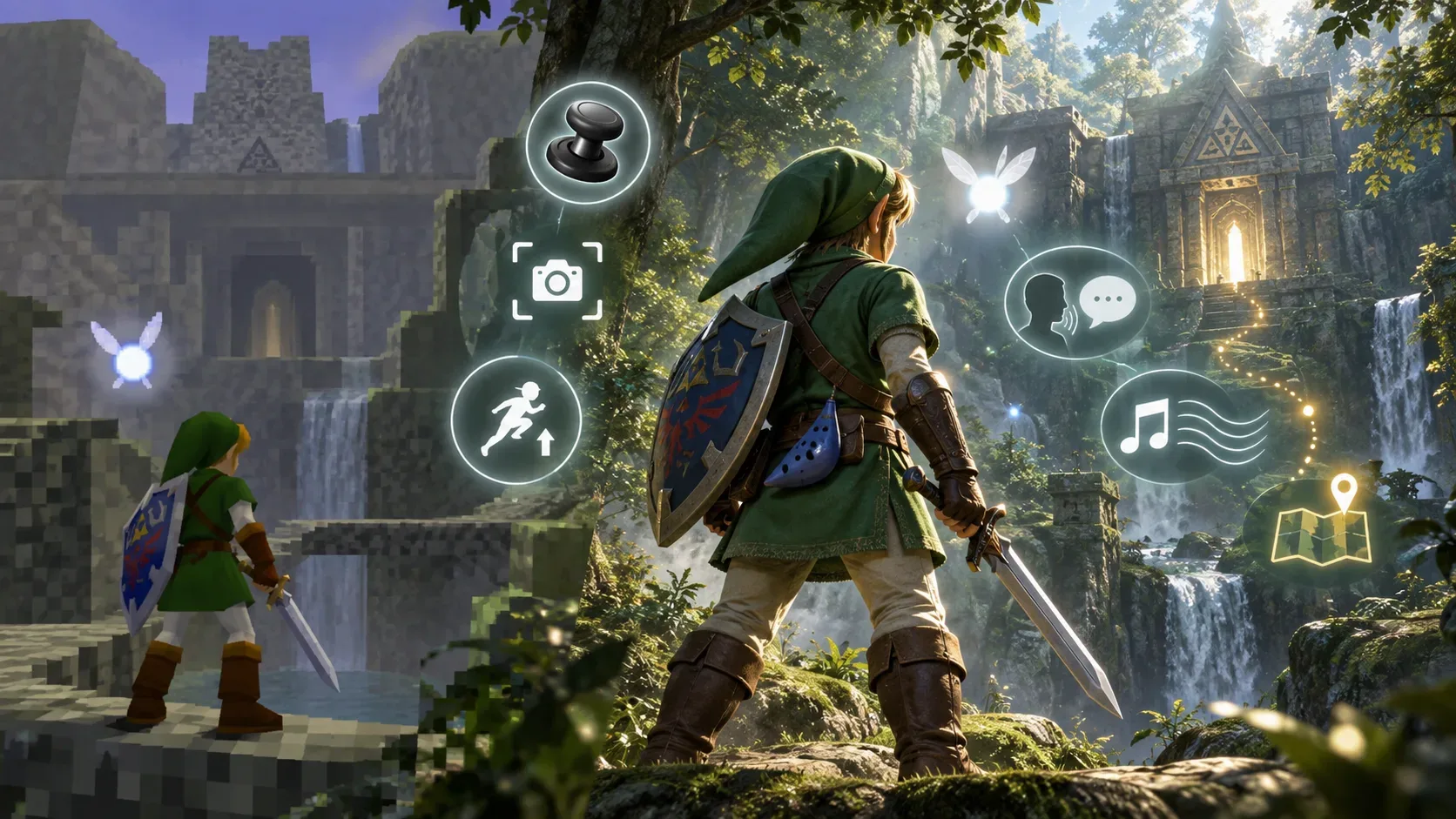
The The Legend of Zelda: Ocarina of Time remake for Nintendo Switch 2 changes more than the graphics. Nintendo has confirmed updates that directly affect how the 1998 game is controlled and presented: jumping and running gain dedicated commands, the camera can be moved with the right stick, cutscenes gain voices and expanded dialogue, the soundtrack receives a symphonic treatment, and players get new ways to track objectives. The game launches on November 5, 2026.
The key is to separate what has already been announced from what Nintendo has not detailed yet. The company described the changes in its Zelda 40th anniversary material and on the Brazilian product page, but it has not published, for example, a final list of every button mapping or a breakdown of which languages will receive dubbed audio. Some popular conclusions about the remake should therefore still be treated as expectations rather than final specifications.
What changes compared with the Nintendo 64 Ocarina of Time
| Area | Nintendo 64 game | Switch 2 remake |
|---|---|---|
| Jumping | Automatic jumping when running off certain ledges. | Free jumping through a new button command. |
| Movement | Running was part of normal movement; rolling was an important contextual action for maintaining pace. | Nintendo says players can run freely with new commands and that actions will feel snappier. |
| Camera | No second analog stick for free camera control; Z-targeting and camera recentering were central. | Improved camera control with the right stick, including in remodeled locations. |
| Dialogue | Text with occasional character vocalizations and sounds, without fully spoken cutscenes. | Voiced cutscenes and expanded dialogue. |
| Music and sound | Audio produced for Nintendo 64 hardware. | Refreshed sounds and symphonic orchestral music. |
| Guidance | Progress relied on dialogue, exploration and in-game clues. | Threads of Time shows story progress and the next objective. |
| Ocarina | Melodies played through controller inputs. | In addition to controls, the game can recognize learned melodies played or hummed near the Switch 2 microphone. |
Manual jumping changes a rule, not just convenience
In the original, Link did not have a free-jump button. He jumped automatically when running off certain ledges. Shigeru Miyamoto later explained that auto-jump let the game choose Link’s pose and trajectory according to the terrain. It was part of Ocarina of Time’s movement design, not merely a controller limitation.
In the remake, Nintendo says players will be able to jump and run freely with newly added button commands. That moves a decision that used to be automatic into the player’s hands. In practice, this is likely to change the rhythm of traversal and the sense of precision in platforming, although Nintendo has not yet explained how areas originally built around auto-jump have been adjusted.
It is also better not to lock in a specific button as final yet. Videos and demonstrations may suggest a mapping, but the official announcement reviewed here confirms the new commands without publishing a complete controls chart. For the original design and the announced change, see the Iwata Asks discussion of Ocarina of Time and Nintendo’s official Zelda 40th Anniversary Direct recap.
The camera is less dependent on the framing inherited from the N64 era
The Nintendo 64 had only one main analog stick. Ocarina of Time worked around that limitation with systems that became historically important, especially Z-targeting, which aligned Link and the camera with enemies, characters and other targets. Outside that system, the camera did not operate like the free modern 3D camera that later became standard.
On Switch 2, Nintendo confirms improved camera control with the right stick. It also says players can freely move the camera in remodeled locations. This should make it easier to look around, inspect architecture and adjust framing without relying only on automatic camera positioning.
This does not mean every combat or targeting rule has been replaced. In the material reviewed here, Nintendo has not publicly detailed every lock-on rule, sensitivity setting, axis inversion option or camera preference. What is confirmed is a layer of free camera control that the 1998 game did not have.
Voice acting: cutscenes are voiced, but audio languages still need to be separated from general language support
Nintendo describes the remake as having fully voiced cutscenes and expanded dialogue. The Brazilian product page also refers to dubbed cutscenes. This is a clear difference from the original, which delivered most of its story through text boxes accompanied by effects and brief vocalizations.
There is an important caveat for localization, however: the product page lists Brazilian Portuguese among supported languages, but that list does not explicitly separate interface/text languages from voice languages. It is therefore not safe to conclude from that page alone that the game will have Brazilian Portuguese voice acting. What is confirmed is voiced cutscenes; the exact audio package for each language still needs confirmation from Nintendo.
The same caution applies to the cast. Nintendo has announced voices and expanded dialogue, but the official material used here does not provide a complete voice-cast list. The safest references remain the official Brazilian game page and future Nintendo announcements as launch approaches.
The soundtrack is not merely remastered: Nintendo says it uses symphonic orchestral music
On the audio side, Nintendo says sounds have been refreshed and the remake includes symphonic orchestral music. That points to a rebuilt presentation rather than simply playing the Nintendo 64 audio assets at higher quality.
The distinction matters because music in Ocarina of Time is part of the game system itself: melodies trigger events, alter world conditions and connect story with exploration. The remake expands that relationship with another feature: the Switch 2 can recognize a melody Link has learned when the player performs it or simply hums it near the system’s built-in microphone.
Threads of Time adds in-game guidance
One of the most practical changes for players who do not know Hyrule by memory is Threads of Time. According to Nintendo, players can check their story progress and next objective at any point. A large tapestry also fills in gradually as the adventure continues.
This changes how the game provides orientation without necessarily turning Ocarina of Time into an experience driven by permanent objective markers. Based on Nintendo’s description, the feature works as a progress and next-step record. The company has not said that every secret, optional route or puzzle solution will be automatically revealed.
ZELDA NOTES is separate from Threads of Time
The two features are easy to confuse. Threads of Time is part of the remake and helps track adventure progress. ZELDA NOTES, by contrast, lives in the Nintendo Switch App for compatible phones and tablets and adds complementary functions.
- Today’s Record: a chronological log of the day’s activities and statistics such as enemies defeated.
- Gossip Quest: challenges that ask players to locate in-game places using a hint image.
- Play Ocarina: a virtual ocarina on a phone or tablet, with guidance, automatic playback and QR-code sharing for created scores.
- Ocarina of Time Quiz: a daily quiz with more than 2,000 questions in total.
The Brazilian product page already states that ZELDA NOTES will support Ocarina of Time. Because it depends on an app and compatible smart device, it should be treated as an additional layer rather than a requirement for playing the main campaign.
What appears to preserve the original — and what should not be assumed yet
Nintendo presents the project as the classic 1998 adventure “built from the ground up” for Switch 2. At the same time, it mentions remodeled locations, expanded dialogue, new controls and presentation changes. That suggests an intention to preserve the adventure’s identity while modernizing how Hyrule is played and presented.
But intention is not the same as a technical specification. In the official material reviewed here, Nintendo has not provided a complete list of changes to the map, dungeon order, quest structure or removed/added content. Claiming that the remake is a 1:1 recreation of the original—or the opposite—would therefore go beyond what has been confirmed. The safer comparison is that controls, camera, voice, audio and guidance have changed in verifiable ways, while the extent of structural changes still needs to be shown.
Release date, platform and price in Brazil
The Legend of Zelda: Ocarina of Time launches on November 5, 2026, and Nintendo lists it as a Nintendo Switch 2 exclusive. The Brazilian page confirms the date, Brazilian Portuguese among the supported languages and an estimated file size of 27 GB.
On Nintendo Brazil’s official showroom checked on September 9, 2026, the digital version is listed at a regular price of R$329.90. Store pricing can change before launch, so the amount should be checked again at purchase time. See the official Brazilian product page and the Nintendo Brazil showroom.
What to check before buying
- the final mapping of all buttons and any remapping options;
- which languages receive voice audio rather than only interface text or subtitles;
- technical resolution and frame-rate details, which have not been specified in the official material reviewed here;
- how much remodeled locations alter exploration, secrets and geometry compared with the Nintendo 64 game;
- which ZELDA NOTES functions require an account, persistent connection or compatible device.
Until those details are published, one thing is already clear: the remake changes more than the visuals. It transfers formerly automatic decisions to modern controls, frees the camera, adds voiced scenes and introduces a new guidance layer. That balance—modernizing interaction without erasing the identity of the 1998 game—is the main difference for players who know Ocarina of Time from the Nintendo 64.