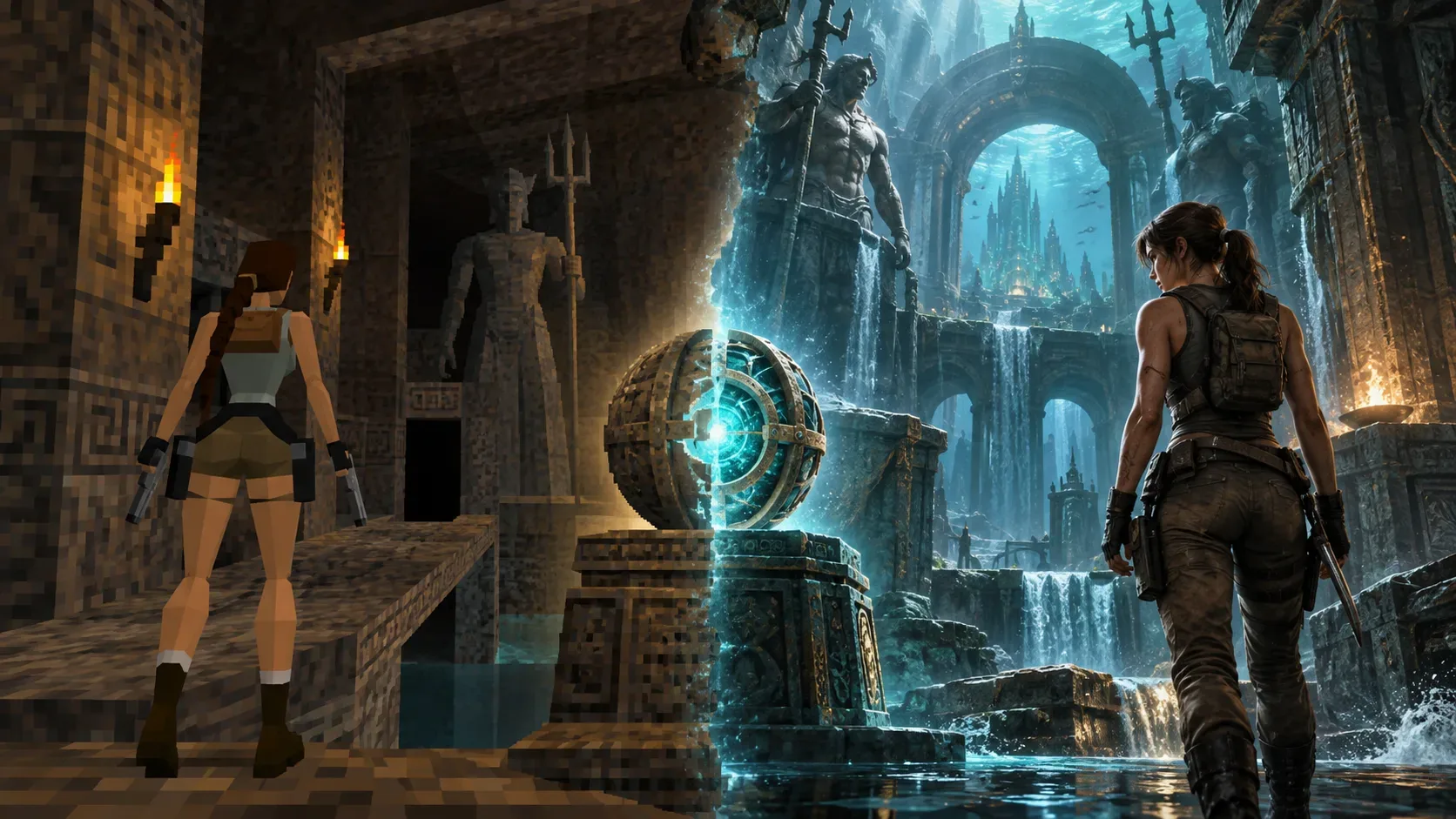
Short answer: the official definition of Tomb Raider: Legacy of Atlantis is a reimagining of the 1996 game, rebuilt from the ground up for a new generation. That puts it well beyond a remaster and also signals that this is not a scene-for-scene recreation of the original. The backbone remains recognizable — Lara Croft, the hunt for the scattered pieces of the Scion, destinations such as Peru, Greece and Egypt, acrobatics, and dual pistols — but Crystal Dynamics and Flying Wild Hog have confirmed larger environments, formerly isolated spaces that are now partly interconnected, rebuilt puzzles, and “new surprises.”
The general release is announced for February 12, 2027 on PlayStation 5, Xbox Series X|S, Steam, and Nintendo Switch 2. The Deluxe Edition offers 48-hour early access, an outfit, and a story DLC pack. The breakdown below separates what is preserved, modernized, new, and still unconfirmed based on official material available through September 15, 2026.
Why “reimagining” describes Legacy of Atlantis better
The official game page itself calls it a “reimagining” of the 1996 title, while Nintendo describes the adventure as “rebuilt from the ground up.” That wording matters: the project keeps characters, the central objective, and locations associated with the first Tomb Raider, but the developers are not merely replacing models, textures, or lighting.
The contrast is clear in the pre-order material published on the official Tomb Raider site. According to Crystal Dynamics, environments have grown in scale; areas that worked as separate rooms in the original now form partly interconnected spaces; and puzzles in Peru’s Lost Valley have been redesigned from scratch. Even classic moments such as the cog puzzle return in a “completely reimagined” form.
That is different from Tomb Raider I-III Remastered, whose proposition was to preserve the original games while letting players switch between classic and updated visuals. Legacy of Atlantis uses the debut adventure as its foundation, but changes how spaces are built and how players move through them.
Preserved, modernized, new, or still unconfirmed
| Status | Element | What is confirmed |
|---|---|---|
| Preserved | Scion | The hunt for the Scion fragments remains the adventure’s central objective. The artifact was also the core goal of Lara’s journey in the 1996 game. |
| Preserved | Core destinations | Peru, Greece, and Egypt are confirmed, along with a mysterious Mediterranean island shrouded in myth. The official material retains the globe-trotting structure that defined the original. |
| Preserved | Lara’s identity | Acrobatics, exploration, deadly contraptions, and dual pistols remain recognizable parts of the character and gameplay. |
| Modernized | Visuals and technology | The game is being developed in Unreal Engine 5, with a fully rebuilt presentation rather than a simple graphical update of the 1996 code. |
| Modernized | Environment scale | Locations are larger, and areas that were once isolated are now partly connected, allowing new paths and angles of approach. |
| Modernized | Puzzles | In the Lost Valley, puzzles have been redesigned from scratch; the classic cog puzzle returns in reimagined form. |
| New | Surprises and changes | The developers promise “new surprises” and “new twists,” but have not detailed all of them yet. |
| New | Story DLC | The Deluxe Edition includes a post-launch DLC Story Pack. The content exists, but its story has not been revealed. |
| Still unconfirmed | Level-by-level fidelity | There is no confirmation that every level, boss, encounter, and solution from the 1996 game will return in the same order or serve the same function. |
| Still unconfirmed | Full story changes | The Scion arc is preserved, but the full scope of narrative changes and the promised “surprises” has not been explained. |
| Still unconfirmed | DLC content | Nintendo says the story pack is planned for 2027, but its exact release date and premise remain pending. |
The Scion is the main bridge back to Tomb Raider 1996
In the original game, released on October 25, 1996, Lara is hired to recover pieces of an ancient artifact known as the Scion. The official page for the classic summarizes the adventure around that mission, supported by running, jumping, swimming, and climbing. Legacy of Atlantis keeps the same narrative engine: Lara travels across several regions in search of the scattered Scion fragments.
That gives the new game a clearly recognizable foundation for fans of the first title. At the same time, preserving the Scion does not mean preserving every step of the campaign. The confirmed larger environments, new routes, and rebuilt puzzles show that the team is using familiar landmarks to create a different progression.
The Lost Valley shows how the reimagining works in practice
The most concrete example shown so far is Peru’s Lost Valley. In the original, the area is remembered for exploration without objective markers, multi-level structures, and the T-Rex encounter. For Legacy of Atlantis, official material says puzzles have been rebuilt from scratch and previously separate spaces have become semi-interconnected environments.
In practice, that points to a structural change: players can still recognize the location and some of its landmarks, but should not assume that routes, solutions, and pacing will match 1996. The returning cog puzzle is a useful example. The classic concept remains, but its execution has been rebuilt for the new design.
Unreal Engine 5 is only one part of the modernization
Unreal Engine 5 is one of the most visible parts of the presentation, but the confirmed modernization goes beyond resolution, lighting, or character models. The official description refers to “modern game design,” and the examples shown so far point to changes in the scale and connectivity of environments. The difference from a remaster is therefore structural and interactive as well as visual.
Nintendo reinforces that reading with the phrase “rebuilt from the ground up.” At the same time, the company highlights traditional elements such as Lara’s acrobatic abilities and dual pistols. The goal appears to be preserving the identity of the first game while changing how its spaces and challenges work.
What the DLC confirms — and what it does not
The Deluxe Edition includes the base game, the Parisian Fugitive outfit, 48-hour early access for pre-orders, and a DLC Story Pack. Nintendo Brazil says the story pack is planned for the second quarter of 2027, with the exact date still to be announced. The official Tomb Raider pre-order page describes it as post-launch content.
What has not been disclosed matters just as much: there is no official synopsis for the DLC, nor confirmation that it adapts an older expansion, continues the main campaign’s ending, or tells a completely new story. Until Crystal Dynamics details the pack, any specific connection to Unfinished Business or another classic adventure would be speculation.
So, remake or reimagining?
If the choice is between “remake” and “reimagining,” reimagining is the more precise term because it is the official wording and because it better describes the changes already demonstrated. Legacy of Atlantis rebuilds the 1996 adventure from the ground up and keeps its pillars, but reorganizes environments, reconstructs puzzles, expands traversal options, and promises surprises that have not yet been revealed.
In other words: this is not a remaster of the classic, and there is no basis for treating it as a faithful level-by-level reproduction. What has been confirmed so far points to a new version of the same central adventure — recognizable through the Scion, its destinations, and Lara’s identity, but designed with a different scale, different technology, and new exploration solutions.