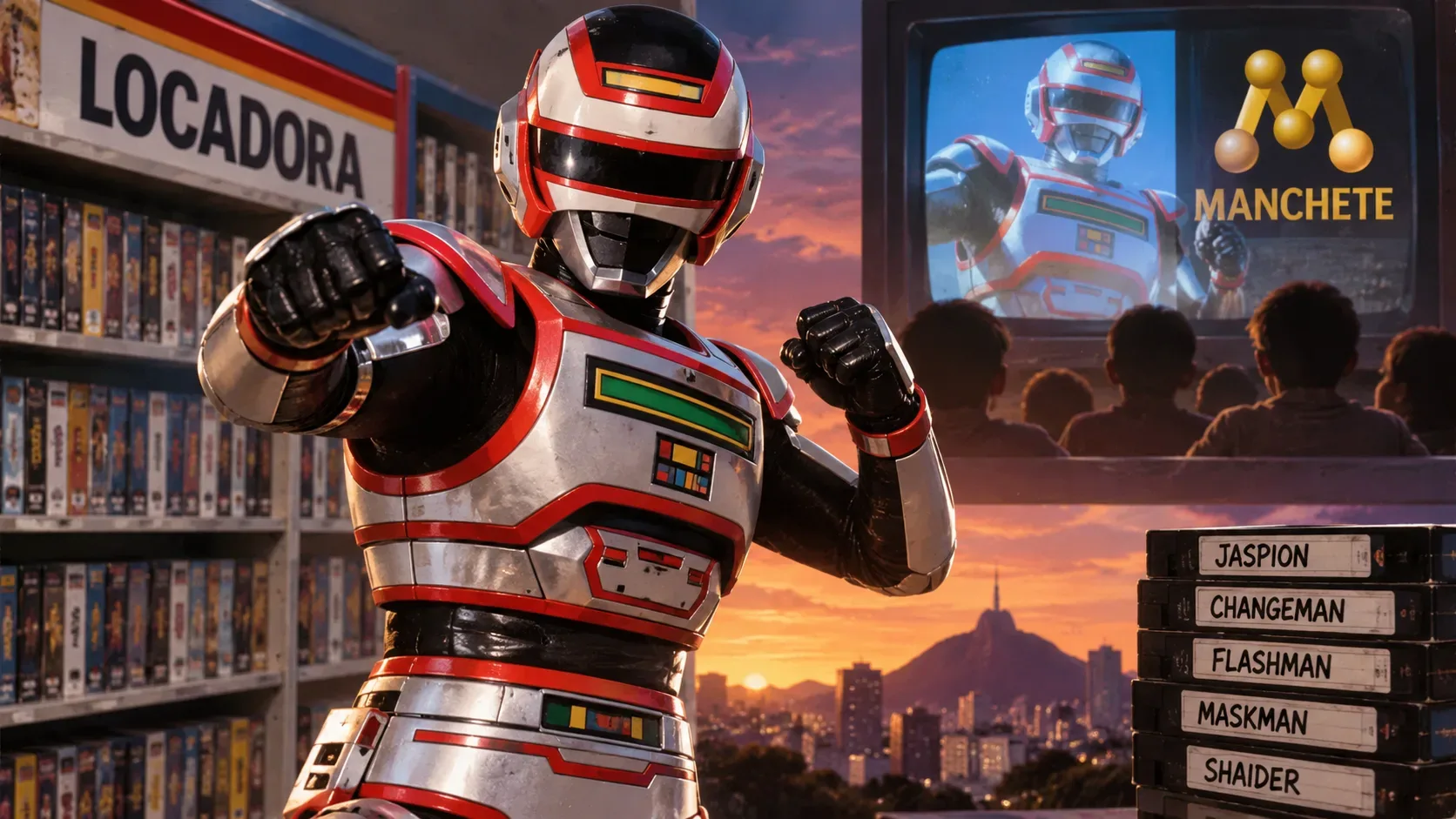
Jaspion became a Brazilian phenomenon not because of one isolated factor, but because an unusual sequence came together at the right time: video circulation before broadcast television, relatively low-risk licensing to a network willing to experiment, daily exposure inside a strong children's program, frequent reruns and, later, a wave of new series, products and live events. The result was larger than the show's original cultural footprint in Japan and turned the character into a local reference point for a generation.
Interest rose again in 2026, when new coverage revisited Hikaru Kurosaki's career and the contrast between Brazilian and Japanese memories of the series. That comparison helps correct a common myth: Jaspion did not have to be a failure in Japan for its Brazilian success to be exceptional. Specialist sources report an average Japanese rating of 11.8%; the important point is that in Brazil the series acquired a cultural weight far beyond what it had in its home market.
The short answer: the phenomenon was a chain of distribution and repetition
The path can be summarized like this:
- video rental and the video circuit: Toshihiko Egashira noticed interest in Japanese programming among Japanese-Brazilian families and also among Brazilian children;
- home video: Jaspion and Changeman circulated on VHS before their broadcast television debut;
- TV licensing: after the response in video, the titles were pitched to broadcasters until they reached Rede Manchete;
- Clube da Criança: the February 22, 1988 premiere placed the heroes in a high-reach daily children's showcase;
- repetition: morning and afternoon slots and reruns multiplied children's contact with the characters, attacks, songs and villains;
- expansion: the success of Jaspion and Changeman opened room for Flashman, Jiraiya, Jiban, Maskman and other tokusatsu, as well as toys, records, tapes, magazines and live shows.
This sequence explains the phenomenon better than attributing it only to the “quality of the show” or to a supposed natural Brazilian preference for Japanese productions.
1. Before Manchete, there was a test in video rental and home video
The story begins with businessman Toshihiko Egashira, who was connected to the video market in São Paulo's Liberdade district. Later accounts and interviews describe a rental operation that handled recordings of Japanese television programs for the Japanese-Brazilian community. Interest from children beyond that audience helped suggest that special-effects heroes could travel outside an ethnic niche.
Egashira acquired rights to Toei productions for the home-video market and built Everest Vídeo. Here it is important to separate the well-supported fact from the exact date: there is documentation of Jaspion on VHS before the February 1988 television debut, but specialist archives disagree on when the first volume reached the market. JBox places the national launch around mid-1987; the Tokusatsu Database, using period advertisements and surviving material, points to signs of a first volume as early as late 1986 and documents multiple releases during 1987.
The safe conclusion is therefore: Jaspion was not born as an instant surprise on Rede Manchete; it had already passed through a video market that worked as a commercial and audience test.
2. Manchete turned niche circulation into mass exposure
Jaspion and Changeman premiered on Rede Manchete on February 22, 1988, inside Clube da Criança, then hosted by Angélica. The date appears consistently in specialist archives and retrospectives about the network. The historical archive dedicated to Manchete records both shows as major children's successes that year and notes that Japanese heroes came to occupy more than one daytime slot.
What television added to what a rental store could not provide was scale and frequency. Renting a tape required a family's initiative; free-to-air television placed the same universe in front of millions of potential viewers, on a recurring schedule and attached to an established children's program. In June 1988, the preserved Manchete schedule shows Clube da Criança occupying the afternoon. In 1989, a newspaper schedule preserved by Brazil's National Newspaper Library lists Flashman at 10:30 a.m., Changeman at 11:00 and Jaspion at 11:30, plus the children's program later in the day.
A schedule cannot prove causation, but it reveals the infrastructure of the phenomenon: Japanese heroes had repeated presence in children's daily routines. That favored familiarity, schoolyard conversation, imitation games and immediate recognition of characters and songs.
3. Jaspion was new in Brazil without needing to be new in Japan
Toei states that Kyojuu Tokusou Juspion aired in Japan from March 1985 to March 1986. The series had 46 episodes and belonged to a line of metallic heroes already familiar to Japanese audiences. The official Toei Video page confirms the broadcast period and the ending at episode 46.
In Brazil in 1988, however, the combination of metallic armor, giant monsters, explosions, martial arts, spacecraft and the robot Daileon was far less familiar in everyday children's television. That created a strong novelty effect. Jaspion was also simple enough for a child to follow individual episodes, while recurring villains and goals rewarded those who watched every day.
That is why the statement “Jaspion failed in Japan and only worked in Brazil” is misleading. Specialist sources such as JBox and a 2026 Superinteressante retrospective cite an average Japanese rating of 11.8%, a respectable result but one that did not translate into the same cultural status the character gained in Brazil. The contrast is about cultural centrality, not simply “success versus failure.”
4. The phenomenon was not Jaspion alone: Changeman premiered with it
Memory often puts Jaspion at the center because its metallic silhouette became a symbol of the period, but the Brazilian launch was a double bet. Jaspion and Changeman premiered on the same day and grew together on Manchete's schedule. The network's 1988 retrospective in the Rede Manchete historical archive treats both as drivers of a Japanese-hero craze that boosted children's programming.
This matters because viewers did not receive only one character; they received a format. Jaspion offered an individual metallic hero, giant monsters and Daileon. Changeman offered the color-coded team dynamics of Super Sentai. When two different formulas worked at the same time, the market got a stronger signal that there was demand for tokusatsu rather than merely for one isolated show.
5. Success became a system: new series, products and live shows
After 1988, Manchete and distributors quickly expanded the supply. JBox records Flashman's debut on the network on March 6, 1989, propelled by the performance of Jaspion and Changeman. Around the same period, other distributors entered the market and programming added titles such as Jiraiya and Lion Man, followed by many other heroes.
The phenomenon also moved beyond the screen. Toys, costumes, soundtracks, tapes, sticker albums, comics and live performances appeared. This commercial circuit does not by itself prove audience size, but it shows that the characters had become recognizable properties. Each new product also advertised the television series, while every rerun helped keep those products valuable and visible.
At this point, “Jaspion became a phenomenon” no longer means only “many people watched it.” The character existed at the same time on television, in video stores, at newsstands, in toy shops and in children's play. Pop culture often forms through exactly this kind of repetition across media.
6. Reruns turned a 1988 hit into generational memory
A 46-episode series can be consumed quickly. To stay present for years, it has to return. Jaspion was rerun by Manchete and later appeared on other Brazilian networks during the 1990s. The archive dedicated to the series records its long presence on Manchete and later runs on Record and CNT/Gazeta.
Reruns have an effect that often disappears from childhood memory: they blend nearby generations of viewers. A child who missed the original premiere could discover the series months or years later; another could rewatch episodes without realizing they were repeats. That helps explain why Jaspion's memory is larger than that of a hit confined to one original season.
This is also an area where fan memory needs caution. Timeslots varied by city and year, affiliates could build different schedules, and episodes were not always shown in a complete uninterrupted sequence. So claims such as “it always aired at the same time” or “everyone watched the premiere” may be plausible personal memories, but they are not automatically documented national facts.
What is documented — and what should be treated cautiously
| Claim | Safer reading |
|---|---|
| Jaspion premiered on Manchete on February 22, 1988. | Well documented. The date appears consistently in historical archives and specialist sources. |
| Jaspion existed on VHS before broadcast television. | Well documented. Advertisements and release records predate the TV premiere. |
| The first VHS came out on one exact date in 1986 or 1987. | Uncertain. Specialist sources disagree on the first volume; the safe point is that home video came first. |
| Jaspion was a failure in Japan. | Misleading wording. Reported average audience is 11.8%; the series had less cultural and commercial impact than in Brazil, but “failure” oversimplifies the evidence. |
| Jaspion alone created the tokusatsu craze. | Exaggeration. Changeman premiered alongside it and was essential to the same cycle of success. |
| Jaspion beat Xuxa or Globo every day. | Not demonstrated as a general rule. Reports of peaks and strong performance exist, but turning snapshots into permanent dominance is memory or simplification. |
Timeline: from video rental to the Japanese-hero boom
- Before 1988: Egashira works in the video circuit and identifies interest in Japanese programming; Jaspion and Changeman enter home video.
- February 22, 1988: Jaspion and Changeman premiere on Rede Manchete inside Clube da Criança.
- 1988: both titles gain repeated scheduling and public attention; related products and initiatives expand their presence beyond television.
- 1989: Flashman and other tokusatsu enter the schedule, consolidating the perception that there is a market for the genre.
- Early 1990s: Manchete remains strongly associated with Japanese heroes as new titles and distributors expand the catalog.
- Mid-1990s onward: reruns on other broadcasters help extend Jaspion's recognition beyond the initial boom.
So why did Jaspion become a phenomenon in Brazil?
Because it arrived through a path that reduced risk before increasing scale. Video showed that an audience existed; licensing brought the series to a broadcaster willing to make room; Clube da Criança provided context and frequency; reruns prolonged exposure; Changeman showed that interest was not limited to one character; and the arrival of new titles turned a bet into a programming category.
This explanation also resolves the apparent paradox between Japan and Brazil. Jaspion did not need to be unknown or unsuccessful in its home country. It only needed to reach Brazil in an environment where its aesthetics felt new, the supply of similar competitors was still small and broadcast television could repeat the content until it became a shared language among children.
Sources for checking the reconstruction
- Toei Video — original broadcast period and final episodes.
- JBox: Jaspion — licensing path, home video, Brazilian premiere and Japanese context.
- JBox interview with Toshihiko Egashira — the recollections of the businessman associated with Everest Vídeo.
- Tokusatsu Database: Jaspion — VHS chronology supported by period advertisements and newspaper clippings.
- Rede Manchete historical archive: 1988 — programming context and the success of Jaspion and Changeman.
- Brazilian National Newspaper Library: May 23, 1989 schedule — primary record of the morning presence of Flashman, Changeman and Jaspion.
- Superinteressante, 2026 — recent retrospective on the difference in impact between Brazil and Japan.