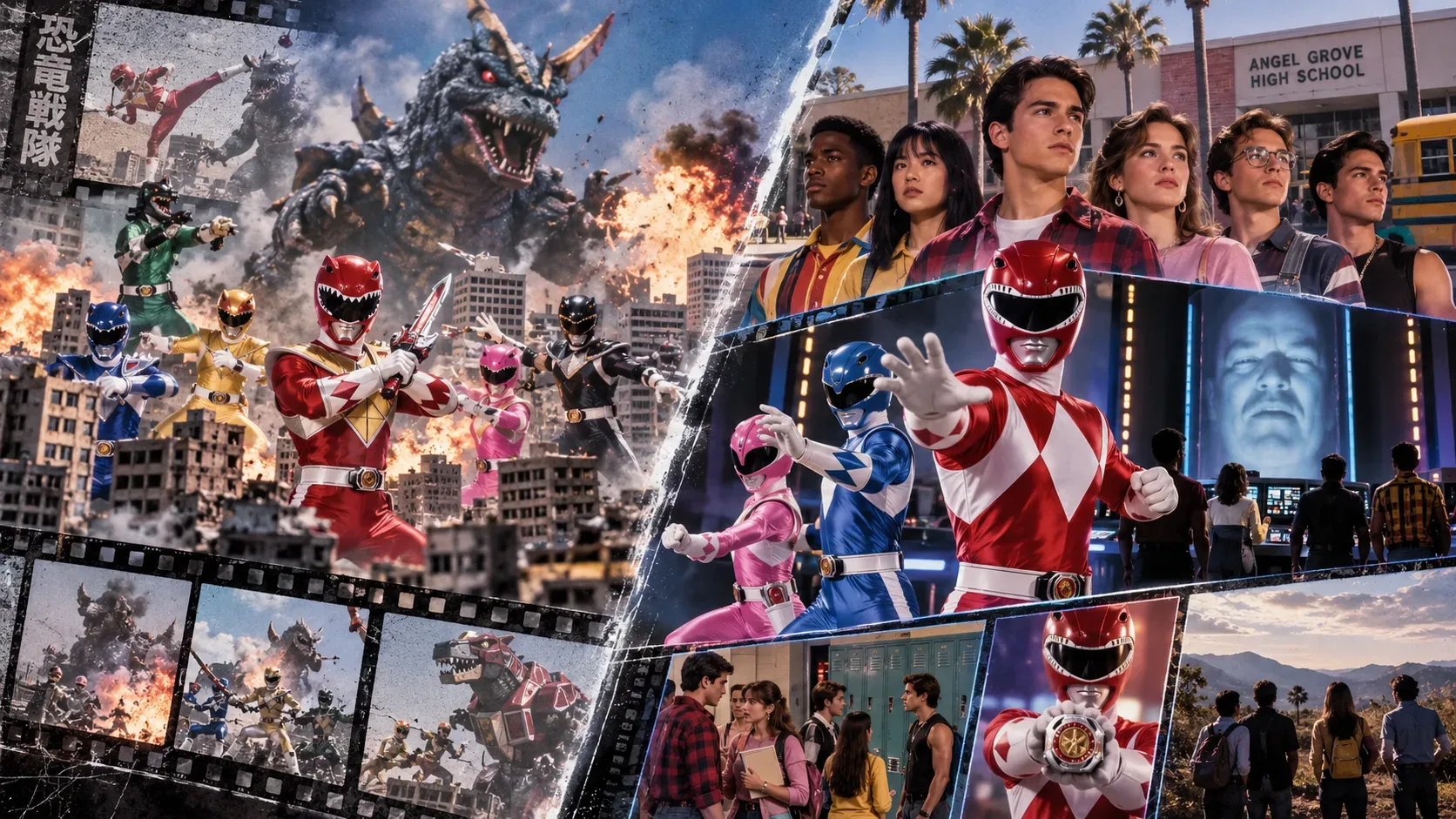
Mighty Morphin Power Rangers was not an English dub of Kyoryu Sentai Zyuranger. Its first season was built as a hybrid production: the American crew filmed the teenagers' lives in Angel Grove and part of the action, while editors incorporated Japanese footage of morphed heroes, monsters, and giant robots. The result looked like one series, even though it combined material made in different countries, with different casts and different story contexts.
That formula answers the central question: scenes with Jason, Trini, Zack, Kimberly, and Billy out of helmet were, as a rule, American production; many fights featuring suited Rangers, monsters, and Zords came from Zyuranger. But the boundary was never absolute. Inserts and fights were shot in the United States, and when the original stock became insufficient, Toei filmed new material in Japan exclusively for Power Rangers.
The first-season production map
| Type of scene | Predominant origin | How Mighty Morphin used it |
|---|---|---|
| Jason, Zack, Trini, Kimberly, and Billy in civilian clothes | United States | Dialogue, episode conflicts, friendship, school, the Youth Center, and the emotional connection with the American audience. |
| Angel Grove, the school, the Youth Center, Bulk and Skull | United States | A narrative world created for the adaptation rather than a continuation of Zyuranger's original story. |
| Zordon, Alpha 5, and much of the Command Center material | United States | Mission exposition, Ranger call-ups, and story bridges between action blocks. |
| Morphed Rangers in many early fights | Japan, with American additions | Zyuranger scenes were re-edited, redubbed, and rearranged; the U.S. unit also shot inserts and original action. |
| Rita and many of her allies and monsters | Largely Japan | Zyuranger characters were renamed, redubbed, and placed inside a new continuity. |
| Dinozords, Megazord, and early giant battles | Japan | Miniatures, suitmation, and mecha footage from Zyuranger formed the backbone of giant-scale sequences. |
| Extra Japanese footage made only for Power Rangers | Japan, commissioned for the adaptation | New fights and monsters expanded the library when the American episode order outgrew the material originally planned. |
A contemporary Los Angeles Times report from November 1993 described the method directly: scenes featuring Rita, monsters, helmeted Rangers, and robotic dinosaurs came from the Japanese program, while new effects and live-action scenes with the Rangers out of helmet were filmed around that footage. Thirty years later, the paper revisited the series and reported that the American crew filmed live-action blocks specifically to bridge the licensed Japanese material.
What Mighty Morphin reused from Zyuranger
Kyoryu Sentai Zyuranger aired in Japan from February 1992 to February 1993 and ran for 50 episodes, according to Toei Video. It supplied not only finished shots but much of the visual identity audiences came to associate with the original Power Rangers.
Ranger suits and visual language
The prehistoric-creature-themed uniforms, helmets, weapons, and poses came from Sentai. That made it possible to cut from an American actor about to morph to a Japanese stunt performer already in costume, as long as the edit hid the change of country and performer. The helmet was especially useful because it erased the face and made the character visually transferable between productions.
The Yellow Ranger makes this separation particularly clear. In Zyuranger, TigerRanger/Boi is a male character, as listed on Toei's own historical page; in Mighty Morphin, Trini is an American teenage girl. Once the helmet was on, the action footage could still be reused even though the characters had different identities.
Villains and monsters
Rita Repulsa emerged from the reuse of Witch Bandora, played by Machiko Soga. Instead of translating the Japanese plot, the American production rewrote the context and laid a new voice over the images. The same principle applied to many monsters: their design and action could come from Japan, while the episode's motive, jokes, threats, and consequences were defined by the American script.
Zords and giant battles
The material that would have been hardest and most expensive to reproduce every week—giant monsters, city miniatures, robots, and explosions—was where the Japanese library offered the greatest value. Zyuranger's Guardian Beasts were renamed Dinozords; Daizyujin became the Megazord; Dragon Caesar became the Dragonzord. The American edit changed names, voices, music, and story context, but reused choreography and practical-effects footage shot by Toei.
What was filmed in the United States
The American material was not merely filler between fights. It created Mighty Morphin's distinct identity. Angel Grove, the school, the Youth Center, the relationships among the five leads, everyday problems, and characters such as Bulk and Skull belonged to the U.S. continuity.
Segments featuring Zordon and Alpha 5 also provided the weekly mission structure and explained why these teenagers had to spring into action. The Television Academy Interviews archive preserves accounts from Haim Saban and Margaret Loesch about the show's development and the partnership that turned the Japanese concept into a Fox Kids series.
And not every helmeted fight should automatically be classified as Japanese. The U.S. production had suits, stunt performers, and a second unit. As the series progressed, that team shot more original material to connect shots, solve continuity problems, and create fights that the existing library could not provide. Identifying the origin of a specific shot therefore requires episode-level analysis rather than simply checking whether the Ranger is morphed.
“Day of the Dumpster” already shows the adaptation machinery
The first episode, broadcast in the United States on August 28, 1993, is a compact demonstration of the method. The introduction of the five teenagers, their Angel Grove dynamics, and the path into the mission are structured around the American cast and footage. Once the story moves into monsters, morphed Rangers, and Zord combat, the edit incorporates Japanese material.
That is why the episode can jump from the look of a California youth series to lighting, framing, and choreography associated with Japanese tokusatsu without ever acknowledging, inside the story, that the production source has changed. The viewer was meant to accept it all as one world.
How editing made two productions look like one series
The adaptation relied less on literal translation than on editing engineering. The American script had to reach a point where the available Japanese action would make narrative sense; afterward, reaction shots and dialogue guided the episode back to the U.S. cast.
- Redubbing: Japanese villains could say something entirely different in the American version.
- Recontextualization: a monster created for one Zyuranger story could receive a new origin or goal in Angel Grove.
- Bridge shots: American inserts of communicators, morphers, reactions, or strikes helped conceal jumps between sources.
- Sound and music: a new score, sound effects, and voices created continuity even when the image came from different productions.
- Shot selection: footage that revealed too much of the Japanese setting or the original actors' faces could be avoided, shortened, or reinterpreted.
The Los Angeles Times' 30th-anniversary retrospective describes a block-based production pace in which U.S. scenes were filmed specifically to link licensed footage. That workflow is the key to understanding why Power Rangers was not simply “Sentai with American actors,” but a new story built on top of a Japanese visual library.
Zyu2: when “filmed in Japan” does not mean “taken from Zyuranger”
Mighty Morphin's success complicated the formula. The American order expanded, and the volume of episodes demanded more action than the originally prepared library could provide. As early as 1993, the Los Angeles Times reported that new monster footage was being shot in Japan for future episodes.
Fans came to call this material “Zyu2”. The term is not the title of a Japanese season and should not be mistaken for extra episodes of Zyuranger. It is a fandom label for footage filmed in Japan exclusively for use in Power Rangers after the original Japanese series. The specialist GrnRngr archive documents that library and emphasizes its exclusive production purpose.
This detail breaks down a simplistic split between “Japanese scene = Zyuranger” and “American scene = original.” Some footage that looks like Sentai really was made in Japan, using Zyuranger-style suits and production language, but it was already being created for the needs of the American series.
Why there is no fixed percentage of Japanese footage
It is tempting to ask “what percentage of Power Rangers was Japanese?”, but a single percentage would be misleading. The weight of source footage varied by episode and scene type. An episode with a long Zord battle could depend heavily on Toei material; another centered on school and character drama could contain far more U.S.-shot footage.
The balance also changed over the franchise's history. Early Mighty Morphin leaned heavily on Zyuranger; later, production had to combine material from new Super Sentai seasons, preserve visual elements unique to Power Rangers, and expand original shooting. The model remained hybrid, but the recipe was never constant.
How to spot a scene's origin on a rewatch
A few clues can help, although none is foolproof:
- teenagers talking around Angel Grove almost always points to American footage;
- early giant battles using city miniatures and the Megazord usually point to Japanese production;
- sudden changes in grain, lighting, vegetation, or framing can reveal the seam;
- helmeted Rangers do not guarantee Japanese origin because the U.S. unit also shot suited action;
- villain footage may be Japanese, American, or Japanese footage created specifically for the U.S. version.
For a serious breakdown, the best method is episode-by-episode comparison while remembering that the adaptation operated through production blocks, not a no-exceptions rule such as “civilian = U.S., helmet = Japan.”
In short
Mighty Morphin Power Rangers reused from Zyuranger mainly the heroes' visual identity, many morphed fights, villains, monsters, Zords, and giant battles. The United States filmed the teenagers, Angel Grove, school life, the Youth Center, original supporting characters, Zordon and Alpha segments, and a varying amount of inserts and original action.
The achievement—and the visual oddness that becomes obvious on a modern rewatch—lies in the stitching. The American series did not merely import a Japanese program: it took Zyuranger apart into reusable pieces, recombined those pieces with a new production, and, when necessary, commissioned even more Japanese footage to sustain its own continuity.