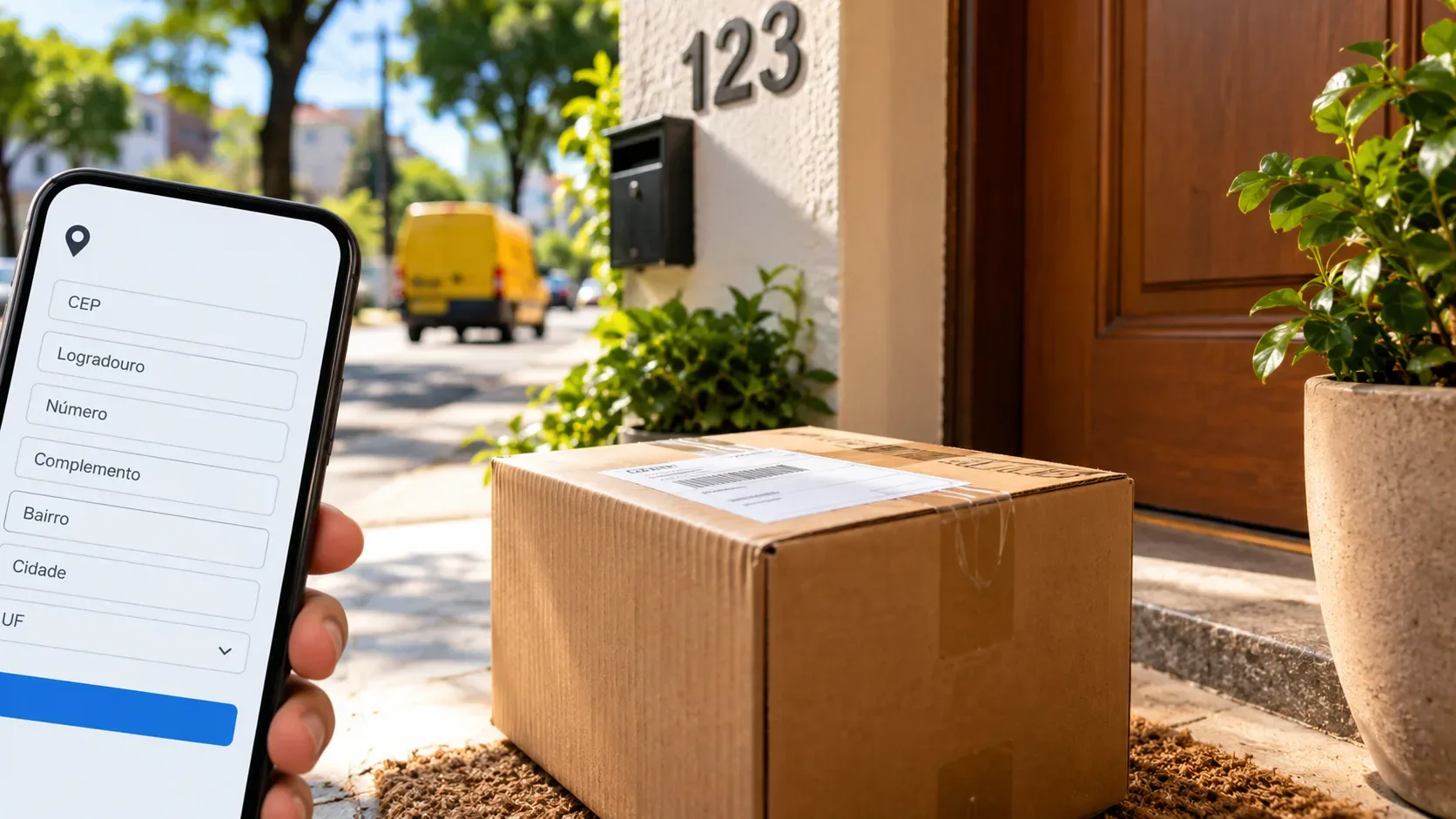
A Brazilian address becomes much easier to understand when you treat it as a set of fields rather than one long sentence. For deliveries, registrations, and online forms, the key elements are CEP, street address, number, complemento, bairro, city, and state (UF). Brazil's postal service, Correios, separates these components in its addressing tools, and its official guide organizes an address with the street and number, an address complement when applicable, neighborhood, CEP, locality, and state abbreviation.
Example of a Brazilian address
An address structure based on the Correios guide looks like this:
João da Silva
Avenida Paulista, 123, Loja B
Paraíso
01311-000 São Paulo - SP
In a form, the same address can be split as follows:
| Field | Example | What it means |
|---|---|---|
| CEP | 01311-000 | Brazilian postal code. |
| Logradouro | Avenida Paulista | Official street or thoroughfare type and name. |
| Número | 123 | Number identifying the property. |
| Complemento | Loja B | Additional information identifying a unit within the property. |
| Bairro | Paraíso | Neighborhood, district, or local subdivision used in the address. |
| Cidade | São Paulo | City/municipality or locality. |
| UF | SP | Two-letter abbreviation for the Brazilian state or Federal District. |
CEP: Brazil's eight-digit postal code
CEP stands for Código de Endereçamento Postal, or Postal Addressing Code. According to Correios, it contains eight digits and is used to help route, process, and deliver mail and parcels. The usual visual format is 00000-000, as in 01311-000.
When a website asks for a ZIP code or postal code for an address in Brazil, that field normally corresponds to the CEP. If you are unsure which code is correct, use the official Correios CEP search and check whether the street, neighborhood, and city match the intended address.
Logradouro: street, avenue, road, and other thoroughfare types
Logradouro identifies the street, thoroughfare, or named locality. It usually includes the type and official name: Rua das Flores, Avenida Paulista, Travessa X, Rodovia Y, Praça Z, and so on. The Correios guide lists many types of logradouro and recommends using the official name assigned by the municipality.
On foreign forms, this information usually belongs in fields such as street, street name, or address line 1. If the form has a separate field for the building or house number, keep the number out of the logradouro field.
Número: the property number
The número indicates which property on the street should receive the delivery. If the form has a specific “number” or “house number” field, enter only that part there.
Some properties genuinely have no number. In those cases, Correios recommends the abbreviation s/n, meaning sem número (“without number”). Do not use s/n merely because you do not know the number: first confirm the address with the resident, business, venue, or an official source.
Complemento: apartment, block, suite, shop, or unit
The complemento adds the information needed to identify a unit within a property or to make the destination more specific. Common examples include “Apto 72” (Apartment 72), “Bloco C” (Block C), “Sala 504” (Suite/Room 504), “Casa 2” (House 2), “Loja B” (Shop B), or combinations of these.
The Correios guide treats the complement as an element used when applicable. Therefore, if the address has no apartment, block, suite, shop, or other extra identifier, the field can be left blank when the form allows it. If a service makes the field mandatory, follow that service's instructions rather than inventing a complement.
Bairro: the subdivision within the city
Bairro is a neighborhood or local subdivision of a municipality. In English, neighborhood is usually the clearest equivalent, although some systems use district. It does not replace the city and should not be entered in the state field.
The Federal District has a specific operational convention noted by Correios: Brasília is treated as the municipality, while administrative regions may appear in the bairro position depending on the territorial organization. For addresses in the Federal District, copy the form returned by the Correios CEP search or the version supplied by the recipient.
City and UF: municipality and state
The city field corresponds to the locality or municipality. UF stands for Unidade da Federação, the Brazilian federative unit, and is normally written as a two-letter abbreviation such as SP, RJ, MG, BA, PE, PR, RS, or DF.
On international forms, “city” maps to cidade, while “state,” “province,” or “state/province” usually maps to UF. If the form provides a drop-down menu, choose the matching state abbreviation or state name.
How to fill out a Brazilian address form, step by step
- Start with the CEP. Many systems use it to suggest the street, bairro, city, and UF.
- Check the suggested street. Autofill is useful, but you should still verify the address.
- Enter the property number. This is generally not determined by the CEP.
- Add the complemento only when needed. Apartment, block, suite, or shop are typical examples.
- Check bairro, city, and UF. They should all belong to the same address.
- Review before submitting. A correct CEP with the wrong number or complement can still point the delivery to the wrong unit.
How to map the fields on non-Brazilian forms
| Field on a foreign form | Brazilian equivalent |
|---|---|
| ZIP code / Postal code | CEP |
| Street / Street name | Logradouro |
| House number / Number | Número |
| Address line 2 / Apartment / Suite / Unit | Complemento |
| Neighborhood / District | Bairro |
| City | Cidade |
| State / Province / Region | UF |
If a form only provides “Address line 1” and “Address line 2,” a practical approach is to put logradouro + number on the first line and the complemento on the second. Bairro, city, state, and CEP should go in their own fields when those fields exist. There is no single universal form layout, so preserve the information and adapt it to each field label.
Common mistakes that create confusion
- Putting the bairro in the city field.
- Putting the state name in the bairro or city field.
- Combining number and complemento when the form provides separate fields.
- Inventing a complemento just to fill an optional field.
- Using a CEP without checking that it matches the street and locality.
- Translating the official street name: words such as “Rua” and “Avenida,” plus the proper name, can remain as part of the official address.
Quick checklist before confirming an address
- Does the CEP have eight digits and match the address?
- Is the logradouro written according to the official address?
- Is the property number correct, or is the property genuinely s/n?
- Does the complemento identify the apartment, block, suite, or unit when needed?
- Is the bairro in the neighborhood/district field?
- Do the city and UF belong to the same address?
To check the official structure, see the Correios Addressing Guide. To search for or validate a CEP, use the Correios CEP search. The practical rule is simple: preserve each component of the Brazilian address and place it in the equivalent field without mixing bairro, city, UF, number, and complemento.