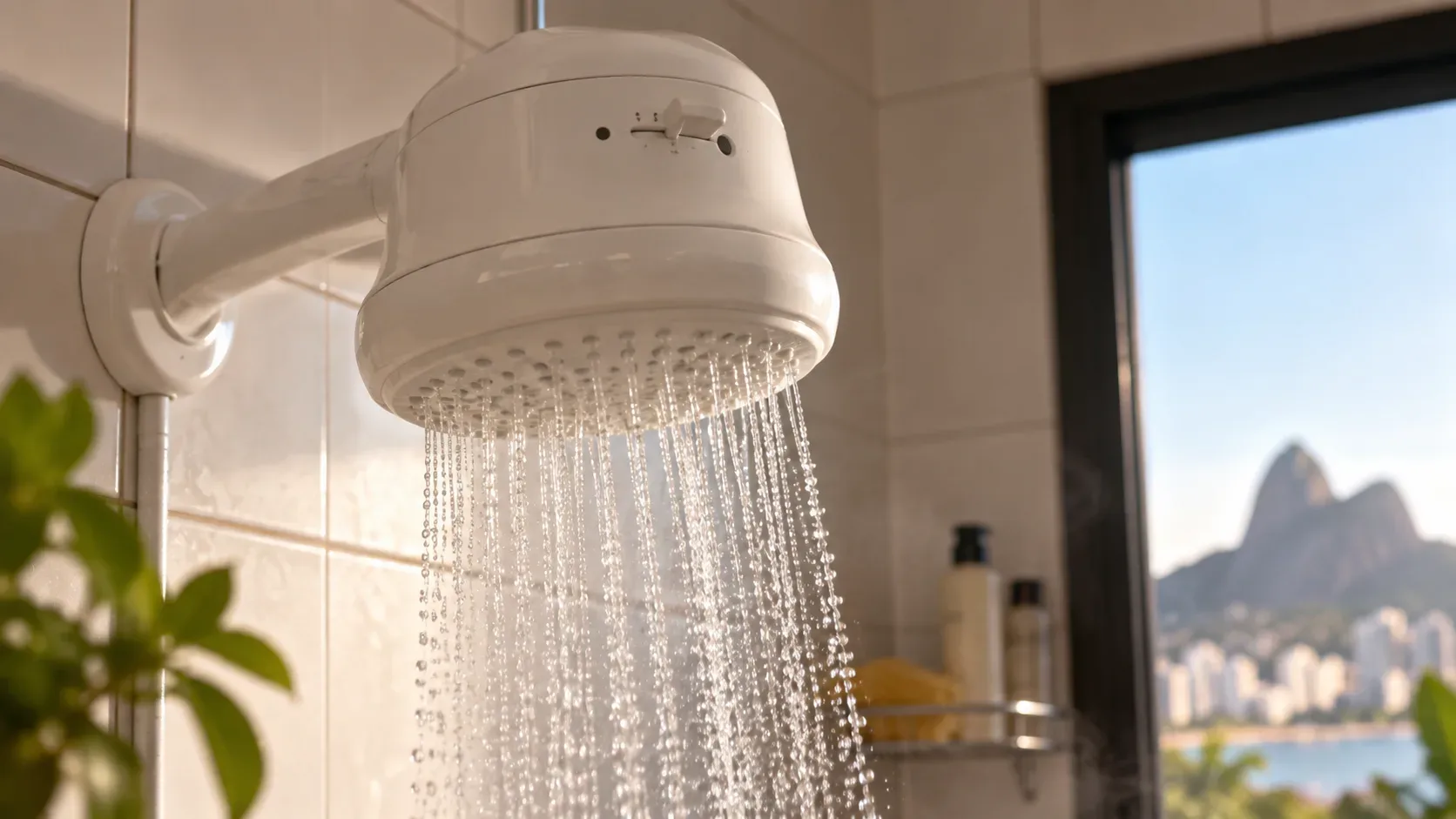

The short answer is: heat and sweat help explain it, but they do not explain everything. In Brazil, a shower often serves several purposes at once: hygiene, cooling down, marking a transition between parts of the day, and getting ready to be around other people. That is why a second shower after work, the gym, a hot commute or before going out at night can feel completely ordinary to many people.
That does not mean “every Brazilian showers two or three times a day.” Brazil is a continental country with very different climates, unequal access to water and widely varying household routines. The most accurate way to understand the habit is as a strong cultural norm that is not uniform.
Do Brazilians really shower more often?
There are good indications that shower frequency is high. A 2026 international comparison from World Population Review lists Brazil at 14 showers per week, or about two a day. That number should not be treated as an individual rule or a census of behavior, but it is consistent with earlier Brazilian data: during the 2014–2015 water crisis, Kantar Worldpanel reported an average of 13.8 showers per week after a reduction from the previous period.
Smaller studies also show meaningful variation. In a recent study of university students in Brazil, 66% reported one shower per day and 32% reported two. That result is useful precisely because it shows that even within one local group there is no single frequency. In another clinical sample of children and adolescents, roughly half bathed once a day and almost half bathed twice or more.
So “Brazilians shower a lot” is a generalization with a real basis, as long as it comes with two caveats: an average does not describe every person, and frequency changes with climate, season, activity and access to water.
Climate matters — especially when the day leaves you hot and sticky
Brazil includes everything from hot equatorial and tropical areas to places with cold winters in the South and at higher elevations. The Brazilian National Institute of Meteorology (INMET) climate normals illustrate this diversity by tracking temperature, humidity, rainfall and other parameters at weather stations across the country.
Even so, a large share of the population lives in places where heat, sun and humidity make sweat and sticky skin a frequent part of daily life. On those days, showering is not just the “required” morning or evening wash. It can be a quick way to restore physical comfort after walking to a bus stop, using crowded public transport, cycling, exercising, working outside or simply crossing a hot city in the afternoon.
The Brazilian Society of Dermatology itself says that the number of showers a person takes should take environmental factors such as temperature, humidity and climate into account, along with activity and access to water. Climate is therefore an important explanation, but professional guidance also recognizes context and variation.
A shower can act as a reset between activities
For many foreigners, one daily shower is organized mainly around the clock: after waking up or before bed. In Brazil, showers are often organized around what happened between those times as well.
| Situation | Why an extra shower may feel natural |
|---|---|
| After commuting | Heat, sweat, pollution, walking and crowded transport can make people want to cool down when they arrive. |
| After exercise | The shower marks the end of the workout and the shift to work, study or social life. |
| Before going out | In some circles, showering before a date, party, dinner or visit is part of “getting ready.” |
| After getting home | Some people like to change out of street clothes and shower before relaxing. |
| Before bed | In warm regions, it can reduce the feeling of heat and sweat accumulated late in the day. |
None of these situations is a national obligation. They do help explain why asking whether someone has showered can mean more than checking off a once-a-day hygiene task. A shower can be a small transition ritual.
The part foreigners may miss: hygiene can also be etiquette
There is an important social dimension. The University of São Paulo, in a Brazilian culture guide for international visitors, notes that daily showering — and sometimes more than once, depending on the heat — is a recognizable everyday habit. Orientation materials for international students at other Brazilian universities make similar observations.
This connects to broader expectations about personal presentation. In many social and professional settings, noticeable sweat odor may be interpreted not only as a consequence of the weather but as a sign that someone has not taken enough care before joining others. An Ipsos cultural report has also described cleanliness as highly valued in Brazil and bad odor as a potential source of embarrassment.
For someone from a place where changing clothes, reapplying deodorant and continuing the day without another shower is normal, the difference can be subtle. In Brazil, a person may do all of those things and still see a shower as the most complete way to feel ready to meet other people.
That does not justify judging foreigners — or Brazilians — who follow a different routine. It is more useful to see this as a social expectation that varies by family, city, age, occupation and social circle.
“Taking a shower” does not always mean taking a long one
A common misunderstanding is to imagine that two showers a day means two long, hot sessions. Many extra showers are short and functional: water, cleaning the areas that accumulated sweat, and a change of clothes.
The Brazilian Society of Dermatology recommends short showers of about five to ten minutes, using cool or lukewarm rather than very hot water. It also advises against excessive cleansing products and scrubbing, and recommends moisturizer when appropriate. That is particularly relevant for people who shower more than once in the same day.
In other words, frequency and intensity are not the same thing. One person may take two quick, gentle showers; another may take a single long, very hot shower. For both skin and water use, the distinction matters.
There is no single “Brazilian way” to shower
Turning the habit into a stereotype erases the differences that make it easier to understand. Several factors can change the routine considerably:
- Region and season: a humid coastal summer does not create the same routine as a cold winter in the southern highlands.
- Work and commuting: someone working from home in air conditioning has a different day from someone spending hours on public transport or doing outdoor work.
- Age and skin: children, older adults and people with sensitive skin may need different routines.
- Water access and infrastructure: frequency depends on supply, housing and cost, not only cultural preference.
- Family and personal habit: some households normalize a shower after waking and another before bed; others concentrate the routine at one time of day.
The available evidence reinforces this variation. A national or international average is useful for seeing a broad pattern, but it should not become a rigid expectation about any Brazilian you meet.
If you are visiting or living in Brazil, what changes in practice?
You do not need to imitate a shower count. It is more useful to pay attention to the combination of climate, sweat, activity and social context.
- After a hot day, a long walk or a workout, showering before meeting people may be the most comfortable option.
- If someone says they are going to “take a shower and get ready” before going out, that can be a normal part of preparation even if they already showered in the morning.
- In shared accommodation, remember that water and energy have a cost: frequent showering does not make long showers necessary.
- If your skin becomes dry, favor cool or lukewarm water, reduce shower time and excess soap, and consider moisturizing, in line with dermatology guidance.
- Avoid turning hygiene into a moral comparison between countries. What looks like “too much” or “too little” usually reflects a mix of climate, infrastructure, custom and social expectation.
So why so many showers?
Because for many people in Brazil, a shower solves several problems at once: it removes sweat and pollution, cools the body, marks the end of a commute or workout, helps “reset” before the next activity, and can be part of the personal presentation expected in certain settings.
Heat creates the need; daily routines create the occasions; culture gives the act social meaning. That combination — rather than a supposed national obsession with cleanliness — is why showering may appear more often in a Brazilian day than a visitor expects.