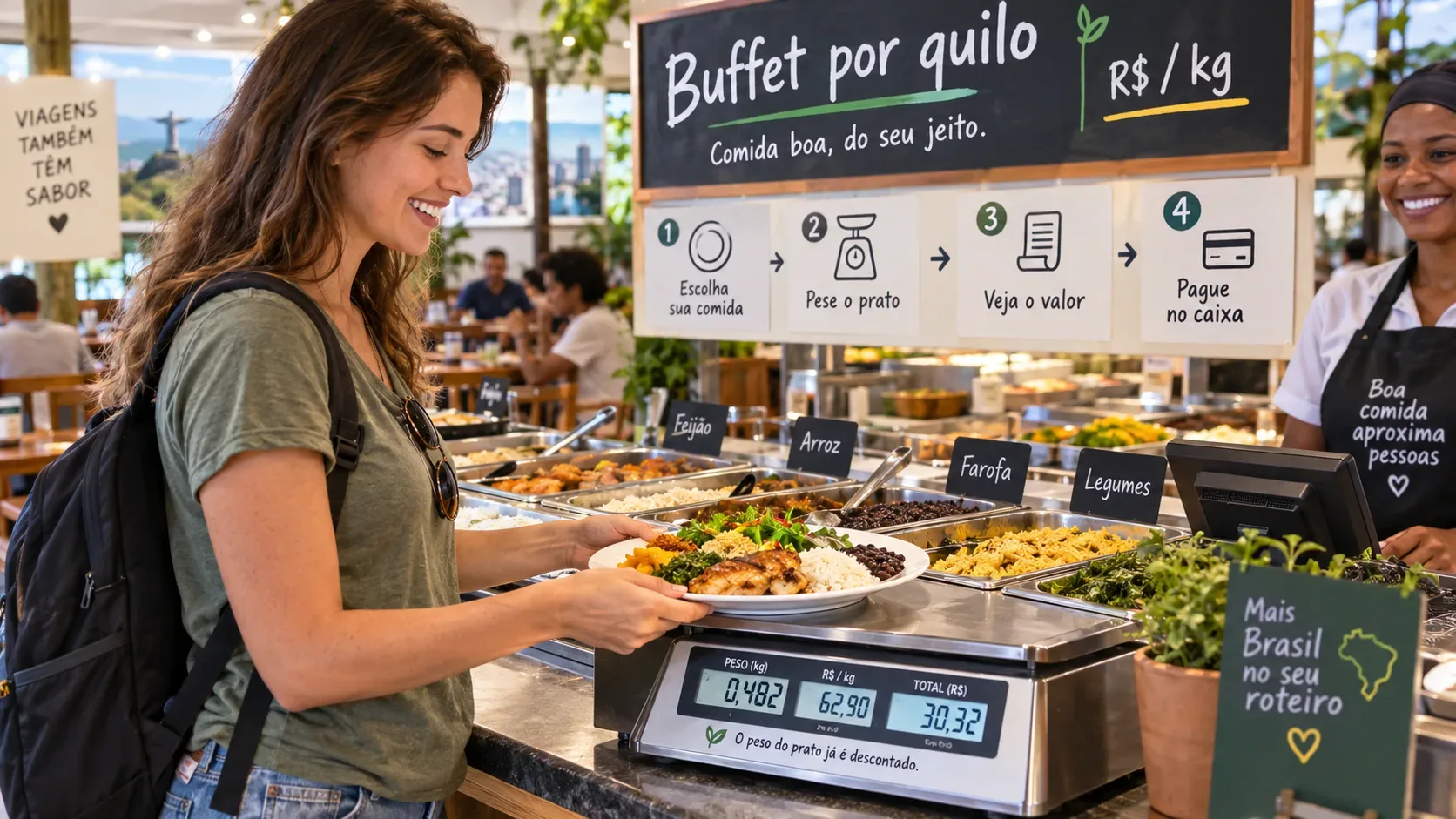
In Brazil, a pay-by-weight restaurant — commonly called a restaurante por quilo — is a self-service buffet where you build your plate and pay according to the weight of the food. For first-time visitors, the key points are simple: check the price per kilogram, go to the scale before sitting down, and make sure the plate’s weight — the tare — is deducted.
What a pay-by-weight restaurant is
Instead of ordering a fixed-price dish from a menu, you take a plate, serve only what you want from the buffet, and bring it to the scale. The price is calculated from the net weight of the food and the posted price per kilogram.
The exact flow varies by restaurant. Some print a ticket after weighing; others record the amount on a check, card, or cashier system. The common point is that the weighing process should allow the customer to see the weight and the calculated price.
Step by step: from the plate to payment
- Check whether the buffet is pay-by-weight. Look for “por quilo”, “quilo”, “kg”, or ask “É por quilo ou preço fixo?” — “Is it by weight or a fixed price?”
- Check the price per kilogram. Procon-SP states that pay-by-weight restaurants should not show only an equivalent price per 100 g; the kilogram price must be clear.
- Take the restaurant’s plate or container. If different sizes or containers are available, they may have different tare weights.
- Serve yourself at the buffet. Put on the plate only what you plan to eat; the final price depends on weight.
- Bring the plate to the scale. In many restaurants this happens before you go to the table. The display should let you check the weighing and the calculated amount.
- Keep the ticket or check, if there is one. Some places charge immediately; others add the meal to your account and collect payment when you leave.
- Pay at the cashier. If anything about the weighing is unclear, ask before completing payment.
How the price is calculated
The basic formula is: net food weight × price per kilogram = meal price. In a hypothetical example, if the price is R$69.90 per kg and the food weighs 0.450 kg, the total is about R$31.46.
The important number is the net weight: the empty plate should not be treated as food you are paying for.
Tare weight: why the plate must be deducted
“Tare” is the weight of the empty container used for weighing. In a pay-by-weight restaurant, that usually means the plate, bowl, or other container supplied by the restaurant.
According to Inmetro, food sold by weight for immediate consumption is regulated by Inmetro Ordinance No. 563/2023. The scale must display the net weight of the food, the price per unit of weight, and the amount to pay. The establishment must also display the tare weights of the containers in a place that is easy for customers to see.
In practical terms, the amount charged should reflect the food, not the weight of the plate. If the restaurant uses more than one type of container, pay attention to the tare that corresponds to yours.
What to look for on the scale
- the price per kilogram;
- the net food weight shown;
- the calculated total;
- the container’s tare information displayed in a visible place;
- the scale’s verification label, which Inmetro says must be current.
Procon-SP also notes that pay-by-weight restaurants must provide tare information and that the information presented to consumers must match what appears on the scale.
Pay-by-weight, all-you-can-eat, or fixed price?
| Model | How it works | What to check |
|---|---|---|
| Pay-by-weight | You pay according to the weight of the food. | Price per kg, tare, net weight, and total. |
| All-you-can-eat / fixed-price buffet | You pay a set buffet price regardless of weight, subject to the restaurant’s rules. | Fixed price and what is included. |
| Prato feito / executive meal | The restaurant serves a set meal at a defined price. | Included items, portion size, and price. |
If the signs are not clear, ask which pricing model applies before serving yourself.
Useful vocabulary for tourists
| Portuguese | Meaning | Useful phrase |
|---|---|---|
| por quilo / por kg | charged by weight | “É por quilo?” — “Is it by weight?” |
| balança | scale | “Onde fica a balança?” — “Where is the scale?” |
| tara | empty-container weight | “A tara do prato já está descontada?” — “Has the plate’s tare already been deducted?” |
| peso líquido | net food weight | “Esse é o peso líquido?” — “Is this the net weight?” |
| comanda / ficha | meal check or consumption record | “Preciso guardar esta comanda?” — “Do I need to keep this check?” |
| caixa | cashier / checkout | “Onde eu pago?” — “Where do I pay?” |
How to check the weighing without feeling awkward
Asking about tare or the scale is a straightforward consumer question. You can use short, neutral phrases:
- “A tara do prato já está descontada?” — “Has the plate’s tare already been deducted?”
- “Esse peso é só da comida?” — “Is this weight only the food?”
- “Qual é o preço do quilo?” — “What is the price per kilogram?”
- “Posso conferir o valor na balança?” — “Can I check the amount on the scale?”
If the restaurant uses different plate sizes, confirm that the scale is set for the container you chose. You do not need to debate the technical rule; simply ask the staff member to explain the weighing.
If the amount looks wrong
- Check whether the posted price is per kilogram and whether it matches the price used by the scale.
- Look for the container’s tare information.
- Ask the staff member to explain or repeat the weighing if there appears to be a discrepancy.
- If the issue remains unresolved, keep the receipt and seek guidance from the appropriate consumer-protection agency.
Quick checklist before you sit down
- Is it pay-by-weight or a fixed price?
- What is the price per kg?
- Is the plate’s tare displayed and deducted?
- Does the display show net weight and total price?
- Do I need to keep a ticket, card, or check?
- Do I pay now or when I leave?
For a traveler, understanding these six points removes most of the uncertainty around a Brazilian pay-by-weight restaurant. The process is straightforward: build your plate, weigh the food, check the amount, and pay according to the restaurant’s procedure.