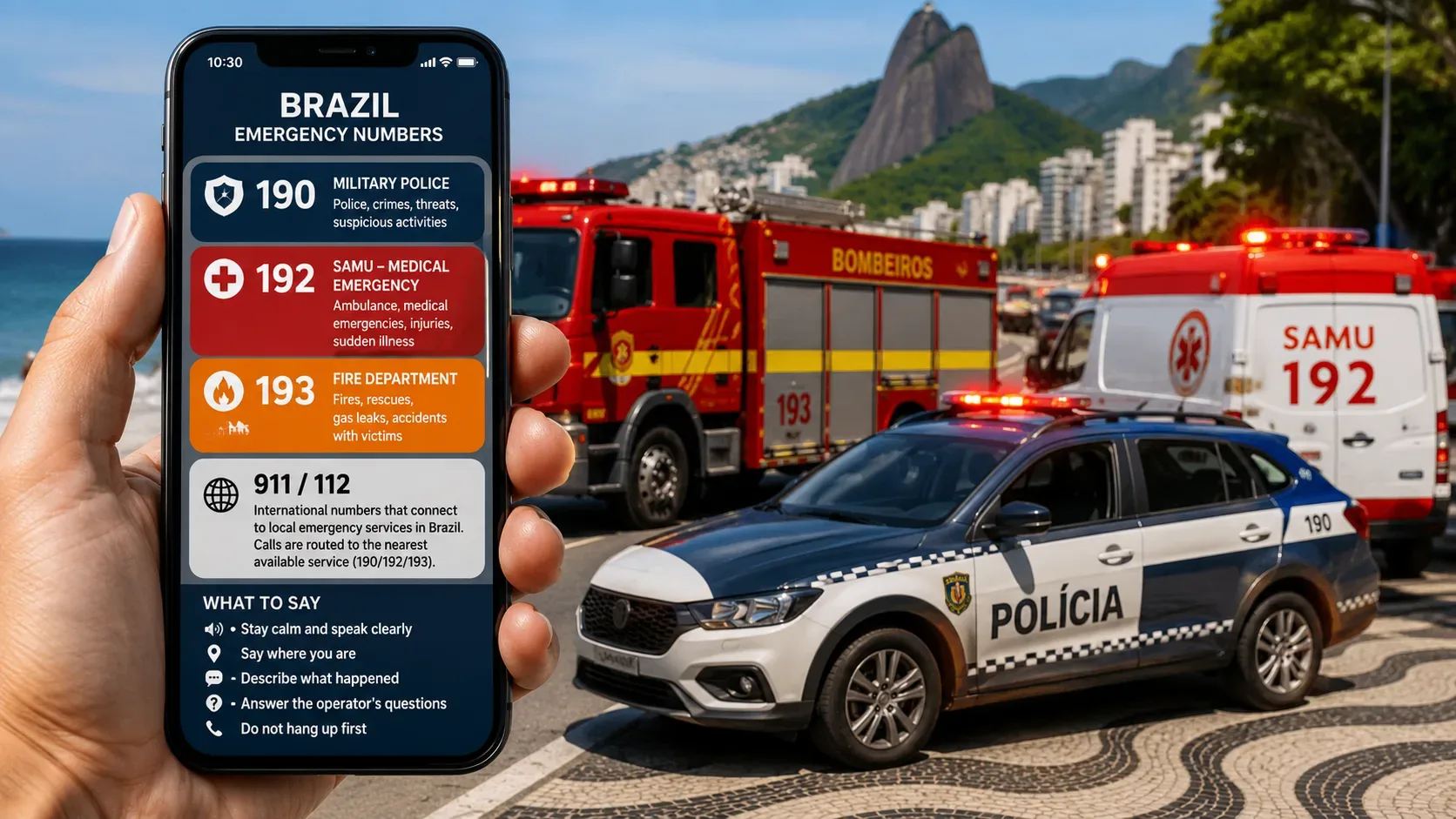
Quick answer: in Brazil, the three numbers a visitor should memorize are 190 for police emergencies, 192 for medical emergencies (SAMU), and 193 for fires, rescue, and lifesaving response (Fire Department). Calls to public emergency services are free. Calls to 911 or 112 from mobile phones may be redirected when technically feasible, but they are not the numbers you should plan to rely on during a trip: use 190, 192, or 193 directly for the situation at hand.
| Main situation | Number | Agency | What to say first |
|---|---|---|---|
| Crime in progress, threat, violence, or an immediate safety risk | 190 | Military Police (Polícia Militar) | City and exact address/location, what is happening, immediate danger, and descriptions of people or vehicles involved |
| Serious medical problem, unconscious person, sudden severe pain, breathing difficulty, suspected heart attack/stroke, or injury with a victim | 192 | SAMU medical emergency service | Location, number of patients, symptoms/condition, and a callback phone number |
| Fire, smoke, rescue, trapped person, drowning, collapse, hazardous leak, or an accident requiring extraction | 193 | Fire Department (Corpo de Bombeiros) | Location, type of incident, number of people involved, victims, and hazards present |
| You dialed 911 or 112 on a mobile phone | 911 / 112 | Redirect to a Brazilian emergency service when technically feasible | Treat it as a fallback; if possible, dial 190, 192, or 193 directly |
190, 192, or 193: choose by the main immediate risk
190 — Military Police
Use 190 when the priority is immediate police intervention: a crime happening now or that has just happened, a threat to someone's physical safety, violence, suspicious activity involving a concrete risk, or another serious situation requiring a rapid police response. Official guidance from Paraná's Military Police describes 190 as the number for an “immediate need or rapid assistance” and stresses the value of details such as the full address and descriptions of the people involved. The number is free and is a national police-emergency code. Official guidance: Paraná Military Police — emergency 190.
Do not use 190 simply for general information or to report a non-urgent event from long ago. In a real emergency, however, do not waste time trying to classify the incident perfectly: explain what is happening and what the immediate danger is.
192 — SAMU for medical emergencies
192 connects you to SAMU, Brazil's Mobile Emergency Care Service. The Ministry of Health says the service operates 24 hours a day, seven days a week, is free, and handles clinical, traumatic, pediatric, surgical, obstetric, mental-health, and other emergencies. Official examples include cardiorespiratory problems, suspected heart attack or stroke, seizures, severe burns, poisoning, electric shock, drowning, and accidents with injured people. See: Brazilian Ministry of Health — SAMU 192.
The phone call is part of the medical response. The call center collects initial information about the patient and location; a medical regulator can then provide first-aid instructions and decide whether an ambulance should be dispatched. Answer the questions even if they seem detailed. They help the service assess urgency and choose an appropriate response.
193 — Fire Department
Use 193 when the incident requires firefighting, rescue, or extraction. State fire departments list examples such as fires, traffic crashes with victims, drowning, rescues, building collapses, people trapped, hazardous-material leaks, and other dangerous environments. Paraná's Fire Department advises callers to provide the address, details of the incident, and the victims' condition: Paraná Fire Department — emergency 193.
Some incidents seem to fit both 192 and 193. In a traffic crash, for example, 192 is appropriate when the dominant need is medical care; 193 is especially important when there is fire, a trapped person, structural danger, drowning, or a need for rescue/extraction. Tell the operator about every hazard you can see.
What happens if you dial 911 or 112 in Brazil?
911 and 112 are not replacements for Brazil's standard emergency numbers. A federal traveler guide states that calls from a personal mobile device to 911 or 112 must be diverted to Brazil's national emergency services. Current telecom rules add an important technical caveat: under Anatel Resolution No. 777/2025, if technically feasible, providers must redirect calls to 112 or 911 to the appropriate Brazilian public emergency service. See Article 127 of Anatel Resolution No. 777/2025.
For a traveler, the practical rule is simple: treat 911/112 as a fallback, not your primary plan. Save 190, 192, and 193 before your trip and use the Brazilian number that matches the emergency. This avoids relying on redirection and removes uncertainty about where the call will go.
What to tell the operator: a script that works under stress
- Start with your location. Give the city, street, number, and a landmark. If you are at a hotel, mall, beach, park, or highway, give the place name and nearest access point.
- Say what happened in one sentence. “There is a fire,” “a person is unconscious,” “an assault is happening now,” or “there was a crash with two injured people.”
- State how many people are involved and their condition. Consciousness, breathing, severe bleeding, someone trapped, smoke, fire, weapons, or another immediate hazard are useful details.
- Give a callback number if asked and keep your phone available.
- Follow the operator's instructions. On 192, for example, telephone guidance is part of SAMU's medical regulation process.
- Do not hang up until the operator tells you to. Follow-up questions can affect which resources are sent or what you should safely do while help is on the way.
Short Portuguese phrases worth saving
- “Preciso de ajuda. Estou em…” — I need help. I am at…
- “Há uma pessoa ferida / inconsciente.” — There is an injured / unconscious person.
- “A pessoa não está respirando normalmente.” — The person is not breathing normally.
- “Há fogo / fumaça / vazamento de gás.” — There is fire / smoke / a gas leak.
- “Há uma ameaça / um crime acontecendo agora.” — There is a threat / a crime happening now.
- “O endereço é…” — The address is…
If the emergency involves more than one service
Real emergencies do not always fit a single category. A crash can involve injury, fire, and a police risk at the same time. Call the number linked to the most immediate danger and describe the entire scene. If the operator tells you to contact another service, follow that instruction. The key is not to delay the first call while trying to guess a perfect division of responsibilities.
- Crash with injuries: 192 is a direct choice for medical care; 193 becomes especially important if rescue, extraction, fire, or another physical hazard is involved.
- Assault or threat in progress: 190 for immediate police response; tell the operator if someone also needs medical care.
- Fire with victims: 193; say immediately if anyone is injured, trapped, or missing.
Your phone may send location automatically — but do not rely on it
Since 2024, Anatel and its partners have deployed Advanced Mobile Location (AML) in Brazil. The feature can use GPS, Wi‑Fi, cell towers, and phone sensors to transmit a more precise location during an emergency call. According to Anatel, it works automatically on compatible devices — Android 5.0 or later and iOS 18.2 or later — and can send data to emergency services equipped to receive it. More information: Anatel — Advanced Mobile Location for emergency calls.
This does not remove the need to say where you are. Device compatibility, coverage, and the receiving emergency center's capability can vary. Give the address or best available landmark verbally.
Save this for offline use
- 190 — Military Police: crime, threat, or immediate safety risk requiring police response.
- 192 — SAMU: urgent or emergency medical care.
- 193 — Fire Department: fire, rescue, extraction, and dangerous physical incidents.
- 911 / 112: may be redirected on mobile calls when technically feasible; prefer the Brazilian numbers.
Before heading out, also save your hotel or accommodation address, a nearby landmark, and these numbers in a note or screenshot that is available without internet access. For emergency codes, dial the three digits directly; do not add Brazil's country code or a local area code.
Official sources and verification
The national codes 190, 192, and 193 appear in Anatel's public-service and emergency-number list. The Ministry of Health maintains guidance for travelers and for using SAMU 192 while staying in Brazil. The 911/112 point was checked against both the federal Tourist Consumer Guide and current Anatel regulation. Information checked on September 2, 2026.