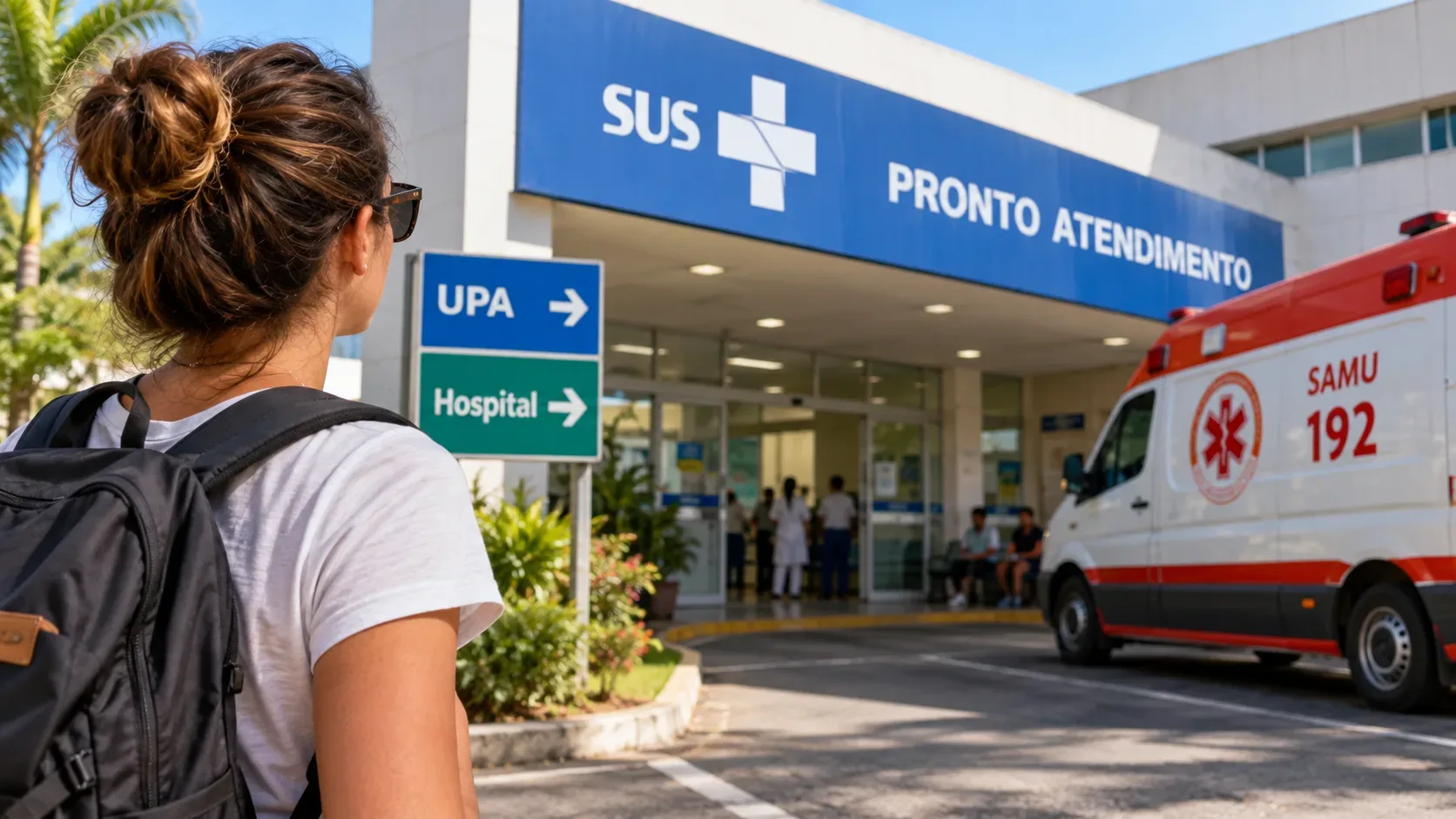
Yes. A foreign tourist who develops a health problem in Brazil can seek care through the emergency network of the Unified Health System (SUS), and Brazil’s Ministry of Health states that the public health services available to travelers are free of charge. In practice, where you should go depends on severity: an immediate threat to life calls for SAMU 192; an urgent clinical or injury-related problem in a stable patient often fits a 24-hour UPA; and severe cases may require a public hospital.
That does not mean a trip to Brazil should be planned as though a short-term visitor had the same ongoing care routine as a local resident. SUS is universal, but the official guidance specifically aimed at foreign visitors focuses mainly on the urgent and emergency care network. Primary care, follow-up appointments, specialist access and long-term treatment are organized locally and can involve registration, referrals and waiting times. For a short stay, SUS is best understood as a public safety net — not an automatic substitute for travel insurance or a plan for private care.
Quick decision guide: where to seek care
| Situation | Most practical route | What to expect |
|---|---|---|
| Life-threatening condition or rapid deterioration | Call 192 for SAMU | Medical telephone regulation and, when indicated, dispatch of a team/ambulance and referral. |
| Acute, significant problem but the patient is stable | Go to a 24-hour UPA | Initial assessment, stabilization, tests as needed, and a decision on discharge or referral. |
| Severe condition that already requires hospital-level resources | Public hospital emergency department, or the hospital indicated by SAMU/UPA | Hospital treatment and admission when clinically necessary and available. |
| Mild complaint without urgent warning signs | Basic Health Unit (UBS) or another local outpatient service | Access is organized by the municipality; for tourists, registration procedures and availability can vary. |
When to call SAMU 192
SAMU 192 is Brazil’s public mobile emergency service. The call is free, the service operates 24 hours a day, and it can be reached from a local landline or mobile phone. The dispatch center triages the call, gives instructions and decides whether a mobile unit needs to be sent.
The Ministry of Health lists sudden chest pain, suspected heart attack or stroke, severe breathing difficulty, crashes or trauma with victims, serious burns, poisoning, drowning, electric shock, seizures and other situations involving risk of death, disability or intense suffering among reasons to call 192. In a real emergency, do not waste time first shopping for a “better” hospital or comparing prices.
When a 24-hour UPA makes more sense
A 24-hour UPA is an urgent-care unit at an intermediate level between basic care and a hospital. It operates around the clock and treats both serious and non-serious clinical conditions, as well as providing first care for surgical and trauma cases. The team can stabilize the patient, perform an initial diagnostic assessment and refer the person to a higher-level hospital when necessary.
Examples listed by the Ministry include high fever, suspected fractures, cuts with limited bleeding, kidney colic, severe shortness of breath, seizures, strong chest pain and persistent vomiting. Some of those symptoms can also signal an emergency; if there is immediate danger, rapid deterioration, altered consciousness or no safe way to travel, calling 192 is the safer choice.
Do tourists pay for SUS care?
The Ministry of Health’s Traveler Health guidance is explicit: public health services available during a stay are free of charge, and a foreign tourist with a health problem can seek care through the SUS urgent and emergency network. That includes SAMU 192 and 24-hour UPAs; public hospitals are part of the same emergency network.
“Free” here means care delivered within the public system without a bill at the point of care. It is different from choosing a private clinic or hospital on your own. In the private system, a visitor may be asked for insurance, proof of ability to pay or direct payment, depending on the provider and the policy.
Do you need a CPF, SUS card or passport?
Not having a CPF or a National Health Card (CNS, often called the SUS card) should not block treatment. The Ministry of Health’s consolidated rule on identification in SUS states that not having or carrying those numbers is not an obstacle to care when the person can be identified with another valid document — and it specifically preserves an exception for urgent situations.
To reduce administrative friction, carry your passport or another identity document and, if you have it, your travel-insurance information. The facility may need to register your details for the medical record. In an urgent situation, however, paperwork should not be treated as a step that comes before care.
Care is not necessarily first come, first served
Clinical priority matters in the emergency network. National organization rules provide for reception and risk classification in acute cases, so a sicker patient may be treated before someone who arrived earlier. A crowded UPA can therefore mean a long wait for a stable case and much faster attention for a patient showing higher-risk signs.
There are also differences between cities and regions. SUS is national, but states and municipalities manage much of the network. Opening arrangements, available resources, crowding and referral pathways vary. To find a UPA or public hospital, check local maps, the municipal health department or ask your accommodation for directions; in an emergency, call 192.
Why travel insurance and private care can still matter
The fact that SUS treats tourists does not make travel insurance unnecessary. Foreign travel authorities still recommend medical coverage for Brazil because a visitor may prefer or need private treatment, a transfer, specialist follow-up or medical evacuation. The UK government recommends appropriate insurance and notes that public hospitals can be crowded and involve waits, while private providers may require proof of funds or insurance coverage.
The U.S. Department of State also recommends travel insurance and says private Brazilian facilities often require payment up front or proof of insurance. The value of private care, then, is not that it creates a right to emergency treatment — SUS already provides a public route — but that it can expand options for provider choice, language support, comfort, continuity and logistics, depending on the city and the policy.
- Use SUS without hesitation when you have an urgent or emergency problem and it is the fastest, safest route.
- Contact your insurer as soon as the situation is stable, especially if admission, transfer or private treatment may be needed.
- For chronic conditions or planned care, travel with enough medication, your prescription and a follow-up plan; do not assume you can quickly reproduce the full long-term care pathway available to a resident.
The essentials to remember
For a tourist in Brazil, the practical rule is simple: 192 for a life-threatening emergency; a 24-hour UPA for an acute urgent problem in a stable patient; a public hospital when hospital-level care is required or you are referred there. Public care is free, and lacking a CPF or CNS should not prevent treatment. Travel insurance remains useful because it gives you options outside the public system and financial protection for private services or evacuation.
This guide is informational and does not replace medical assessment. If there are signs of an emergency, seek care immediately.