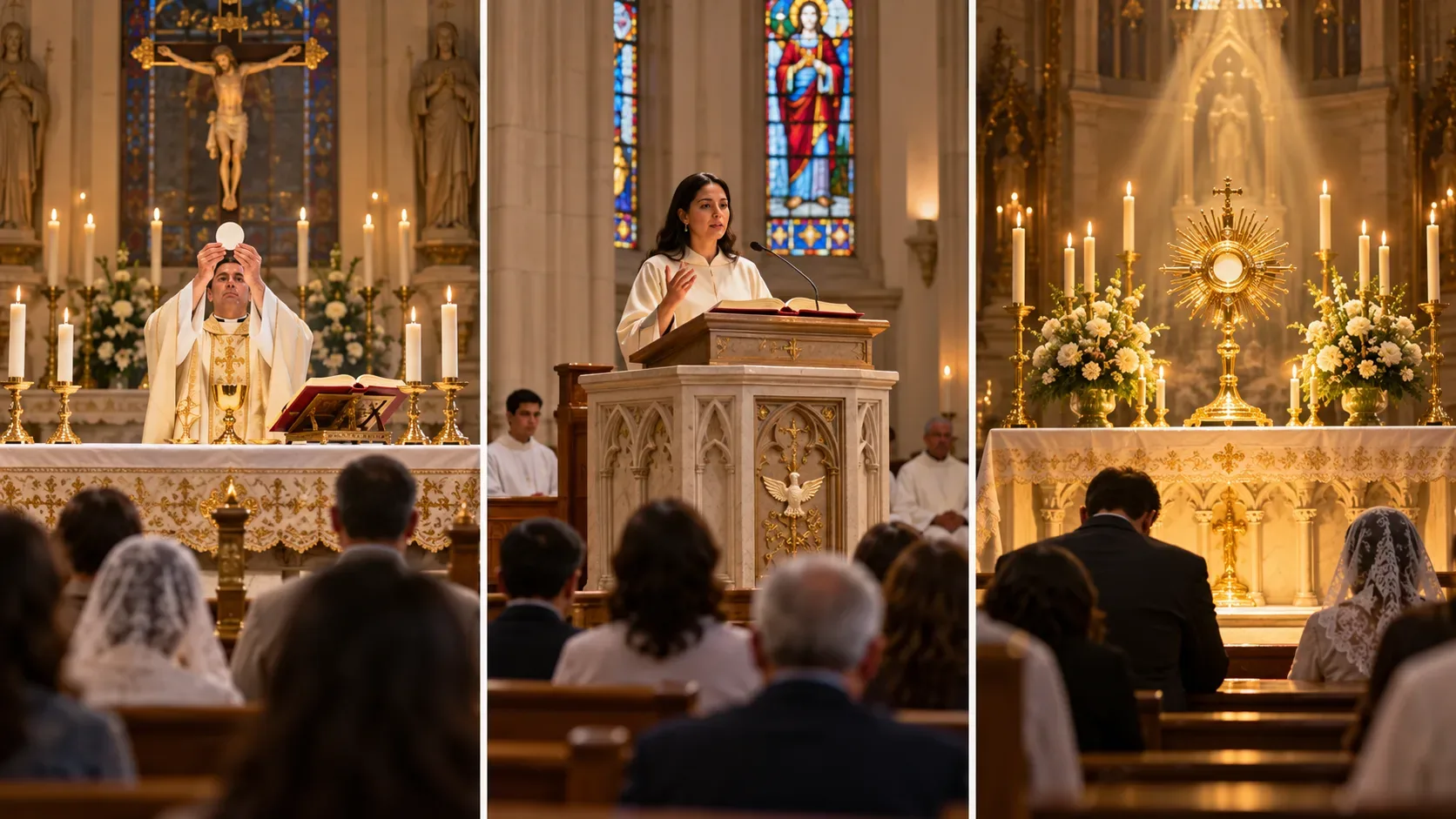
Mass, a Celebration of the Word, and Eucharistic adoration are not different names for the same Catholic practice. All three may gather the community and include silence, hymns, prayers, and Scripture readings, but their purposes and structures are distinct. Mass is the full Eucharistic celebration and includes the Eucharistic Prayer, in which bread and wine are consecrated by a priest. A Celebration of the Word centers on the proclamation and hearing of Scripture and does not include consecration; in some settings it may include the distribution of Holy Communion with hosts consecrated previously. Eucharistic adoration, in turn, is worship of Christ present in the Blessed Sacrament already consecrated, normally outside Mass.
Quick comparison of the three practices
| Aspect | Mass | Celebration of the Word | Eucharistic adoration |
|---|---|---|---|
| Main purpose | To celebrate the Paschal Mystery in the Church's Eucharistic action, joining the Liturgy of the Word and the Liturgy of the Eucharist. | To gather the community to hear, receive, and respond to the Word of God in prayer. | To adore Christ present in the Blessed Sacrament and to extend, outside Mass, prayer connected with the Eucharistic mystery. |
| Who presides or leads | A validly ordained bishop or priest celebrates the Eucharist; a deacon may assist but cannot consecrate. | A deacon may lead; when no ordained minister is present, another person authorized by the bishop may lead according to the applicable norms. | For exposition with Benediction, the minister is a priest or deacon. In circumstances provided by law, an acolyte, extraordinary minister of Holy Communion, or another designated person may expose and repose the Blessed Sacrament without Benediction, according to the bishop's norms. |
| Eucharistic Prayer and consecration | Yes. It is the center and high point of the celebration and is spoken only by the priest by virtue of ordination. | No. There is no Eucharistic Prayer and no consecration of bread and wine. | No. The Blessed Sacrament being adored was consecrated previously at Mass. |
| Holy Communion | The Communion rite is part of Mass, although reception by individual faithful depends on the conditions proper to each person and celebration. | It may or may not take place. When it does, the Eucharist consecrated previously is distributed, without turning the celebration into Mass. | It is not the purpose or a necessary stage of adoration. Adoration may precede or follow Mass, but exposition must be interrupted while Mass is celebrated. |
| Typical setting | Sundays, feasts, holy days of obligation, weekdays, and other liturgical occasions on which the Eucharist is celebrated. | Communities unable to have Mass, prayer gatherings, and other occasions provided by the Church for celebrations of the Word. | Visits to the Blessed Sacrament, holy hours, brief or prolonged exposition, and other periods of Eucharistic prayer. |
What makes Mass different
Mass is the celebration of the Eucharist. The Code of Canon Law describes the Eucharistic celebration as an action of Christ and the Church in which Christ is offered to the Father and gives himself as spiritual food to the faithful. The General Instruction of the Roman Missal presents the celebration as one act made up of parts joined together, especially the Liturgy of the Word and the Liturgy of the Eucharist.
In the Liturgy of the Word, Scripture is proclaimed, with the psalm, Gospel, homily when prescribed, Profession of Faith when required, and Prayer of the Faithful. The Liturgy of the Eucharist follows, with the preparation of the gifts, the Eucharistic Prayer, and the Communion rite. The Eucharistic Prayer is a decisive point of distinction: the General Instruction identifies it as the center and high point of the celebration and states that, by its nature, it is spoken only by a priest by virtue of ordination.
For that reason, there is no Mass presided over by a layperson or deacon. A deacon has proper liturgical functions and may proclaim the Gospel, preach when appropriate, assist at the altar, and distribute Holy Communion, but a deacon does not speak the Eucharistic Prayer or carry out the consecration. Canon 900 reserves to a validly ordained priest the capacity to confect the sacrament of the Eucharist in the person of Christ.
What a Celebration of the Word is
A Celebration of the Word is a liturgical celebration centered on the proclamation, hearing, and response to the Word of God. The Second Vatican Council directed that such celebrations be promoted, including on Sundays and feast days, especially where no priest is available. The constitution Sacrosanctum Concilium provides that in those situations the celebration be led by a deacon or another person authorized by the bishop.
The exhortation Verbum Domini further states that celebrations of the Word are privileged occasions for encountering the Lord and have their own value in liturgical formation. In Brazil, the CNBB likewise gives guidance for this ministry and stresses that a Celebration of the Word is not to be confused with Mass, even when the community gathers on Sunday.
Can Holy Communion be distributed during a Celebration of the Word?
Yes, in some forms and according to the applicable norms, Holy Communion may be distributed. CNBB materials present forms in which Eucharistic Communion can be part of the celebration, while other liturgical guidance distinguishes celebrations with or without distribution of the Eucharist.
The essential point is that, when Communion is distributed, the hosts were consecrated previously at Mass. There is no Eucharistic Prayer and no new consecration during the Celebration of the Word. Therefore, a Celebration of the Word with Communion remains a Celebration of the Word, not Mass.
Who may lead it?
When a deacon is present, the deacon may lead the assembly according to the rite and the applicable norms. When no ordained minister is available, an authorized layman or laywoman may carry out the role entrusted by ecclesiastical authority. The specific form, vesture, functions, and any distribution of Holy Communion depend on liturgical and diocesan norms. Such delegation does not make a lay minister a priest and does not transfer to that minister the parts proper to Mass.
What Eucharistic adoration is
Eucharistic adoration is worship offered to Christ present in the Eucharist outside the celebration of Mass. It may take place before the Blessed Sacrament reserved in the tabernacle or during exposition, when a consecrated host is placed in a monstrance or another vessel provided by the rite.
The instruction Redemptionis Sacramentum states that Eucharistic worship outside Mass is closely connected with the celebration of the Eucharistic Sacrifice and encourages both public and private adoration. During exposition there may be periods of silence, readings from Sacred Scripture, hymns, prayers, and other elements provided in the liturgical books, always directed toward adoration of Christ in the Blessed Sacrament.
Is there a consecration during adoration?
No. In adoration, the Eucharist has already been consecrated at an earlier Mass. There is therefore no Eucharistic Prayer, no presentation of bread and wine for consecration, and no second consecration before the monstrance.
Church law itself separates the two moments: canon 941 provides that exposition of the Blessed Sacrament is not to be held in the same area of the church during Mass. Redemptionis Sacramentum likewise states that exposition must be interrupted while Mass is being celebrated.
Who may expose the Blessed Sacrament and give Benediction?
Canon 943 establishes that the minister of exposition of the Blessed Sacrament and Eucharistic Benediction is a priest or deacon. In special circumstances, an acolyte, extraordinary minister of Holy Communion, or another person designated by the local ordinary may carry out exposition and reposition only, without giving Benediction with the Blessed Sacrament, while observing the diocesan bishop's prescriptions.
Why the three practices can look similar
Confusion arises because all three may share outward signs. A Bible, ambo, candles, hymns, silence, prayers, ministers, and an assembly can appear in more than one of them. What defines the practice, however, is not appearance alone but the rite being celebrated and its purpose.
- If there is a Eucharistic Prayer with the consecration of bread and wine by a priest, it is Mass.
- If the center is the proclamation of the Word, with no Eucharistic Prayer or consecration, it is a Celebration of the Word, even if Holy Communion consecrated previously is later distributed.
- If the center is adoration of Christ present in the Blessed Sacrament already consecrated, it is Eucharistic adoration, whether or not there is solemn exposition.
Four common misunderstandings
1. “If there is Communion, it must be Mass”
Not necessarily. Holy Communion may be distributed outside Mass according to the Church's rites and norms. What cannot be absent from Mass is the Eucharistic celebration presided over by a priest, with the Eucharistic Prayer and consecration.
2. “A Celebration of the Word is a Mass without a priest”
No. The Church insists that the distinction between Mass and assemblies held in the absence of a priest be preserved. A Celebration of the Word has its own liturgical value, but it does not reproduce the Eucharistic part of Mass and does not carry out the consecration.
3. “Adoration is an automatic continuation of Mass”
Adoration is deeply connected with the Eucharist, but it is a distinct liturgical act. It may take place after Mass, including with a host consecrated during that Mass, but exposition and adoration follow their own norms.
4. “If a layperson leads the celebration, that person is taking the priest's role”
No. When the Church authorizes a layman or laywoman to lead a Celebration of the Word or, in circumstances provided for, to expose and repose the Blessed Sacrament without Benediction, that person exercises a limited ministry. Functions reserved to the priest, above all the Eucharistic Prayer and consecration, remain reserved.
What may legitimately vary
Not every Celebration of the Word or period of adoration will have exactly the same format. Hymns, the length of silence, permitted readings, the presence of Communion during a Celebration of the Word, the use of solemn exposition during adoration, and the distribution of roles among ministers can vary. Diocesan norms and guidelines from an episcopal conference may also apply.
These variations, however, do not erase the essential boundaries: Mass contains the Eucharistic celebration and consecration; a Celebration of the Word does not consecrate the Eucharist; and adoration is directed toward the Blessed Sacrament already consecrated.
How to recognize each one in practice
To identify what is happening in a church, look at the core of the rite. If a priest moves from the Liturgy of the Word to the preparation of the offerings and the Eucharistic Prayer, it is Mass. If the assembly gathers to hear the readings and pray without a Eucharistic Prayer, it is a Celebration of the Word, even if hosts consecrated previously are distributed afterward. If attention is directed toward the Blessed Sacrament reserved or exposed for prayer and contemplation, it is Eucharistic adoration.
This distinction helps each practice be appreciated for what it is. Mass holds a central place because the Eucharistic Sacrifice is celebrated in it; a Celebration of the Word enables the community to gather and be nourished by Scripture when the Eucharist cannot be celebrated or in other settings provided by the Church; and adoration extends prayer before Christ present in the Eucharist already consecrated.