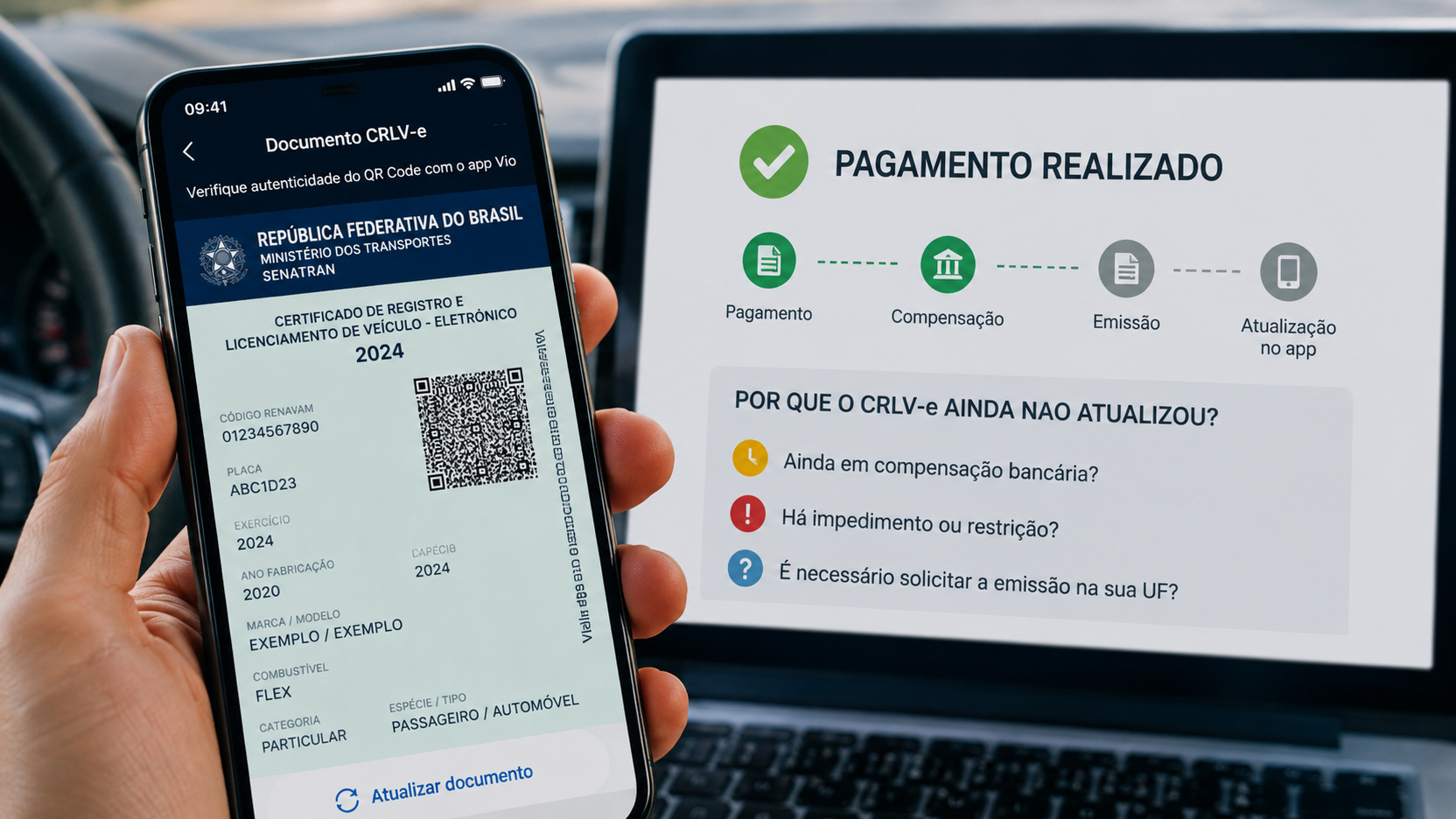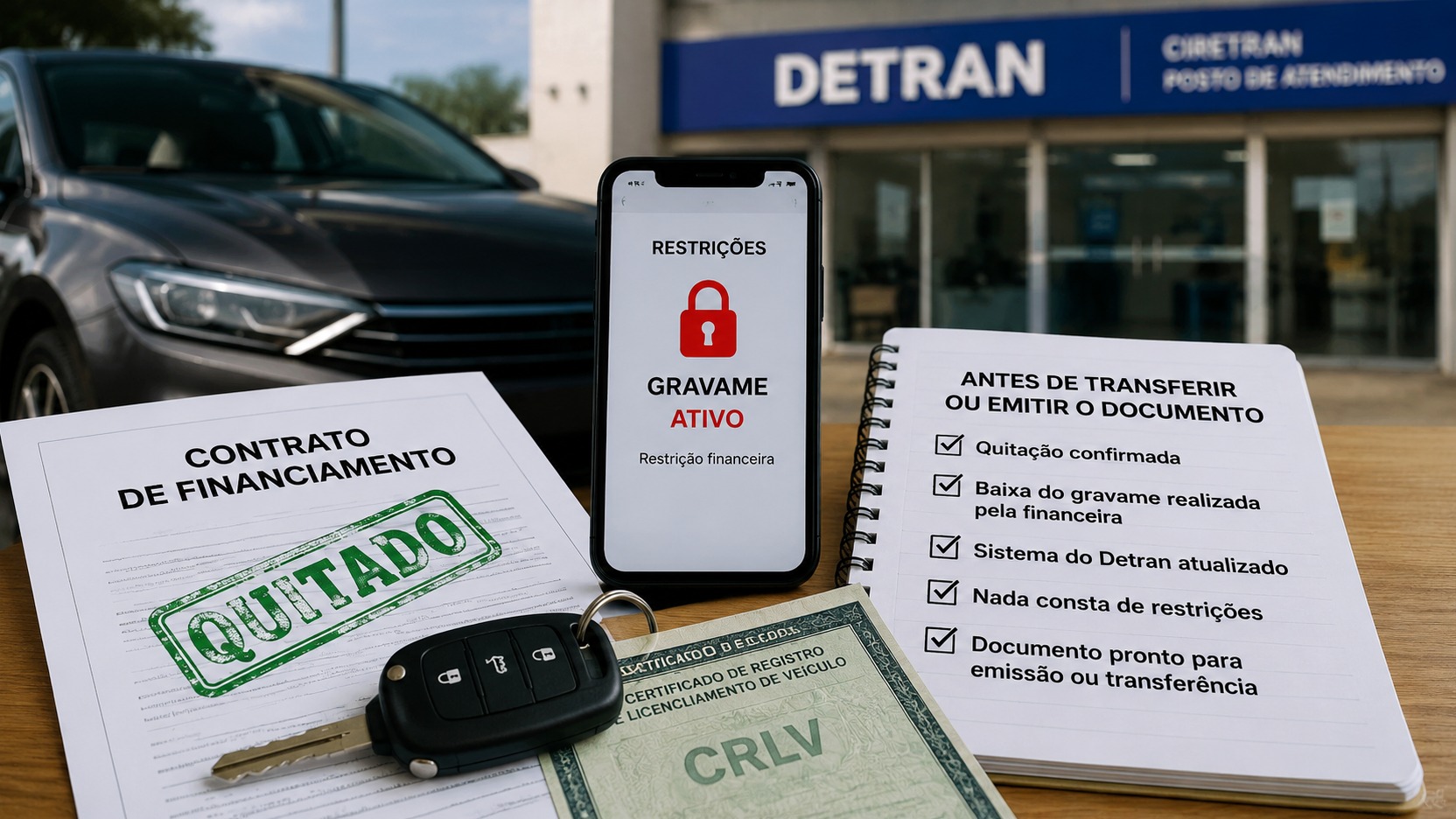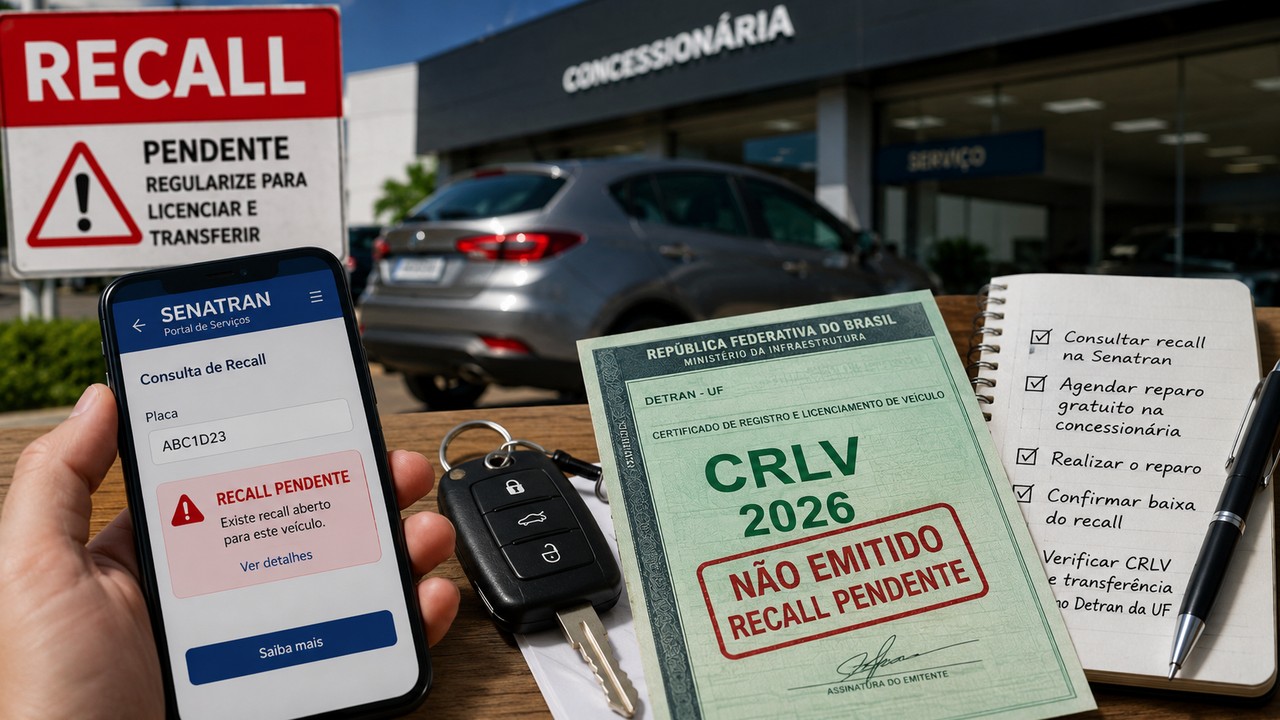
An open recall deserves immediate attention, but the simple existence of the call does not produce, in all situations, the same documentary effect. According to the federal rule of the Brazilian Traffic Code, the blocking of licensing is linked to campaigns carried out from October 1, 2019 that remain unattended one year after communication. Once this information is included in the Annual Licensing Certificate, the vehicle can only be licensed upon proof of compliance with the recall.
In transfer, the response requires a second layer. The CTB explains the blocking of licensing, while the transfer procedure is carried out by Detrans. In São Paulo, for example, the Detran-SP service letter, updated in August 2026, informs that the pending recall prevents both annual licensing and the transfer of ownership. Therefore, anyone who is going to sell or buy a used vehicle must consult the vehicle's status and also the operational rules of the Detran of the Federation unit in which the process will be completed.
The decisive point: open recall is not automatically synonymous with blocked CRLV
Art. 131 of the CTB creates a specific time frame. For campaigns carried out from October 1, 2019, the recall not responded to within one year, counting from the communication, must be included in the Annual Licensing Certificate. After this inclusion, § 5 determines that the vehicle will only be licensed when there is proof that the call was answered.
This helps to separate two situations that are usually treated as if they were the same. A recently opened recall may appear in the Senatran consultation and must be resolved for safety reasons, but the federal licensing block provided for in these paragraphs does not simply arise on the day the campaign is announced. Already a recall that reached the
legal framework and incorporated into the vehicle's documentary status may prevent the issuance of the next license until regularization.
There is also a legal reservation for exceptional situations of proven lack of parts or need to escalate service. The CTB allows Contran to extend the blockade requirement, considering road safety. This possibility is not an automatic authorization for each owner to continue the pending issue indefinitely: it is an exceptional decision by Contran.
Practical matrix: what changes depending on the situation
Newly opened recall and licensing
If the campaign has not yet completed one year since the communication, the federal rule of art. 131 does not establish, for this reason alone, the licensing block provided for the recall not met after the one-year mark. Even so, the owner must consult Senatran and the vehicle's status at Detran, because other restrictions may exist and because the defect that led to the recall continues to be a safety problem to be corrected.
Recall older than a year and licensing
When the campaign falls under art. 131 and remains unattended after one year, the information must be included in the Annual Licensing Certificate. After inclusion, new licensing is subject to proof of repair. In practice, it is at this stage that many owners realize the pending issue: the debts are settled, but the CRLV for the year is not released because there is still a recall that has already reached the blocking stage.
Recall and transfer of ownership
Here it is dangerous to apply a simplified national rule. Federal law is explicit when regulating licensing, but the transfer goes through the procedures of the UF Detran. Detran-SP currently declares that the pending recall prevents the transfer. Other state agencies may present the requirement with different wording, steps, and screens. Therefore, before signing the sale as if the operation was ready to end, confirm whether the vehicle has a pending recall and whether the competent Detran requires regularization to complete the new registration.
It is also not advisable to confuse the signing of the transfer authorization or the sales communication with the actual completion of the transfer. If there is a restriction that prevents the document from being issued in the buyer's name, the negotiation may progress at one stage and stall at the next. To avoid this delay, the safest solution is to check the recall before final payment and, when there is a pending issue that could block the process, arrange the repair before completing the transfer.
Used car buyer
For the buyer, the query must be made by the vehicle, not just by the seller's word. Senatran allows you to check recalls using the Digital Traffic Card and the Portal
Services, with vehicle data. If there is an open call, it is worth identifying the campaign, confirming that the repair was carried out and checking whether the write-off has already appeared on the national basis before finalizing a purchase that depends on immediate transfer.
How to check the recall at Senatran
The official query can be made on the Digital Traffic Card, within the vehicle area, or on the Senatran Services Portal. The service informs you if there are pending recall records linked to the vehicle. This query is particularly useful when the owner has not received the summons, bought the car used or suspects that an old repair has not yet been reflected in the base.
The result of the consultation needs to be interpreted together with the documentary situation. Seeing a pending recall answers the question “is there a recall still open for this vehicle?”, but does not replace checking the licensing and restrictions registered by Detran. For a purchase, do both checks; for a CRLV that has not been issued, also check debts and other restrictions, because the absence of the document may have more than one cause.
The correct sequence for regularizing and writing off
First: identify the campaign and schedule service
With the recall confirmed, contact the manufacturer or an authorized dealer of the brand. The recall service is free. The summons exists precisely to correct a defect that may affect the safety, health or other protected interests of the consumer, so it makes no sense to postpone the repair just because the document has not yet locked.
After: carry out the repair and keep the receipt
When attending, keep the service order or equivalent document with the identification of the vehicle, the date and the service performed. This proof is useful if there is a delay in updating the database or a discrepancy between what the dealership carried out and what continues to appear in the query.
Registration is not done by the owner at Detran
The discharge flow depends on the service record by the responsible network. Senatran's documentation explains that, after the repair, the dealership informs the entity responsible for the recall, which records the write-off in the Renavam. Detran-SP also informs that the dealership records the service in the Senatran system and that the pending issue is removed from the vehicle's registration. In other words, the owner does not “erase” the recall on their own or resolve the situation simply by presenting the receipt at any Detran counter.
Finally: confirm the update before trying again
After the repair, consult Senatran and the UF Detran again. If the issue continues to appear, first contact the dealership or manufacturer with the
proof of service and request correction of the record. If the licensing or transfer still remains blocked after the update informed by the network, then take the protocol to the competent Detran to check if there is another restriction or if the state base has not yet reflected the reduction.
What if the dealership says they don't have the part?
The lack of a part does not make the recall the consumer's responsibility. Record the service attempt, request a protocol and formal forecast from the dealership or manufacturer and monitor the situation. The CTB itself provides that Contran may, exceptionally, extend the requirement related to the blockade when there is a proven lack of parts or the need to escalate service. The decision, however, is regulatory; The owner should not assume that the exception has been granted for their vehicle without confirmation.
If the defect represents a relevant risk and there is no solution available, in addition to charging the manufacturer, the consumer can seek guidance from consumer protection agencies. For the documentary part, the UF DMV is the one who must clarify how the blockade is being handled in that specific case.
Old campaigns: the 2019 cutoff does not mean that old recalls can be ignored
The text of § 4 of art. 131 expressly mentions campaigns carried out from October 1, 2019. The CTB itself provides regulations for the insertion of data from previous campaigns. Furthermore, the query bases have historical limits: Detran-SP informs that the Senatran portal displays recalls published from April 20, 2011 and recommends looking for the manufacturer for previous information.
For an older car, therefore, the absence of results in the query should not be automatically interpreted as proof that there was never a recall. If the model history indicates an old campaign, also consult the manufacturer for the chassis.
What the seller and buyer must agree on before the transfer
When there is a pending recall, it is best to separate the commercial issue from the registration issue. The seller can arrange the repair before delivery and wait for the write-off to appear in the system. If the parties decide to continue with the negotiation before then, they need to know that the completion of the transfer may depend on the UF DMV procedure and that a blockage does not disappear just because the private contract gave the buyer the obligation to carry out the recall later.
For the buyer, a good rule of thumb is not to treat “signed documents” as a synonym for “vehicle already transferable”. Consult recall, licensing and restrictions, confirm the situation with the competent Detran and only then define the time for final payment. For the seller, regularizing it in advance reduces the risk of the transaction getting in the way and avoiding arguments about who should take the car to the dealership.
Short answer to each question
Pending recall blocks CRLV? You can block. In the federal regime of art. 131, the central point is the campaign carried out from October 1, 2019, which was not attended to in a year and had the information included in the Annual Licensing Certificate; After that, the vehicle is only licensed with proof of service.
Pending recall prevents transfer? You can prevent it, and confirmation must be made at the UF Detran. In São Paulo, the current official guidance expressly states that pending recall prevents the transfer of ownership.
Who issues the recall? Not owned by a common manual request. After the free repair on the authorized network, the service needs to be registered in the manufacturer/dealership flow to reach the national base and remove the pending issue.
What is the safest sequence? Consult Senatran and Detran, identify the campaign, carry out the free repair, keep the receipt, wait for the base to be updated and only then repeat the licensing or complete the transfer. If the write-off does not appear, cover the dealership or manufacturer and use the protocol to handle the discrepancy with the UF Detran.