You paid off the financing, received confirmation of the payment, and even so the vehicle still appears with a lien. The first step is not to try to transfer the car blindly or assume that Detran made a mistake. It is to find out at which stage the removal stopped: at the creditor institution, in the annotation by the traffic authority, or in a local procedure required to update the registration and the document.
The national rule provides an objective clue. Contran Resolution No. 807/2020, still in force in 2026 with later amendments, requires the creditor institution to send the traffic authority, within 10 days, information that the debtor's obligations have been paid off. Detran is responsible for annotating that information in the contract record and maintaining the state registry and its integration with Renavam. In practice, therefore, the lender and Detran have different roles.
Paying off the debt, removing it from the system, and updating the document are not the same thing
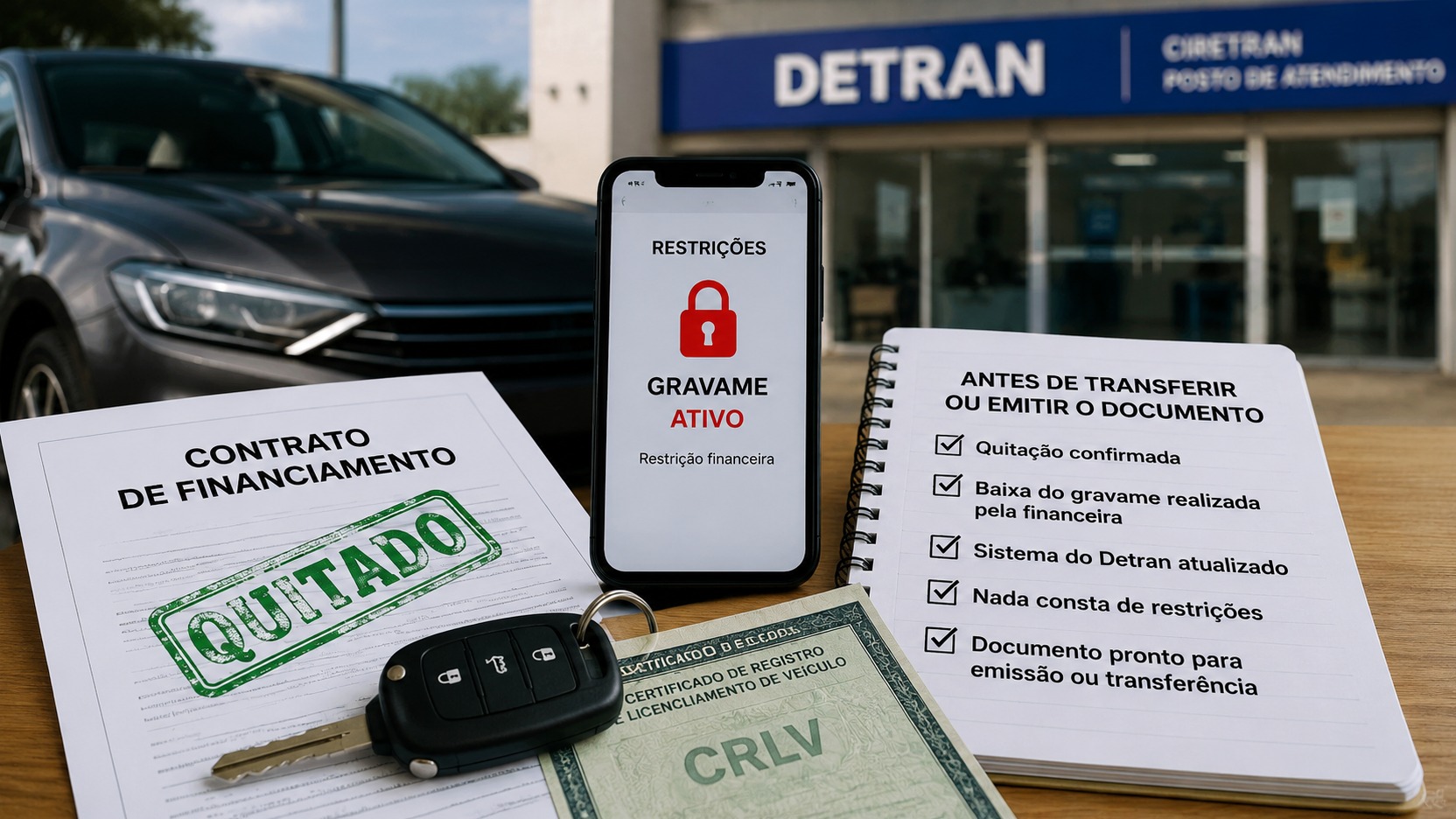
The lien is the notation linked to the financing guarantee, such as a fiduciary lien. While that restriction remains active in the vehicle registry, it may prevent or condition services such as transfer of ownership and issuance of an updated document.
Paying off the contract is the financial event. After that, the creditor institution must communicate the end of the guarantee. Next, the traffic authority must reflect that information in the registry. Depending on the state and the vehicle's situation, there may still be a step for the owner to complete the service, issue a new CRV or CRLV-e, pay a fee, undergo an inspection, or combine the lien removal with another procedure.
This separation explains why two people who paid off financing on the same day may have different experiences. One sees the restriction disappear from the registry without in-person service. Another receives confirmation from the lender that the lien was removed but needs to request a document update from Detran. A third discovers a registry discrepancy, an old contract, a change of jurisdiction, or a special situation that blocks automatic completion.
Who needs to act first after the payoff
Under Contran Resolution No. 807/2020, the initial obligation belongs to the creditor institution: it must send Detran the payoff information within 10 days. The text does not say that the consumer must ask the bank to start this procedure.
That does not mean Detran is merely a spectator. Senatran itself explains that the financial institution enters the lien information in the National Lien System and, when the debt is paid off, reports the removal; Detran makes the corresponding entry in Renavam. The state authority also controls document issuance and vehicle registration services within its jurisdiction.
If the bank says only that the debt has been paid off but cannot say whether the lien removal was transmitted, ask for the date it was sent and the protocol number or other proof that the communication was made. Paying off the debt and communicating the lien removal are different facts.
Why the lien may still appear
The lender has not yet sent the removal
If 10 days have not yet passed since the payoff, there may simply be an operational interval. If the deadline has already passed and the institution cannot demonstrate that it sent the information, the point of failure tends to be on the creditor's side.
In this scenario, insisting only with Detran often creates a back-and-forth. The more useful step is to open a formal service request with the financial institution, keep the protocol numbers, and ask for specific confirmation of the lien removal, not merely confirmation that the contract was paid off.
The removal was communicated, but the registry or document still depends on Detran
State procedures are not identical. In Minas Gerais, for example, the official service states that the financial institution is responsible for communicating the payoff to Detran-MG, but it also explains that the fiduciary lien is removed from the document only after a new CRV is issued. The owner may request that removal together with a transfer of ownership or other vehicle changes.
In Rio de Janeiro, Detran-RJ maintains a specific service called Baixa de Gravame Comercial, with its own rules for documentation, fees, and service. The portal also offers combinations of this service with other procedures, such as transfer of ownership in certain situations.
These examples show why there is no single national roadmap for the final stage. The institution's obligation to communicate the payoff is national; the way to complete the service before the traffic authority may vary by state.
The contract is in a registry status that requires regularization
There are cases in which the system cannot simply close the lien. In Rio Grande do Sul, a current state rule provides for situations in which paid-off or settled contracts remain as "awaiting CRV issuance for removal." In those cases, the financed party may need to appear at a Vehicle Registration Center to annotate the restriction in the vehicle record before the creditor can complete the removal.
Problems may also exist when the vehicle changed states, when there is a discrepancy between databases, or when the lien is tied to a type of guarantee different from a standard fiduciary lien. Detran-SE, for example, instructs that certain lien inconsistencies in a jurisdiction transfer be regularized with the Detran of the state of origin.
It is not a standard financing arrangement with a fiduciary lien
Leasing, retention of title, and other guarantees may follow a different workflow. Detran-RJ, for example, handles the removal or addition of a lease through the ownership transfer service. Therefore, before applying generic guidance, confirm which type is recorded in the vehicle registry.
What to check before transferring the car
Confirm the payoff and the date it occurred
Keep the receipt, payoff statement, account statement, or equivalent document. The date matters because it is the practical reference for checking whether the up-to-10-day deadline for the creditor's communication has already been exceeded.
Check the vehicle's status through Detran's official channel
Use the debts, restrictions, or liens lookup provided by the Detran in the state where the vehicle is registered. Avoid relying only on apps or commercial searches, because what matters for the transfer is the status recognized in the official registry.
Ask the lender whether the removal was actually transmitted
The right question is objective: has the payoff information already been sent to the traffic authority for removal of the lien? Ask for the date, protocol number, or proof of transmission. If the answer is only "the contract is closed," the registry step still needs to be confirmed.
Check the procedure in your state
After confirming that the creditor did its part, see whether Detran requires a lien removal request, issuance of a new document, payment of a fee, inspection, in-person service, or some combination with the transfer. In 2026, Minas Gerais, Rio de Janeiro, and Rio Grande do Sul have official workflows that differ from one another.
Check for other outstanding issues
Even after the lien is removed, fines, IPVA, licensing, administrative blocks, judicial restrictions, or registry problems may prevent the transfer or document issuance. Resolving the lien does not mean the entire vehicle record is clear.
Can I transfer the vehicle while the lien still appears?
It is not safe to assume that you can. Detran-SP describes the financial lien as a restriction that prevents transfer of ownership until the debt is paid off. Other states allow, in certain situations, the lien exclusion to be combined with the transfer service itself, provided the removal has been correctly reported by the creditor and the other requirements have been met.
Therefore, if the official registry still shows an active lien, confirm first whether your state requires prior removal or allows simultaneous removal. Signing a sale agreement, committing to a delivery deadline, or scheduling the transfer without that check increases the risk that the process will be blocked during service.
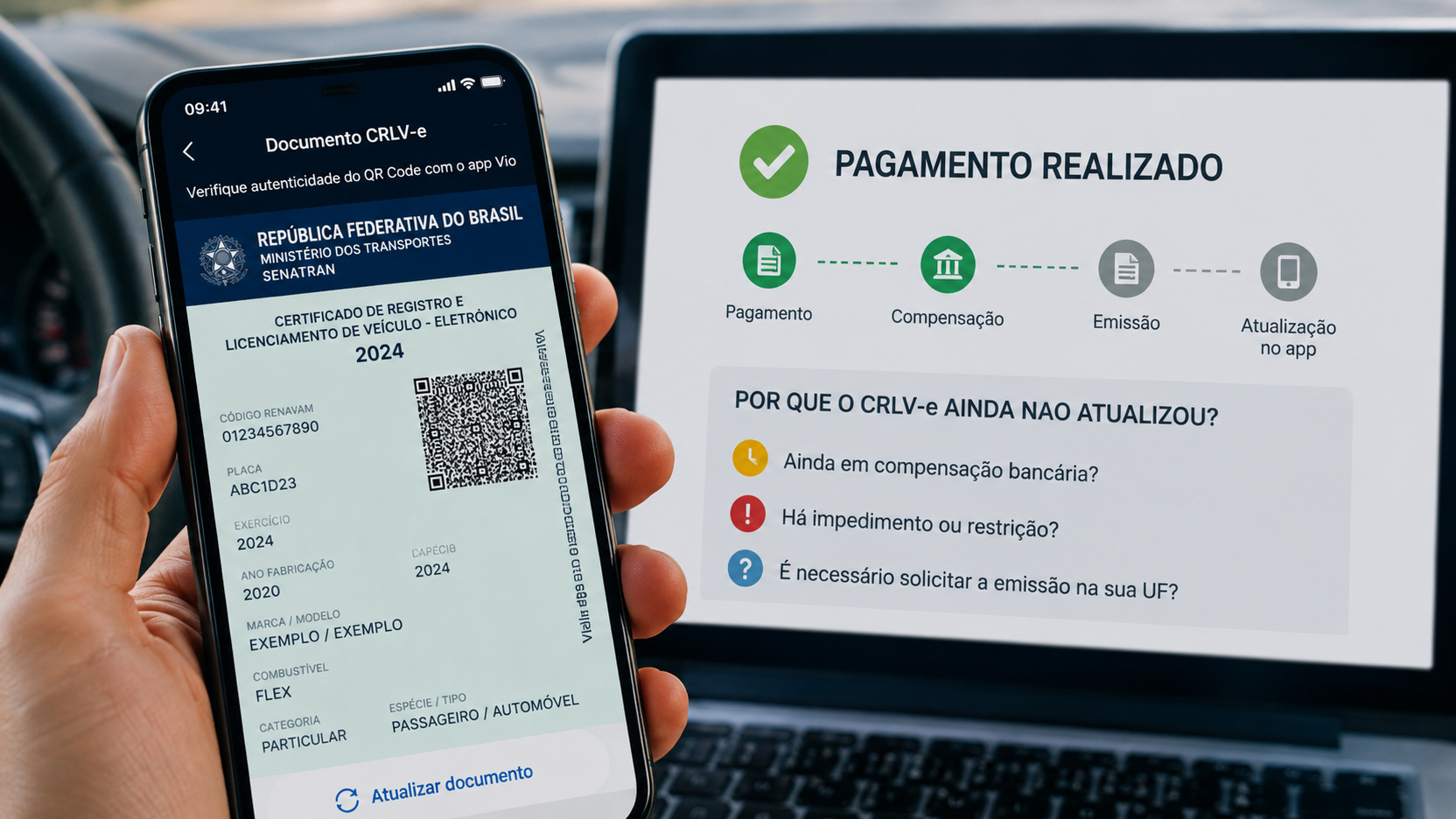
The financing was paid off, but the CRLV-e still shows the restriction
This may simply be a difference between the contract status and the issuance of the document. In Minas Gerais, the official guidance explicitly states that the fiduciary lien is removed from the document only after a new CRV is issued. Other states may have a different procedure.
Before concluding that the lender failed, check whether the removal is already recorded in Detran's registry and whether the only remaining step is to generate or request a new document. If the registry still shows the restriction as active, return to the earlier question: did the creditor institution transmit the payoff or not?
When to complain to the lender
If the up-to-10-day period has already passed and the creditor does not prove that it sent the payoff information to the traffic authority, file a formal complaint. Banco Central advises consumers to first contact the branch or SAC and, if necessary, the institution's ombudsman. If the problem persists, it is possible to seek Procon or file a complaint through Consumidor.gov.br.
There is also a Banco Central complaint channel for institutions it supervises. Banco Central itself notes, however, that it does not resolve the individual case or replace consumer protection mechanisms; the complaint is used to obtain a response from the institution and provide input for supervision.
Keep the protocol number, proof of payoff, screenshots from the official vehicle lookup, and any written response from the bank. If a sale is in progress, there is concrete loss, or an urgent issue has not been resolved administratively, these documents can help in a possible Procon service request or legal guidance.
When the problem tends to be with Detran
If the lender presents proof that it transmitted the removal and Detran confirms that the information arrived, but the registry or document is not updated, the next step is to open a protocol with the state authority. In that contact, ask them to identify which pending issue is preventing completion and which service must be requested.
The answer may be simple, such as issuing a new document, or may reveal a state-specific requirement. It may also point to a data discrepancy, a jurisdiction issue, a contract in a special status, or the need to correct information sent by the lender.
A roadmap to get out of the impasse without wasting time
If the payoff is recent and 10 days have not yet passed, monitor the registry and keep the proof of payment.
If the deadline has passed and the lender does not prove that it sent the removal, press the institution through formal channels and escalate to SAC and the ombudsman.
If the lender proves that it sent the information but the lien remains in the official registry, take that information to Detran and find out which state-level step is still pending.
If the registry no longer shows the restriction but the document still shows the lien, check whether your state requires a new CRV or CRLV-e to be issued to reflect the change.
And if you intend to sell the car, treat the vehicle as documentarily clear only after checking the situation with Detran and understanding whether the transfer can be completed directly or together with the lien removal. State procedures, fees, and service channels can change, so the official Detran page for the relevant state should be the final reference for the service.