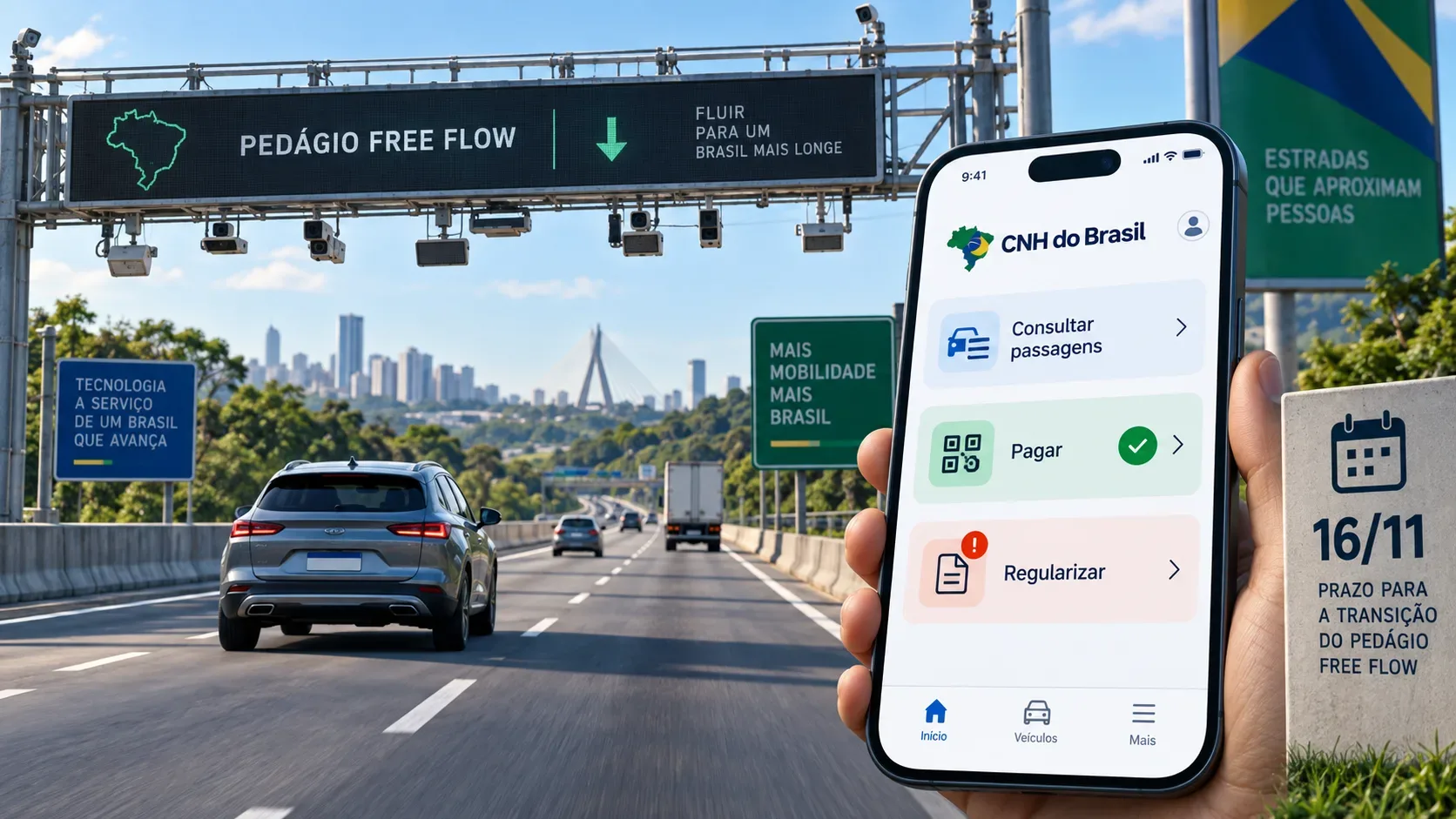
Since August 24, 2026, the CNH do Brasil app has brought together electronic free-flow toll passages from integrated systems, showing the date, responsible concessionaire, toll status and the official route to payment. The key point is simple: the app centralizes the lookup, but it does not process the toll payment itself. When the driver taps “Como pagar” (“How to pay”), the app redirects to the concessionaire’s official channel.
How to check a free-flow toll passage in CNH do Brasil
To use the feature, the guidance published by ANTT is to keep the CNH do Brasil app updated to version 7.3.0 or later. In the app, follow this path:
- Open Veículos (“Vehicles”).
- Select the vehicle that passed under the gantry.
- Open Pedágio Eletrônico (“Electronic Toll”).
- Review passages in chronological order and, when needed, filter them by period or status.
On roads already integrated with the system, ANTT says a passage may appear in the app within 24 hours after the vehicle crosses the gantry. If notifications are enabled, the app can also alert the driver when a charge becomes available and send another alert five days before the due date.
What the statuses shown in the app mean
| Status | What it means | What to do |
|---|---|---|
| “Em processamento” (Processing) | The concessionaire is still confirming the passage data. | Wait for processing to finish and check again. If the matter is urgent, also check the concessionaire’s official channel. |
| “Pendente de pagamento” (Payment pending) | The passage has been processed and the toll can be paid. | Open the passage, tap “Como pagar” and complete payment through the concessionaire’s official channel. |
| “Pago” (Paid) | The toll has been paid. | Keep the receipt and confirm that the status remains updated. |
| “Vencido” (Overdue) | Payment was not made within the ordinary deadline. | The payment obligation remains. Use “Como pagar” to be redirected to the concessionaire and settle the debt. |
Where the payment is made
CNH do Brasil does not collect the toll inside the app and does not ask for card details to complete payment. The “Como pagar” button redirects the user to the official channel made available by the concessionaire. Depending on the road and operator, the available options may include the company’s website, its own app, kiosks or authorized points, with the payment methods offered by each channel.
Drivers with a valid toll tag continue to be charged automatically under the terms of the service they use. Even so, passages from integrated systems may also appear in CNH do Brasil for tracking. Drivers who do not use a smartphone can continue to check and pay through concessionaire channels.
For security, verify the concessionaire name shown in the record and prefer the in-app redirect or the company’s official website. Avoid links received in unsolicited messages.
What is the normal payment deadline?
The ordinary framework provides a 30-day payment period. Contran Deliberation No. 277/2026 changed the rule so that this period is counted from confirmation that the passage record has been processed by Brazil’s highest federal traffic authority. In the operational guidance published by ANTT for the app, this is presented to drivers as 30 days from the moment the passage appears with the status “Pendente de pagamento”.
For that reason, drivers should not simply count 30 days from the date the vehicle crossed the gantry. Use the due date and status shown in the system and, if there is a discrepancy, confirm the information with the responsible concessionaire.
What applies through November 16, 2026
An exceptional 200-day transition regime is in force. It began with the publication of Contran Deliberation No. 277 on April 29, 2026, and the Ministry of Transport identifies November 16, 2026 as the end of the period. This transition does not eliminate the toll charge: payment remains mandatory.
During the transition window, nonpayment covered by the rule does not lead to new violation notices, penalty notices or points on the driver’s record. For passages made during this period, the rule allows payment by the end of the transition window or by the end of the applicable ordinary deadline, whichever is more favorable to the user.
This distinction matters: November 16 is not a general amnesty and it does not make outstanding charges disappear. It is the end date of the exceptional regularization regime, while the ordinary deadline is preserved when it falls later and is more favorable for a passage covered by the transition.
What to do in each situation
| Situation | Recommended action |
|---|---|
| Recent passage marked “Pendente de pagamento” | Pay through the concessionaire’s official channel within the displayed deadline. There is no benefit in waiting until November 16 if the charge is already available. |
| Passage still marked “Em processamento” or not yet visible | On integrated roads, monitor the app for up to 24 hours. If you need confirmation sooner or the record remains missing, check directly with the concessionaire. |
| Passage marked “Vencido” during the transition | Open “Como pagar”, pay the toll through the official channel and keep the receipt. The transition rule allows covered tolls to be regularized without the traffic penalty arising from late payment within the applicable window. |
| Older debt that generated a traffic-violation proceeding | Deliberation No. 277 provides that paying the corresponding toll within the transition deadline can cancel the related proceeding, penalties and points. The operational procedure may vary depending on the issuing authority. |
| Free-flow fine already paid | The rule allows the interested person to request review of the proceeding and, where applicable, reimbursement, provided the corresponding toll is paid within the established window. Check the procedure with the authority responsible for the fine. |
What if the charge is wrong?
The feature includes a “Contestar” (“Contest”) option. According to ANTT, this button redirects the user to the responsible concessionaire’s official channel, where the request is reviewed. When contesting a charge, state the reason, keep protocol numbers and, when possible, gather payment receipts, plate details and passage information.
What changes after November 16
Once the exceptional regime ends, the transition’s general protections against the issuance and progression of penalties for nonpayment no longer apply. Unsettled debts may then follow the ordinary enforcement and sanction process for electronic tolling.
This does not mean every pending passage automatically becomes a violation on November 17. For passages made during the transition, the rule itself requires the more favorable deadline to apply between the end of the exceptional period and the ordinary 30-day period. A charge processed close to the end of the transition may therefore have a due date later than November 16.
Checklist to regularize payments correctly
- Update CNH do Brasil to version 7.3.0 or later.
- Open each vehicle under Veículos > Pedágio Eletrônico and review passages, dates and statuses.
- Keep app notifications enabled if you want the charge and due-date alerts.
- Pay only through the official channel indicated by the concessionaire; CNH do Brasil is a lookup and redirection point.
- Keep the receipt and confirm that the status has been updated.
- If there is an incorrect record or amount, use “Contestar” and follow the concessionaire’s service process.
- For older debts or violation proceedings, do not assume cancellation without confirming payment of the corresponding toll and the procedure used by the responsible authority.