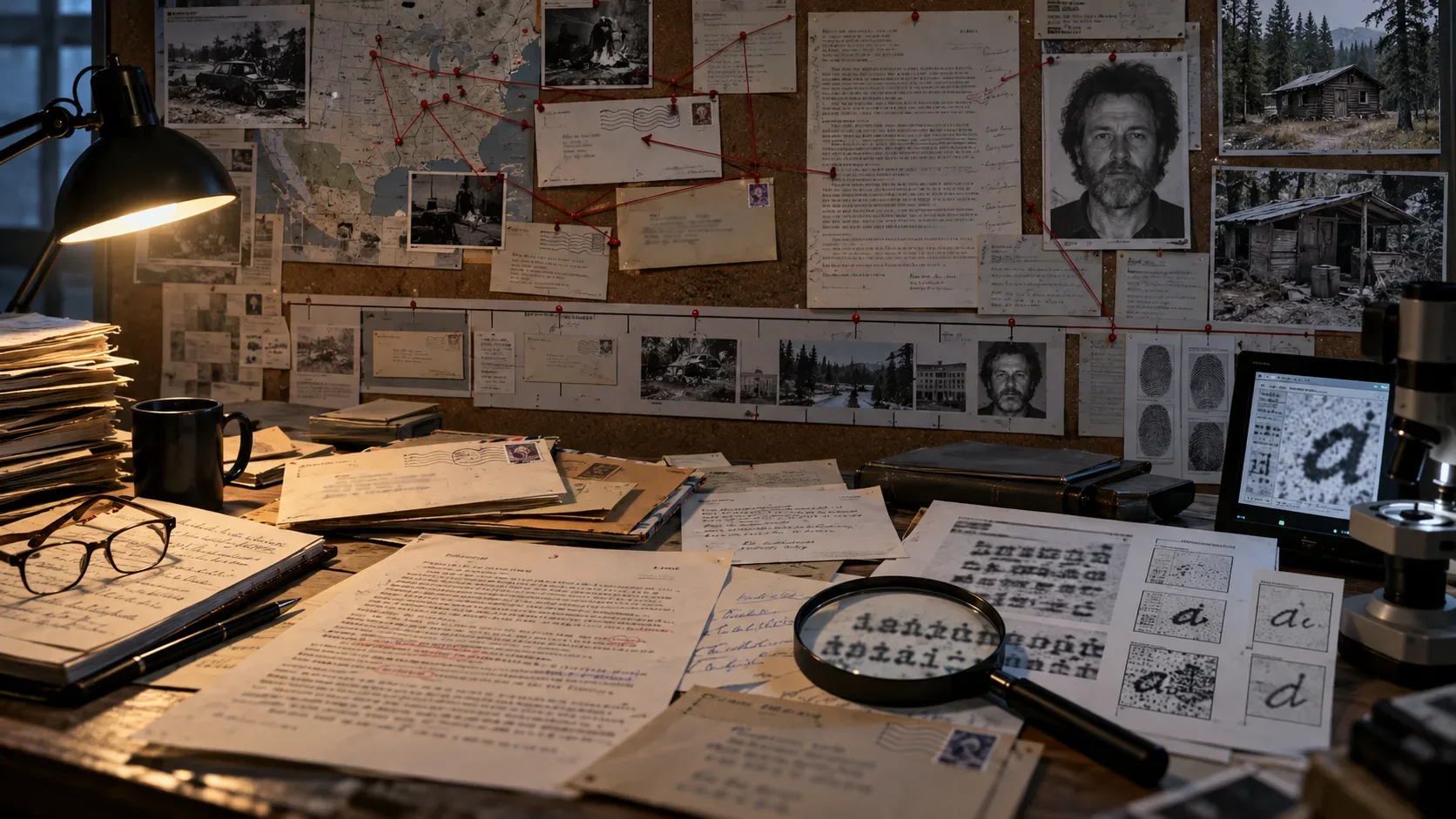
In the Unabomber case, texts did not identify Theodore Kaczynski through one isolated detail. The turning point came when the author's communications provided enough material for comparison, the 1995 manifesto was published to increase the chance of recognition, and Kaczynski's relatives supplied older writings attributed to him. According to the FBI, linguistic analysis of those documents, combined with facts from the bombings and Kaczynski's background, helped support the application for a search warrant. The search executed on April 3, 1996 then added physical and documentary evidence that confirmed the importance of that trail.
Why the writings became important evidence
For much of the investigation, the UNABOM task force faced a basic problem: the devices were built in ways that left few traceable clues. The FBI says recovered components were examined and victims' lives were studied in detail, but those approaches took years without producing an identification. That made any voluntary communication from the author especially valuable.
Beginning in 1993, letters sent by the Unabomber to news organizations and other recipients gave investigators something different from bomb fragments: language. The messages allowed them to observe word choices, recurring themes, spellings, sentence construction, and cultural references. The FBI later described this material as an unusual source of information about the author's education, interests, and manner of expression.
Two things should be kept separate. The relevant trail was not merely handwriting or the physical appearance of a letter. The main focus became linguistic content, meaning how the author developed ideas, repeated expressions, selected words, and organized arguments.
From letters to the 1995 manifesto
In 1995, the Unabomber sent a text of about 35,000 words titled Industrial Society and Its Future, setting out his views on technology and society. After internal debate, FBI Director Louis Freeh and Attorney General Janet Reno supported publication as a public safety measure and as an opportunity for someone to recognize the author.
The editorial decision was made jointly by The Washington Post and The New York Times, but the supplement containing the manuscript was printed in the Post on September 19, 1995. According to the newspaper, the two organizations shared the cost, while the Post had the operational ability to distribute the special section in every copy that day.
For investigators, the manifesto's value was its scale. Instead of a handful of letters, there were dozens of pages containing vocabulary, themes, and patterns of phrasing. The FBI could now rely on the possibility that a reader might recognize not a single opinion, but a familiar combination of ideas and writing habits.
How suspicion reached the Kaczynski family
FBI historical materials credit Linda Patrik, David Kaczynski's wife, with an early role in noticing similarities between the manifesto's ideas and positions Theodore Kaczynski had expressed for years. David began to consider seriously that his brother could be the author and sought legal advice.
An attorney representing David contacted the FBI. The materials provided included a 23-page essay Theodore had written in 1971, along with letters and other documents known to be his. That created the missing comparison: on one side, anonymous texts attributed to the Unabomber; on the other, older writings with known authorship.
Publication also generated a great deal of noise. The FBI's historical podcast says more than 50,000 calls reached the UNABOM tip line between publication of the manifesto and February 1996. The value of the family's lead was not simply that it named a person, but that it arrived with documents that could be compared.
What investigators compared in the writings
The FBI cites similarities in vocabulary, content, spelling, and phrasing. In a 2021 retrospective, agents gave examples such as the British spelling analyse and the phrase sphere of human freedom, found in materials associated with the case and in Kaczynski's earlier writings. These examples did not function as a unique password, but as parts of an accumulating pattern.
The 1971 essay was especially useful because it predated the manifesto by many years and allowed comparison of formulations without relying on a text produced after the case had become widely known. The strength of the analysis came from recurring language choices and themes, combined with additional letters and documents that enlarged the sample.
In its historical summary, the FBI says the linguistic analysis indicated that the author of the papers supplied by the family and the author of the manifesto were almost certainly the same person. The FBI's own description also shows the method's limit: that conclusion was combined with facts about the bombings and Kaczynski's life to support the warrant. The text was not treated as isolated proof that could close the case by itself.
From documentary lead to search warrant
After Theodore Kaczynski became a focus of the investigation, agents tested the textual hypothesis against biographical and geographic information. Parts of his life matched places already important to the task force, including Chicago, the University of California at Berkeley, the Salt Lake City area, and his later residence near Lincoln, Montana.
This combination of comparable writings and independent information supported the request to search Kaczynski's cabin. On April 3, 1996, investigators executed the warrant. The FBI says they found bomb components, about 40,000 handwritten pages of journals and notes that included experiments and descriptions of the crimes, and a live bomb ready for mailing.
This moment is essential to understanding the evidentiary trail. Text comparison helped investigators reach a suspect and justify a search. The search then produced physical material and additional documents that allowed the hypothesis to be tested against independent evidence found at the location.
Timeline of the documentary identification
| Period | Document or event | Contribution to identification |
|---|---|---|
| From 1978 onward | Investigation of the bombings and device components | Built the case history, but for many years produced few clues directly traceable to the author. |
| 1993 | Letters and communications sent by the Unabomber | Expanded the linguistic material available for analysis of themes, vocabulary, spelling, and style. |
| 1995 | Submission of the manuscript Industrial Society and Its Future | Provided an extensive sample of the anonymous author's language and ideas. |
| September 19, 1995 | Manifesto published in The Washington Post after a joint decision with The New York Times | Exposed the text to readers who might recognize patterns of thought and writing. |
| Late 1995 and early 1996 | Family consults an attorney and supplies Theodore Kaczynski's essay, letters, and documents | Created a known-authorship set for direct comparison with the Unabomber texts. |
| April 3, 1996 | Search warrant executed at the Montana cabin | Added physical evidence and thousands of pages of records that corroborated the investigation. |
What the case shows about textual evidence
- Anonymous communication can create a comparable signature: repeated words, ideas, spellings, and constructions can form useful patterns when known-authorship material exists for comparison.
- Human recognition can open a lead: the family did not provide only a subjective impression. It supplied documents that allowed investigators to test the suspicion.
- Linguistic analysis works best with corroboration: in the Unabomber case, the writings were combined with chronology, locations, biography, and other investigative facts.
- Identification and proof are different stages: the texts helped direct and support the search; execution of the warrant added independent physical and documentary evidence.
For that reason, saying Kaczynski was discovered simply through his "writing style" misses the most important part of the method. Identification emerged through a chain: anonymous communications supplied patterns, publication increased the chance of recognition, the family provided known writings, comparative analysis strengthened the hypothesis, and the rest of the investigation supplied the elements needed for the search. Documentary evidence was decisive because it connected with other evidence, not because one isolated sentence served as definitive proof.