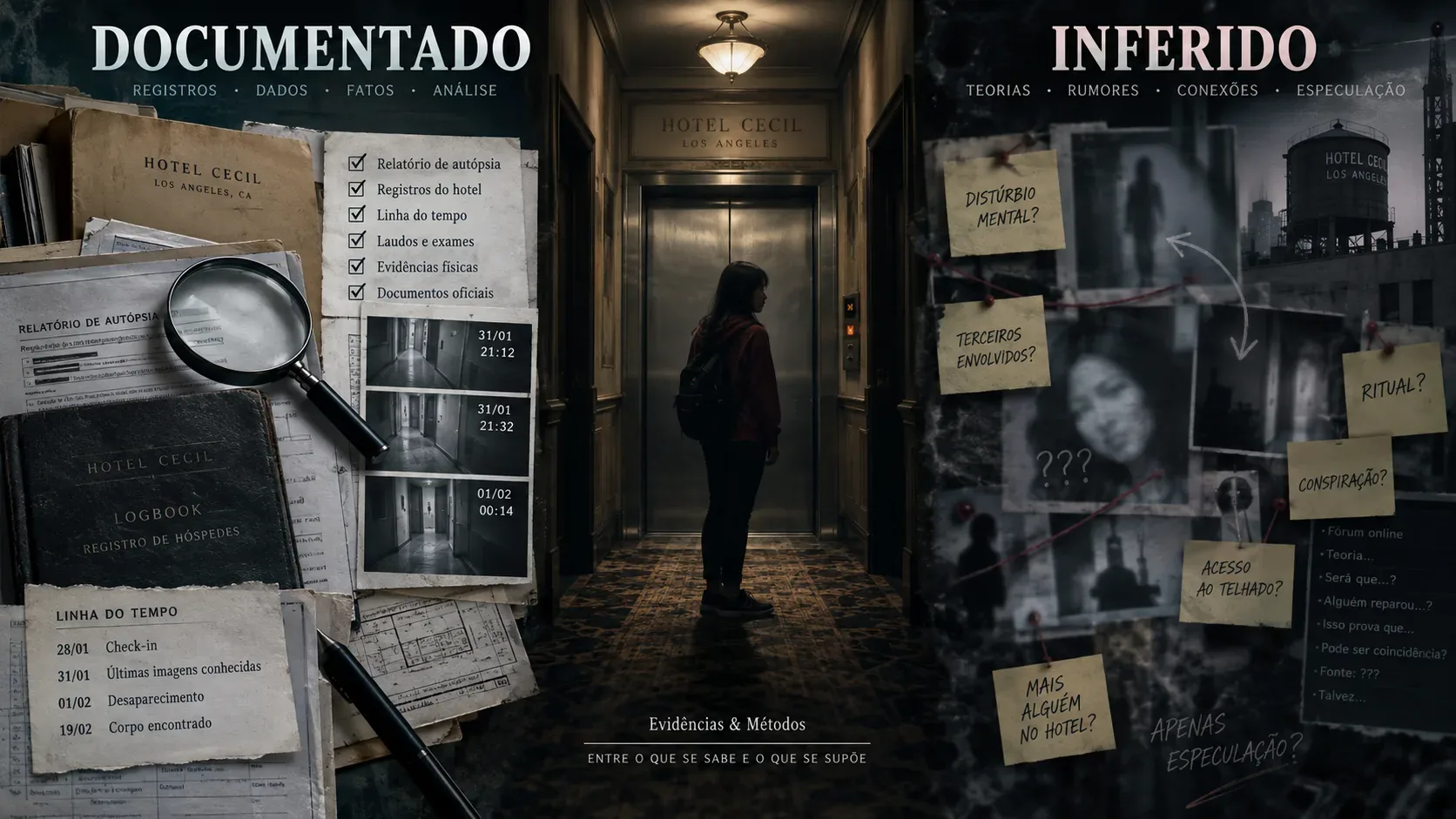
The Elisa Lam case took on a second life online because an elevator video appears open to interpretation. The documentary record is less ambiguous on some points and more limited on others. The Los Angeles County coroner's autopsy listed drowning as the cause of death and accident as the manner of death, with bipolar disorder recorded as a significant condition. The same report noted no trauma and referred to toxicology that did not attribute the death to drugs. At the same time, none of those documents reconstructs, minute by minute, how Lam reached the roof, why she entered the tank, or exactly what explains each gesture seen in the elevator.
What the evidence allows us to say
| Documented | What this does not prove |
|---|---|
| The medical examiner report attributed the death to drowning and classified the manner of death as an accident. | The report does not describe a complete sequence of movements from the elevator to the tank. |
| The autopsy recorded no trauma and moderate decomposition. | The absence of trauma does not, by itself, establish everything that happened before death. |
| Toxicology did not detect illicit substances such as cocaine, methamphetamine, MDMA, opiates, fentanyl, PCP or THC in the tested heart blood. The report also recorded prescription medications or metabolites in specific samples. | The results do not, by themselves, establish Lam's mental state at a particular moment or turn postmortem concentrations into a simple story of medication adherence or nonadherence. |
| The elevator video shows Lam alone within the visible frame. The coroner investigator recorded that no other person was seen in the footage. | A single camera does not show what was outside the frame, in other corridors, rooms, stairways or on the roof. |
| Her body was found on February 19, 2013, in a rooftop water tank. The investigator described an unsecured removable metal hatch, and the employee who found the body later stated that the hatch was open. | Those records do not identify a witness who saw Lam reach the roof or enter the tank. |
The autopsy establishes the cause of death, not the entire sequence
The public copy of the Los Angeles County Department of Coroner report, case 2013-01364, lists the immediate cause as drowning and marks accident as the manner of death. Bipolar disorder appears in a separate field as a significant condition not related to the immediate cause. The anatomic summary records moderate decomposition, no trauma, and points to separate toxicology and microscopic reports.
That distinction matters. A forensic death investigation primarily answers two questions: what caused the death and how the death is classified. It does not function as a recording of events. The presence of a medical condition in the report does not mean the report diagnosed, from the elevator video, what Lam was thinking or perceiving at that moment.
The microscopic report also recorded autolysis in the examined tissues. That does not invalidate the medical examiner's conclusion, but it is a reason to be cautious about claims that extract details from the autopsy that the document itself does not provide.
Toxicology does not mean that "nothing was found"
A common summary says the toxicology was "negative." That is imprecise. In heart blood, the report recorded ethanol as negative and did not detect a range of recreational drugs. It also recorded bupropion metabolites and venlafaxine as present, quetiapine as not detected, and quantities insufficient for measurement for ibuprofen and lamotrigine in that sample. In liver tissue, venlafaxine and lamotrigine were quantified. Contemporary Los Angeles Times coverage summarized the official conclusion that drugs did not contribute to the death.
The careful takeaway is that toxicology helps exclude intoxication by several substances as an explanation for the death, but it should not be used on its own to build a retrospective diagnosis of the behavior seen in the video. Claims about doses taken, treatment discontinuation or symptoms require clinical and forensic toxicology context beyond a surface reading of a laboratory table.
What hotel and court records say about roof access
While Lam was still missing, the LAPD publicized her disappearance and, on February 13, released the elevator footage in an effort to obtain information. On February 19, a maintenance employee found her body while checking the water tanks after complaints about low water pressure.
Documents from the civil lawsuit filed by Lam's parents against Cecil Hotel management add relevant details about access. Declarations assembled in the case describe an alarmed roof door and alternative routes involving fire escapes. Maintenance worker Santiago Lopez stated that he had to deactivate the roof-door alarm, climb to the tank platform and then use another ladder to reach the top of the reservoir. According to his declaration, the tank hatch was open when he looked inside. A copy of the civil case documents is available online.
This record matters because it contradicts a widely repeated online claim that the tank lid was found closed, which would imply that another person had to replace it. The coroner investigator's narrative describes an unsecured removable metal hatch, and Lopez's account says it was open when the body was found.
That still does not establish the exact route to the tank. The existence of an alarmed door does not mean it was the only possible route, and the documents do not provide an eyewitness account of Lam reaching the roof. The precise formulation is that roof access was restricted and had barriers, but later records describe more than one physical route.
What the elevator video shows and what it cannot demonstrate
The footage shows Lam entering the elevator, pressing multiple buttons, moving in and out of the cab, looking into the hallway and making hand movements. The coroner investigator's narrative records that no other person appears in the video and states that she does not appear to be chased. The first point is a direct observation of the frame. The second is the investigator's interpretation.
The video alone does not prove that someone was outside the frame, but it also does not prove that Lam had no contact with anyone elsewhere or at another time. It does not prove a supernatural cause, identify an attacker, establish a motive or allow a reliable diagnosis of a specific psychiatric episode. It also does not show the roof, the route to the tanks or entry into the reservoir.
This is the central methodological limit of the case: surveillance images feel concrete, but they remain a partial sample. The more an explanation depends on something the camera did not record, the more it shifts from observation to inference.
Dates and records also require care
There are small differences in the public chronology. The LAPD's initial release said Lam had last been seen on January 31. The coroner investigator's narrative, however, says the elevator footage was reported to be from February 1 and calls that date the last time she was known alive. These differences do not change the medical examiner's conclusion, but they show why a responsible timeline should identify the source for each date instead of merging every reference into a single supposedly perfect record.
What remains unresolved by the documented evidence
- The exact route to the roof: the records describe possible access points, but do not document the path Lam actually used with a witness or continuous video.
- Why she entered the tank: the death was classified as an accident, but there is no recorded witness to the moment of entry.
- What explains every gesture in the elevator: there are hypotheses, but the video does not provide direct access to Lam's mental state.
- The minute-by-minute sequence between the elevator and the death: there is no continuous recording connecting those events.
- The exact moment of death: the report identifies the cause and classification, but it does not provide a precise chronology that fills the entire period of disappearance.
How to separate evidence from narrative in this case
A responsible reading begins with source hierarchy. First come the coroner report and investigator's narrative, police records and sworn civil declarations from people directly involved. Contemporary reporting then helps contextualize dates and official decisions. Internet theories come last. They may raise questions, but repetition does not turn them into facts.
Using that method, the conclusion is more restrained than the popular theories. It is documented that Lam died by drowning, that the manner of death was classified as accidental, that no trauma was identified, that drugs were not considered a cause of death, and that the tank opening was described as open or unsecured when her body was located. What is not documented is a complete reconstruction of how she reached the reservoir, her precise reason for entering it, or a definitive explanation for each behavior recorded by the camera.
That is the boundary the elevator video cannot cross. It is an important piece of visual evidence, but it does not replace the documentary record or turn what happened outside the frame into fact.