On March 18, 1990, two men dressed as police officers entered the Isabella Stewart Gardner Museum in Boston, subdued two guards, and stole 13 items. The haul included paintings, drawings, a small Rembrandt etching, an ancient Chinese bronze vessel, and an eagle-shaped finial. The official pages consulted on September 27, 2026, still describe the case as unsolved and the search as active. The FBI has publicly stated investigative conclusions about who it believes the thieves were and the route taken by some of the art. That is not the same as publicly establishing the perpetrators' identities or locating the works today.
How the March 18, 1990, theft unfolded
According to the museum and the FBI, the pair claimed to be responding to a disturbance and were admitted through the staff entrance in violation of security procedures. After overpowering the two guards, they restrained them in the basement. The intruders spent about 81 minutes in the building and removed items from three rooms.
- In the Dutch Room on the second floor, they took works by Vermeer, Rembrandt, and Govaert Flinck, as well as an ancient Chinese bronze vessel. Two Rembrandt paintings were cut from their frames.
- In the Short Gallery, also on the second floor, five works by Edgar Degas and an eagle finial disappeared.
- In the Blue Room on the first floor, they took Édouard Manet's painting Chez Tortoni.
- The museum says the pair left at 2:45 a.m., making two trips to their car. The guards remained restrained until police arrived at 8:15 a.m.
What are the 13 missing items?
The list below follows the museum's published inventory. Original titles help readers identify each object in collection catalogues and recovery notices. The two entries titled Study for the Programme represent separate works, not an accidental duplicate.
| No. | Work or object | Artist or origin | Type | Room taken from |
|---|---|---|---|---|
| 1 | The Concert | Johannes Vermeer | Painting | Dutch Room |
| 2 | Christ in the Storm on the Sea of Galilee | Rembrandt van Rijn | Painting | Dutch Room |
| 3 | A Lady and Gentleman in Black | Rembrandt van Rijn | Painting | Dutch Room |
| 4 | Portrait of the Artist as a Young Man | Rembrandt van Rijn | Small etching | Dutch Room |
| 5 | Landscape with an Obelisk | Govaert Flinck | Painting | Dutch Room |
| 6 | Gu | China, unidentified maker | Bronze vessel | Dutch Room |
| 7 | Study for the Programme (1 of 2) | Edgar Degas | Drawing | Short Gallery |
| 8 | Study for the Programme (2 of 2) | Edgar Degas | Drawing | Short Gallery |
| 9 | Leaving the Paddock | Edgar Degas | Drawing | Short Gallery |
| 10 | Procession on a Road near Florence | Edgar Degas | Drawing | Short Gallery |
| 11 | Three Mounted Jockeys | Edgar Degas | Drawing | Short Gallery |
| 12 | Eagle Finial | Antoine-Denis Chaudet (museum catalogue) | Eagle finial | Short Gallery |
| 13 | Chez Tortoni | Édouard Manet | Painting | Blue Room |
The total of 13 includes different media and techniques: these were not 13 paintings. The youthful Rembrandt self-portrait is a small etching; the Gu is a Chinese bronze vessel; and the Eagle Finial is a decorative object associated with Napoleonic imagery. The museum catalogues the latter under Antoine-Denis Chaudet's name.
What the FBI actually confirms about the thieves and the art's location
The FBI documents how the two men entered, the restraint of the guards, the stolen inventory, and the continuing search. It describes the items as valued at more than $500 million at the time of the theft. That figure is a stated valuation for the group, not a verified sale price for each item.
In a joint statement dated March 18, 2013, the FBI said it had identified the thieves with a high degree of confidence and linked them to a criminal organization based in the mid-Atlantic states and New England. It also said works had been moved to Connecticut and the Philadelphia area and that some had been offered for sale. The statement did not publish a named list of perpetrators and acknowledged that its knowledge of the works' whereabouts after that period was limited.
In the public wanted notice consulted for this article, the FBI says it has determined that the 13 items were separated after the theft. It says some are believed to have traveled along the U.S. East Coast, through the mid-Atlantic and southward, while stressing that their present location could be anywhere in the world. An investigated route is therefore not a confirmed storage address.
In 2015, the FBI released footage of an unauthorized museum entry on the day before the crime. It showed an unidentified man and a vehicle, and the release sought new leads. The footage alone does not establish that the visitor was one of the two thieves.
In a 2023 official podcast, Agent Geoffrey Kelly said the investigation had working theories about where the art had traveled but acknowledged those theories could be wrong. In the same interview, he said investigators had received no credible information that any of the pieces had been destroyed. That is not proof that all 13 remain intact.
What remains unproven in the public record
There is a difference between the FBI expressing confidence in an investigative lead and releasing conclusive public proof about specific people. The museum still calls the theft unsolved. The institutional sources consulted here do not justify presenting names circulated in books, documentaries, or news reports as perpetrators established by a court.
These releases also do not publicly confirm a hiding place for any of the 13 objects, a completed sale of the entire group, or the destruction of the art. Theories involving inside assistance, particular criminal groups, or international destinations should be identified as theories or attributed allegations, not stated as facts established by the FBI.
Rewards, empty frames, and how to submit information
The museum continues to offer up to $10 million for information leading to the safe return of the art in good condition and provides for a proportionate share when individual items are recovered. It also offers an additional $100,000 for the eagle finial. The FBI explicitly says it does not administer these rewards or their terms.
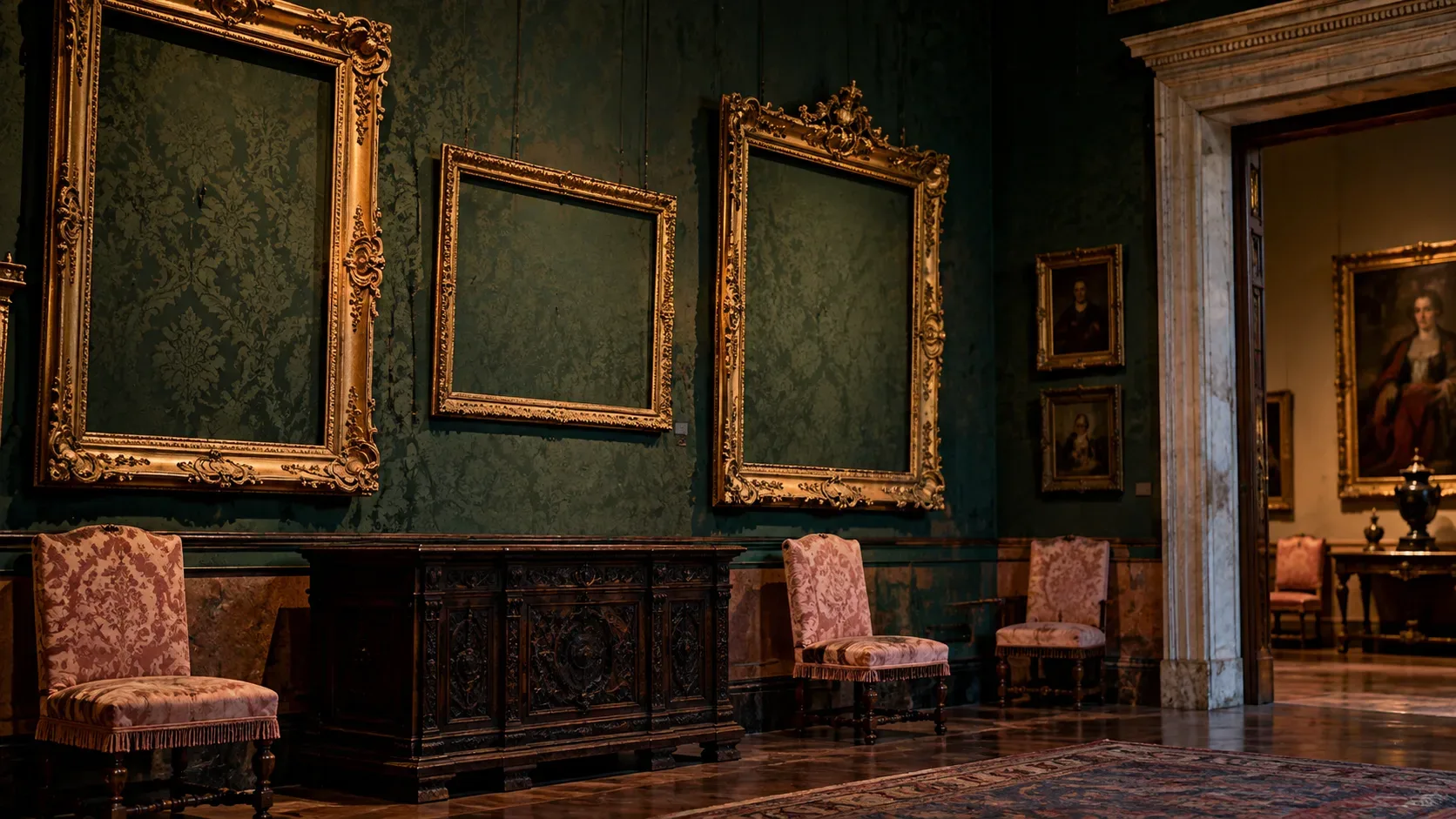
Anyone with information can reach the FBI at 1-800-225-5324 or tips.fbi.gov. The museum lists +1 617-278-5114 and reward@gardnermuseum.org. The empty frames in the Dutch Room were rehung in 1994 as reminders of the losses and a sign of the intention to recover the paintings. Their presence does not suggest the missing works have already been found.
Sources and references
- FBI: Gardner Museum heist case history
- FBI: public notice seeking the stolen art
- Isabella Stewart Gardner Museum: account and inventory of the 13 items
- U.S. Department of Justice: March 18, 2013, announcement
- FBI: security footage release, August 6, 2015
- FBI: official investigation interview, June 23, 2023