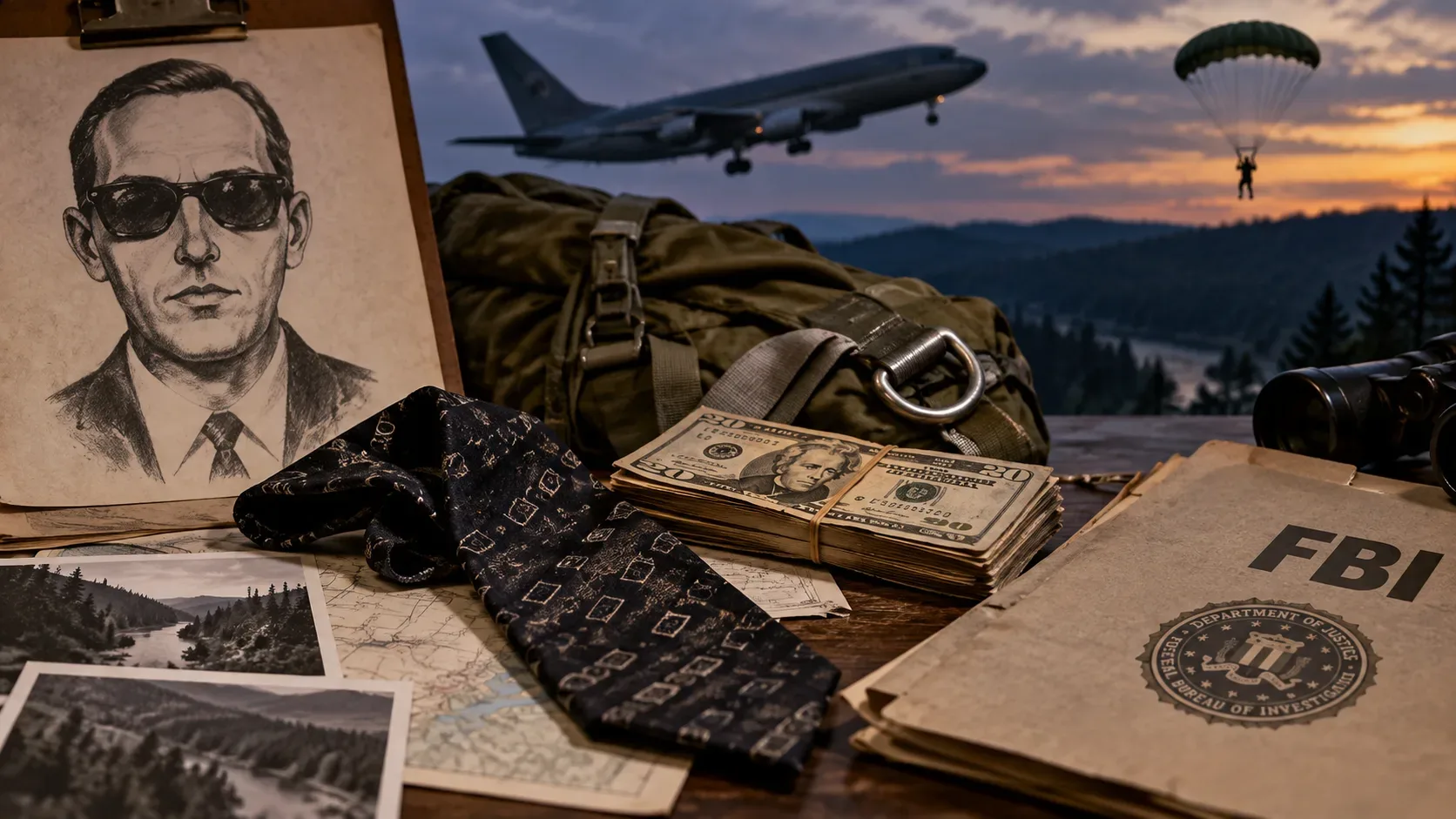
On November 24, 1971, a man who bought a ticket as Dan Cooper hijacked Northwest Orient Flight 305 between Portland and Seattle. He demanded $200,000 in $20 bills and four parachutes, released the passengers in Seattle, and later jumped from the rear of the Boeing 727 in flight. The FBI never identified him definitively. The name “D.B. Cooper” came from press coverage, not from the name used by the hijacker. The clearest way to separate fact from theory is to ask what each piece of evidence actually supports.
What is confirmed in the D.B. Cooper case
The FBI historical account confirms the core elements of the hijacking: the man's true identity remains unknown, the ransom was delivered, the jump occurred after the aircraft left Seattle, and part of the money was found years later. The FBI also preserves a large collection of records in the FBI Vault.
| Evidence | What it supports | What it does not prove |
|---|---|---|
| $5,800 in ransom money found in 1980 | The serial numbers matched the money delivered to the hijacker. This directly links the bills to the 1971 ransom. | It does not show how the money reached the site, where Cooper landed, whether he died in the jump, or who he was. |
| Black tie left on the aircraft | The FBI says Cooper wore the J.C. Penney tie and removed it before the jump. The item later yielded a DNA sample. | A DNA sample on an object does not, by itself, equal a definitive individual identification. In 2016 the FBI said no lead had produced a conclusive identification. |
| Parachutes delivered to the hijacker | The FBI records that Cooper demanded four parachutes, jumped carrying two, and used cord from one of the remaining parachutes to tie the money bag. | The parachutes left behind do not establish the fate of the main parachute used in the jump, nor do they prove Cooper's experience level or survival. |
| Witness descriptions and composite sketch | They provided a visual profile and helped the FBI eliminate suspects who did not match descriptions considered consistent. | Without sufficient forensic or documentary linkage, physical resemblance does not identify the hijacker. |
The 1980 money directly links to the ransom, but it does not solve the case
On February 10, 1980, eight-year-old Brian Ingram found $5,800 in deteriorated $20 bills on a Columbia River sandbar known as Tena Bar in Washington. HistoryLink documents the discovery, and the FBI confirms that the serial numbers matched the batch delivered to Cooper.
That match is strong because it does not depend on witness memory or visual resemblance. The bills were ransom money. The limitation begins with the next step: their presence at Tena Bar does not explain the route by which they arrived there. River movement, human transport, later deposition, and other scenarios must be tested separately. The find also does not demonstrate that Cooper died, because lost money and survival are not mutually exclusive.
The tie is a real artifact from the aircraft, but the DNA has limits
According to the FBI, Cooper wore a black J.C. Penney tie that he removed before the jump. The agency says the tie later provided a DNA sample. That makes the object important for forensic comparison, but it does not turn every partial match, biological trace, or indirect association into an automatic identification.
The decisive point comes from the FBI's own review of the investigation. In July 2016, the FBI stated that none of the many tips, new techniques, or laboratory examinations had produced the proof needed for a definitive identification of the hijacker. Modern claims that the “case was solved by DNA” therefore need to be tested against chain of custody, sample quality, the comparison method, and independent confirmation.
The parachutes reveal operational choices, not the outcome
Cooper asked for four parachutes. The FBI records that he left the aircraft carrying two, including a training unit that had been sewn shut and could not be used normally, and that he used cord from one of the remaining parachutes to secure the money bag. One unused parachute remained as evidence.
The FBI also noted that the parachute used for the jump could not be steered, that Cooper's clothing and footwear were poorly suited to a difficult landing, and that he jumped at night over wooded terrain. Those factors make the possibility that he did not survive plausible, but they do not prove it. Neither the main parachute from the jump nor a body has been recovered in a confirmed way.
Why famous suspects remain hypotheses
Within the first five years, the FBI had considered more than 800 suspects and eliminated most of them. Richard Floyd McCoy, for example, became a well-known candidate after committing a similar hijacking only months later. The FBI says it nevertheless ruled him out because he did not match the physical descriptions provided by two flight attendants and for other investigative reasons.
This example illustrates a useful rule: similarity of method is not identity. A D.B. Cooper theory has to explain the confirmed evidence and also survive evidence that cuts against it. Biographical coincidences, parachuting skills, similar photographs, or family stories may justify investigation, but they do not replace proof directly connected to Flight 305.
What changed when the FBI stopped actively investigating
On July 8, 2016, after 45 years of the NORJAK investigation, the FBI redirected the case's resources to other priorities. The statement published on July 12 says the agency had reviewed credible leads, coordinated searches, collected available evidence, and interviewed identified witnesses. It also says no tip had resulted in a definitive identification.
This does not mean the FBI declared that it knew who Cooper was or accepted a specific theory. The agency said it would no longer actively investigate the case, but asked people with specific physical evidence related to the parachutes or the money to contact a local FBI field office. The distinction matters: the case left active investigative priority without gaining an official solution.
How to evaluate a new D.B. Cooper theory
- Start with the physical link. Does the theory explain the serial-numbered ransom money, the tie, and the parachutes without inventing missing facts?
- Separate compatibility from identification. Resembling the composite sketch or having aviation experience may make a person interesting, but it does not identify that person.
- Look for chain of custody and method. DNA, particles, documents, and objects gain weight only when their origin and analytical process are verifiable.
- Test what the theory fails to explain. A strong hypothesis must address contradictions, not just collect favorable coincidences.
- Use the official standard as a reference. The FBI ended active investigation because decades of work and new techniques still did not produce sufficient proof for a definitive identification.
What genuinely remains open
There is a solid factual core: a man using Dan Cooper on his ticket hijacked Flight 305, received $200,000 and parachutes, jumped after Seattle, left objects on the aircraft, and was never officially identified. Part of the ransom, $5,800, surfaced in 1980. The tie yielded DNA. Parachutes and cord preserve details of the preparation. None of these facts, alone or together so far, closes the question of the hijacker's identity or his fate after the jump.
That is why the case remains useful as an example of investigative method: evidence can narrow possibilities without producing a final conclusion. In the D.B. Cooper case, the boundary between what is proven and what is merely plausible is the part that matters most.