Increasing fiber without worsening gas and discomfort usually depends less on making a radical change and more on the pace. The starting point is to raise intake gradually, spread fiber-rich foods across the day, and keep fluid intake adequate. If the gut reacts poorly to a sudden change, that does not mean all fiber is a problem.
How much fiber to aim for each day
The NIDDK states that adults, depending on age and sex, should get about 22 to 34 g of fiber per day. This range is a reference, not a target that needs to be reached all at once. People who currently eat little fiber often tolerate an increase better when changes are gradual.
In guidance specifically for irritable bowel syndrome, the NIDDK notes that adding about 2 to 3 g of fiber per day may help prevent gas and bloating linked to rapid increases. That figure does not need to be treated as a universal rule, but it illustrates the main principle: small increases are often easier to tolerate than large jumps.
How to increase fiber without worsening gas
A practical strategy is to change one part of the diet at a time and watch how the body responds before moving on. Instead of adding oats, seeds, legumes, fruit with skin, and a large volume of vegetables on the same day, choose one or two changes and expand variety gradually.
| Meal | Practical swap | How to progress |
|---|---|---|
| Breakfast | Replace a refined cereal with oats or whole-grain bread | Start with a usual serving and increase only if it is well tolerated |
| Lunch | Add beans, lentils, or chickpeas | Use a smaller serving at first if legumes commonly cause gas |
| Snack | Choose whole fruit, with edible skin when appropriate | Introduce one fruit at a time to make tolerance easier to assess |
| Dinner | Increase vegetables and leafy greens | Avoid sharply increasing the volume of several vegetables at once |
Fluids help fiber work better
The NIDDK recommends drinking water and other liquids to help fiber work better and support softer stools that are easier to pass. There is no single fluid target that fits everyone. Needs vary with body size, health, activity level, and environment.
In practice, when fiber intake goes up, it makes sense to review hydration as well. Increasing fiber while fluid intake remains very low may make intestinal adaptation harder for some people.
Which foods can help raise fiber intake
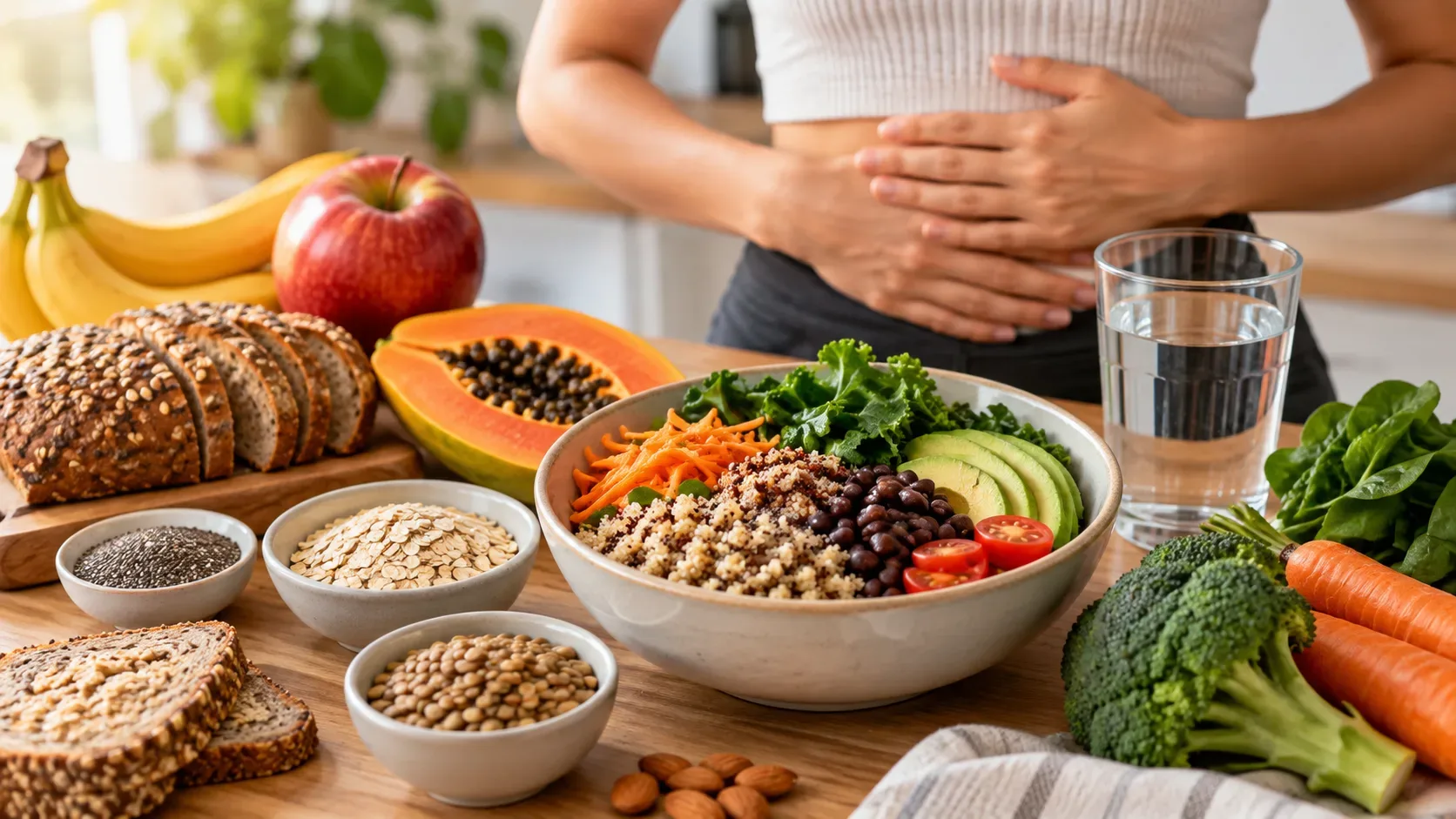
Good food sources listed by the NIDDK include whole grains, oats, legumes, fruit, vegetables, and nuts. Combining different food groups helps avoid relying on a single concentrated source.
- Whole grains: oats, whole-grain bread, and whole-grain pasta.
- Legumes: beans, lentils, chickpeas, and soybeans.
- Fruit: berries, apples with the skin on, oranges, and pears.
- Vegetables: carrots, broccoli, green peas, and leafy greens.
- Nuts and seeds: these can complement intake, but highly concentrated sources are best introduced in moderate portions at first.
For people with irritable bowel syndrome, the NIDDK notes that soluble fiber may be more helpful for symptom relief than insoluble fiber. Oats, fruit, and beans provide soluble fiber, while whole-grain products and many vegetables provide insoluble fiber. For people with frequent symptoms, the type of fiber may matter as much as the total amount.
Signs that the pace may be too fast
More gas, bloating, or discomfort soon after a major dietary change suggests that slowing down may help. A practical approach is to return to the amount that was well tolerated, keep intake stable, and make the next increase smaller.
It also helps to notice whether discomfort appears with any increase in fiber or is linked to a specific food. If one source repeatedly causes symptoms, another fiber source can be tested instead of abandoning the goal of increasing fiber altogether.
When to seek professional evaluation
If constipation, pain, gas, or discomfort does not improve with self-care, it is reasonable to speak with a health professional or dietitian to individualize the plan. The NIDDK advises more urgent medical evaluation when constipation occurs with rectal bleeding, blood in the stool, constant abdominal pain, inability to pass gas, vomiting, fever, or unintentional weight loss.
A simple plan to put into practice
- Identify where your current diet already contains fiber and where a simple swap would fit.
- Increase one or two sources at a time instead of trying to reach the daily range within a few days.
- Spread fiber-rich foods across meals and snacks.
- Pay attention to hydration as fiber intake rises.
- If gas and bloating worsen, slow the pace and increase again more gradually.
- If symptoms are persistent, severe, or come with warning signs, seek professional evaluation.
Sources: NIDDK, eating and nutrition for constipation; NIDDK, eating and irritable bowel syndrome; NIDDK, constipation symptoms and warning signs.