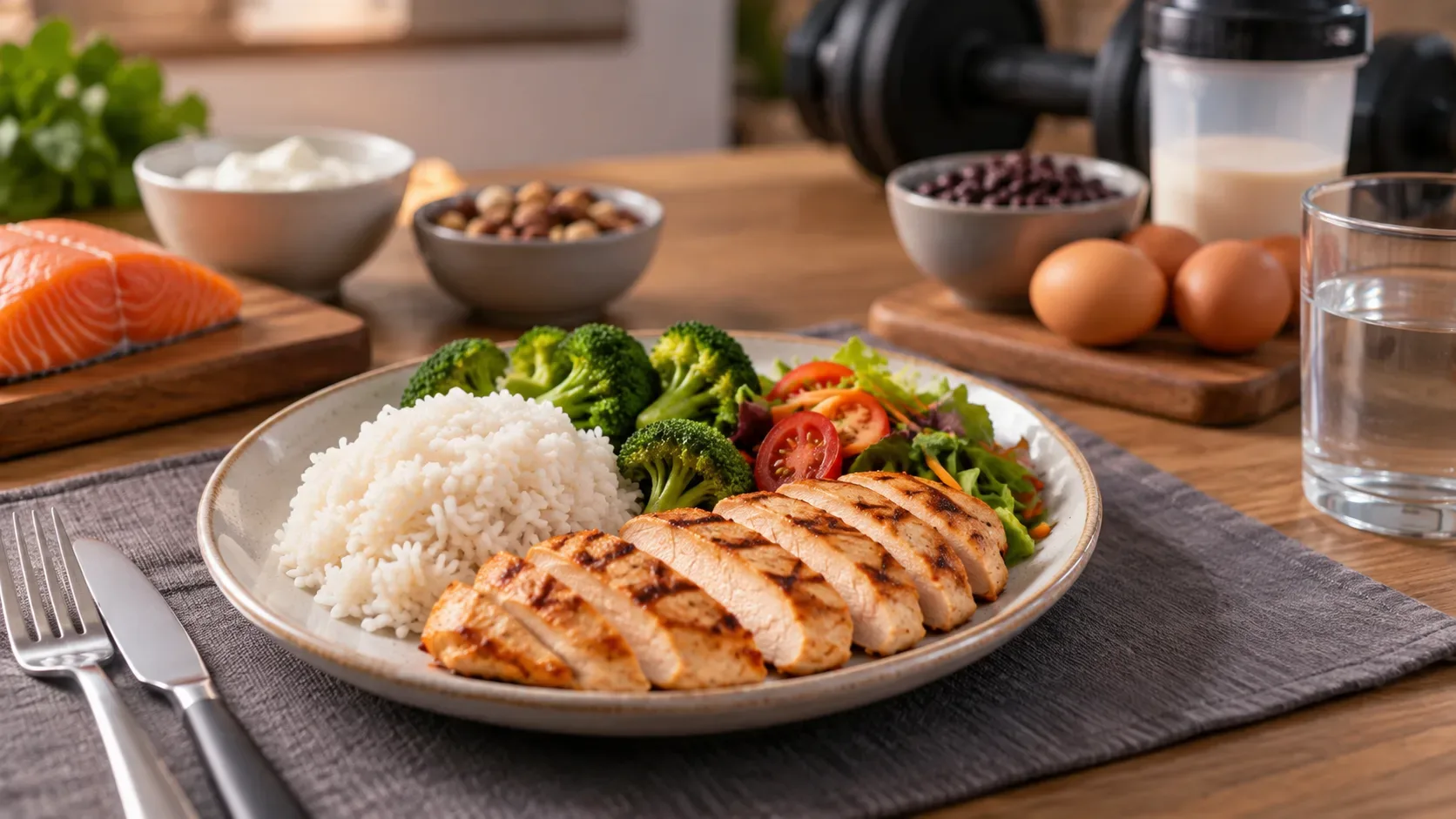
There is no universal number of grams of protein per meal after which the body simply stops absorbing protein or wastes everything above that amount. The confusion comes from treating two different questions as if they were the same: how much ingested protein is digested and absorbed, and how much of a single dose maximizes muscle protein synthesis in a specific context.
For people who resistance train and want to gain or preserve muscle mass, total daily protein remains the first target to get right. Distribution across meals can help organize that total and create several muscle protein synthesis stimuli during the day, but per-meal ranges are better viewed as practical references, not as rigid limits on utilization.
Absorbing protein is not the same as maximizing muscle protein synthesis
After a meal, protein is digested into peptides and amino acids, which enter circulation and can be used by muscle and by many other tissues and processes. The idea that everything above 20, 30, or 40 g is automatically lost oversimplifies metabolism.
A review focused specifically on this question concluded that larger doses can increase amino acid oxidation, but that does not mean every additional amino acid has the same fate. Some can continue to contribute to protein synthesis and turnover in the body. The same review proposed 0.4 g/kg per meal across at least four meals as a practical target to reach about 1.6 g/kg/day, and noted that a daily intake of 2.2 g/kg/day spread across four meals would equal about 0.55 g/kg per meal. These are planning references, not absorption limits. Source: Schoenfeld and Aragon review.
What per-meal ranges actually mean
A position stand from the International Society of Sports Nutrition notes that the per-meal dose that supports muscle protein synthesis varies with age, recent exercise stimulus, protein quality, and other factors. As a general guide, it cites about 0.25 g/kg of high-quality protein or approximately 20 to 40 g per dose, ideally distributed across the day. Source: ISSN.
This helps explain why a fixed gram amount cannot work equally well for everyone. A 55 kg person and a 95 kg person have very different body sizes, daily intakes, and meal patterns.
| Body weight | 0.4 g/kg per meal | 0.55 g/kg per meal |
|---|---|---|
| 60 kg | 24 g | 33 g |
| 70 kg | 28 g | 38.5 g |
| 80 kg | 32 g | 44 g |
| 90 kg | 36 g | 49.5 g |
The table only converts the body-weight references into grams. It does not mean eating above those numbers is useless.
Total daily protein is the priority before optimizing each meal
For most people who exercise, the ISSN position stand states that about 1.4 to 2.0 g/kg/day is sufficient to build or maintain muscle mass in a training context. Source: ISSN.
A meta-analysis of 49 studies and 1,863 participants found that protein supplementation supported gains in strength and fat-free mass during resistance training, and its statistical model found no additional average fat-free mass gain above about 1.62 g/kg/day under the conditions studied. That breakpoint describes the average pattern in the included studies, not an individual biological ceiling. Source: Morton and colleagues.
In practice, debating whether one meal contains 28 or 35 g matters little if the daily total is far below what the goal requires. Daily adequacy comes first; distribution comes next.
Spreading protein across meals can help, but it is not a mathematical rule
A relatively even distribution offers a simple way to create several opportunities for muscle protein synthesis. The ISSN suggests doses spaced about every 3 to 4 hours, and the 2018 review uses four meals as a practical structure. Even so, long-term evidence does not show that perfectly even distribution is mandatory for everyone.
A 2024 review emphasizes that the effects of distribution are intertwined with age, physical activity, total protein quantity, and protein quality, and that the importance of distribution for muscle mass remains less clearly defined than the importance of consuming enough protein over the day. Source: 2024 review.
The 100 g study further weakened the idea of a rigid ceiling
A 2023 study followed young adults after exercise and compared 25 g with 100 g of protein. The 100 g dose produced a larger and more prolonged anabolic response, lasting more than 12 hours in some measures, with greater amino acid availability and incorporation into muscle proteins. Source: Trommelen and colleagues.
This result matters because it shows that a large meal does not become metabolically irrelevant after a fixed point. At the same time, it does not prove that 100 g at every meal is the best strategy for hypertrophy. The study was controlled, involved a specific population, and measured acute responses after exercise. Everyday decisions still need to account for daily total, number of meals, tolerance, total energy intake, and preference.
How to adjust for body size, number of meals, and training
- Body size: g/kg references are more useful than one fixed gram target for everyone.
- Number of meals: someone eating three times per day will probably need more protein in each meal to reach the same daily total as someone eating four or five times.
- Training: resistance exercise increases muscle sensitivity to protein for many hours. There is no need to treat a few minutes after training as the only useful window.
- Quality and meal composition: proteins with adequate essential amino acids and complete meals can have different digestion and amino acid release patterns than an isolated supplement.
- Age and individual context: the response to a dose can change with age, training status, and other characteristics. A practical range should therefore not become an absolute rule.
A simple way to organize intake
- First set a daily target that fits the goal and training demands.
- Choose a number of meals that is realistic for your routine.
- Divide the daily total across those meals and use something near 0.4 g/kg per meal as a practical reference if it fits the plan.
- Place one or more protein-containing meals near training according to your routine and tolerance, without depending on an exact minute.
- If one meal occasionally contains more protein, do not treat the amount above a target as automatically wasted.
Example: an 80 kg person planning 1.6 g/kg/day reaches 128 g per day. Across four meals, the average is 32 g per meal, exactly 0.4 g/kg. Across three meals, the average rises to about 43 g. The second arrangement does not violate an absorption limit; it simply changes distribution.
When more protein in one meal stops being practical
Even without a rigid absorption ceiling, very large protein servings may be unnecessary for some goals or hard to fit into a diet. Satiety, gastrointestinal comfort, calories, dietary variety, and room for carbohydrates, fats, fruits, vegetables, and fiber also matter. A protein strategy has to work within the diet as a whole.
The ranges discussed here mainly refer to healthy, physically active adults. People with clinical conditions that change protein requirements or protein management should follow individualized guidance from a health professional.
In summary
The body does not switch off protein absorption after 20, 30, or 40 g. What tends to show a response range is muscle protein synthesis measured under specific conditions, and even that should not be turned into a universal limit. For people who train, getting the daily total right is usually more important than chasing an exact number at every meal. Distributing that total in doses that fit body weight, routine, and training is a useful refinement.
As a practical reference, about 0.4 g/kg per meal across four meals is a reasonable way to organize 1.6 g/kg/day, while 0.55 g/kg per meal would correspond to 2.2 g/kg/day across the same number of meals. Use these ranges as planning tools, not as the point where the body stops using protein.
Main sources
- Schoenfeld and Aragon, 2018: protein per meal and daily distribution
- ISSN, 2017: position stand on protein and exercise
- Morton and colleagues, 2018: meta-analysis of protein and resistance training
- Trommelen and colleagues, 2023: anabolic response to 25 g and 100 g
- 2024 review on protein quantity and distribution