The best pre-workout meal is not universal. The right choice depends on how much time remains before training, how demanding the session will be, and how your gastrointestinal tract responds to food volume, fat, fiber, and different foods. In general, the closer you are to exercise, the smaller, simpler, and easier to digest the intake should be. The longer or more intense the session, the more important it tends to be to start with carbohydrate available.
Sports nutrition guidelines treat timing as a tool, not as an isolated rule. The International Society of Sports Nutrition position stand on nutrient timing notes that carbohydrate and protein can be distributed around exercise, but that the size and timing of the pre-exercise meal change how much is needed afterward. The joint position of the Academy of Nutrition and Dietetics, Dietitians of Canada, and the American College of Sports Medicine likewise emphasizes that food type, amount, and timing should be adjusted to the training scenario and the individual.
The practical rule: the clock changes the meal format
The time available before training helps determine how much volume is realistic and how complex the meal can be. The matrix below is not a meal plan or a prescription. It organizes priorities so you can build an option that fits your routine and tolerance.
| Time before training | Main goal | Carbohydrate | Protein | Fat and fiber | More tolerable format |
|---|---|---|---|---|---|
| 30 to 60 min | Start with energy without a heavy stomach | Prioritize easy-to-digest sources, especially if the workout is intense or prolonged | Optional in a small amount if well tolerated and the previous meal was several hours ago | Reduce if they tend to cause bloating, reflux, urgency, or slow digestion | Small snack, low volume, familiar food; liquids or semi-solid foods may help some people |
| 1 to 2 h | Balance fuel with gastrointestinal comfort | Should form the base when the session places high demands on glycogen | A moderate amount usually fits well | Can be included in smaller amounts depending on tolerance | Substantial snack or small meal without excessive volume |
| 3 to 4 h | Have a complete meal with time to digest | An important base for long, interval, or high-intensity training | A high-quality source can be included normally in the meal | There is more room for fat and fiber, but people with symptoms should adjust | Complete, familiar meal with a portion matched to hunger and the workout |
Carbohydrate: priority rises with duration and intensity
Carbohydrate is a central fuel for higher-intensity efforts and long sessions. That does not mean every workout needs a special carbohydrate load. A short, easy session may start perfectly well after a normal day of eating, especially if you ate within the previous few hours and are not hungry.
For events or training sessions that require high carbohydrate availability, sports nutrition documents commonly cite a broad range of 1 to 4 g of carbohydrate per kg of body mass during the 1 to 4 hours before exercise. This range is a reference for sports settings, not a mandatory target for every person or every workout. The useful principle is the logic behind it: the more time available and the higher the session demand, the larger the meal can be; the closer you are to the start, the more important it becomes to reduce volume and choose foods with predictable digestion.
If training lasts longer than about an hour and includes high intensity, exercise itself increases fuel demand. The ISSN position stand notes that prolonged, intense exercise challenges energy supply and may require a carbohydrate strategy during the session as well. That makes it even more useful to avoid starting after an unplanned long fast.
Protein: useful around training, but the whole day still matters
Protein before exercise can make sense, especially when the last protein-containing meal was several hours earlier. However, there is no need to force a large dose immediately before training for the session to be productive. The ISSN considers total daily protein and regular distribution across the day important priorities, and notes that doses of roughly 20 to 40 g of high-quality protein can robustly stimulate muscle protein synthesis in many adults who train.
In practice, proximity to training changes the role of protein. With 3 to 4 hours available, it can be part of a normal meal. With 1 to 2 hours, a moderate portion tends to be more comfortable. With only 30 to 60 minutes, prioritize tolerance and avoid turning the pre-workout snack into a bulky meal just to hit a number. The post-workout meal and the rest of the day count too.
Fat and fiber are not enemies, but they can get in the way when time is short
Fat and fiber belong in a healthy diet. The pre-workout caution is situational. Large meals that are very high in fat or fiber can increase fullness and, in susceptible people, contribute to discomfort when exercise begins soon afterward. Therefore, the shorter the interval before training, the more reasonable it is to reduce these components if you already know they worsen your symptoms.
This does not require cutting fiber from the entire day or following a restrictive diet. The goal is simply to move slower-digesting or more fermentable foods to times when the gut has more room. A recent review on exercise-associated gastrointestinal symptoms also highlights that large meals very close to exercise increase the risk of nausea, reflux, cramps, and bloating, whereas smaller, simpler snacks tend to be better tolerated by people who need to eat close to a session.
How to adjust for the session you are about to do
- Short, easy workout: if you had a normal meal in the previous hours and feel well, you may not need a specific pre-workout snack. Hunger, time of day, and the gap since your last meal are more useful than following a fixed routine.
- Moderate workout around one hour: a snack or light meal with carbohydrate may improve the sense of available energy, especially if the previous meal was a while ago.
- Long, interval, or intense training: carbohydrate becomes a higher priority. This is where planning the meal 1 to 4 hours beforehand makes more sense and, depending on duration, nutrition during exercise may also matter.
- Strength training: carbohydrate can help support higher-volume sessions, while protein before or after contributes to the broader recovery and adaptation context. Total daily intake of both still matters.
What easy-to-digest food really means
There is no universal list because tolerance varies. Instead of memorizing permitted foods, think in characteristics. Close to training, a carbohydrate source with low to moderate volume, little added fat, and fiber adjusted to your tolerance often works better. If you want to include protein, choose an amount that does not leave you feeling heavy.
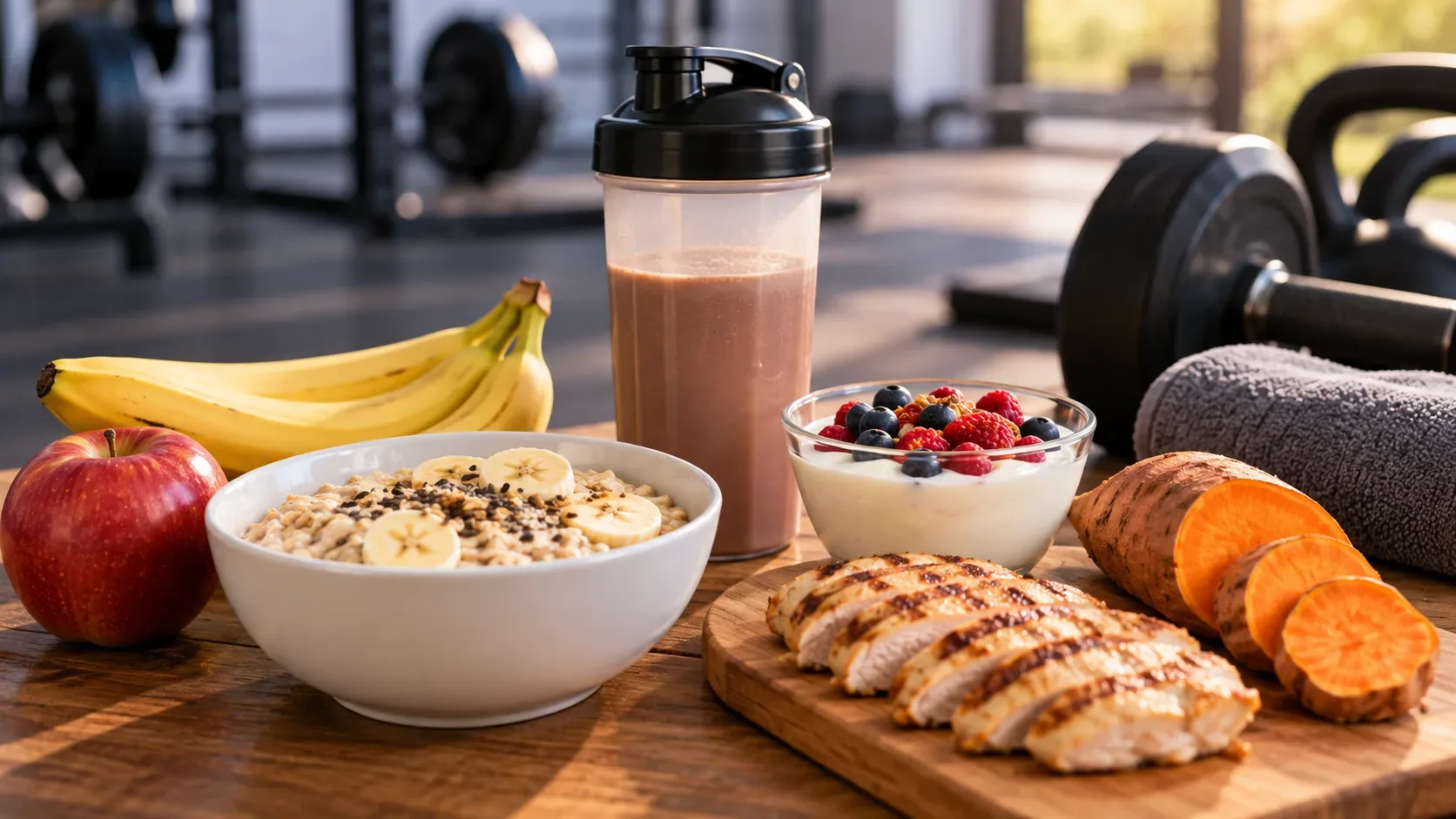
Familiar foods are especially useful. Fruit you tolerate well, breads, rice, oats in an adjusted portion, yogurt, milk, simple preparations, and other habitual foods can serve different purposes depending on the time available. Oats, for example, may work very well for some people 2 or 3 hours before training but feel heavy for someone who is sensitive to fiber with only 30 minutes to go. The same food can be appropriate or inappropriate depending on timing and the individual.
Use gastrointestinal tolerance as data, not as a minor detail
If you often experience reflux, gas, cramping, bowel urgency, or a heavy stomach during training, record what you ate, the amount, the timing, and the type of session. That history helps identify patterns. Tolerance can also change between running, cycling, strength training, and team sports because mechanical impact, intensity, and body position differ.
A useful rule is to test strategies during ordinary training before using them in a competition or an important session. Changing timing, amount, and food all at once makes it harder to know what improved or worsened your comfort.
Common pre-workout mistakes
- Eating a very large meal only minutes before exercise.
- Copying another person's amount without considering body mass, routine, duration, and intensity.
- Adding so much fat, fiber, or protein that carbohydrate becomes insufficient for a long, intense session.
- Using a supplement as if it were mandatory when ordinary food can meet the need.
- Testing a new food before a race, long workout, or key session.
- Confusing hunger, thirst, anxiety, and gastrointestinal discomfort without observing patterns across multiple sessions.
When individualized guidance is worth it
People who train at high volume, compete, need to manipulate body weight, have diabetes, gastrointestinal disease, a history of hypoglycemia, major dietary restrictions, or recurring symptoms benefit from individualized guidance. The same applies when the goal is to turn broad ranges into specific amounts. Population guidelines help organize decisions, but they do not replace clinical and sports assessment when individual conditions are present.
In summary
Choose your pre-workout intake by working backward: first check how much time is left before starting, then consider duration and intensity, and finally adjust volume to your tolerance. With 30 to 60 minutes, think small and easy to digest. With 1 to 2 hours, a more complete snack with carbohydrate and protein can fit. With 3 to 4 hours, a full meal can provide fuel with more digestive comfort. For long or intense sessions, carbohydrate deserves more attention; for protein, the whole day and meal distribution matter as much as the exact minute you eat.