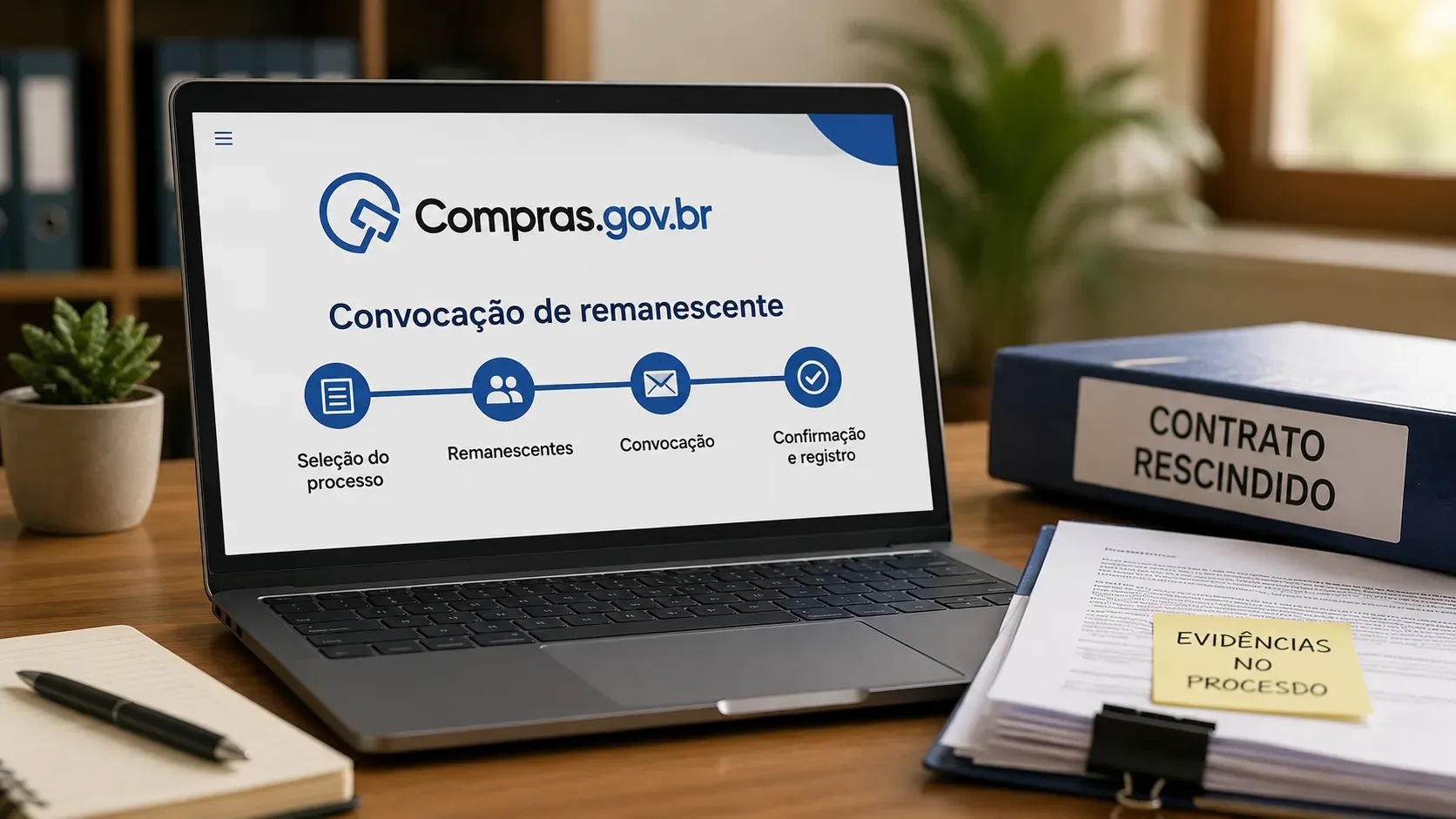
The new remaining-bidder call feature in Compras.gov.br allows a contracting authority to reopen an already awarded procurement when a contract is terminated and part of the work, service, or supply still needs to be performed. The feature went live after the scheduled maintenance on August 22, 2026, and the Federal Procurement Portal published separate tutorials for Government users and suppliers on August 27. In practice, the system organizes electronically the sequence set out in Article 90 of Law No. 14,133/2021: first, attempt to contract remaining bidders under the winner's conditions; if that stage is unsuccessful, move to negotiation with the other ranked bidders, always respecting the original ranking.
The most important point is not to treat the feature as a shortcut for choosing another supplier. The call remains tied to the original procurement process, the ranking order, the tender requirements, proposal and qualification review, and the duty to state reasons for decisions. The system helps record the procedure, but the consistency of the file depends on the data entered and the evidence kept in the administrative record.
When the remaining-bidder call can be used
Paragraph 7 of Article 90 of Law No. 14,133/2021 allows the Administration to call the other ranked bidders to contract the remaining portion of a work, service, or supply after contract termination. The same paragraph requires the criteria in paragraphs 2 and 4 to be observed: calling bidders in ranking order under the winner's conditions and, if no one accepts, negotiating with the remaining bidders, also in ranking order.
Before opening the feature, confirm that the original procurement has been awarded and identify precisely what remains under the terminated contract: quantities not yet performed, the period needed for continuity, applicable financial balance, and any price updates. The official Government-user manual instructs users to enter the call data and updated prices when the contract to be signed has already undergone price updates.
Prerequisites before clicking “Remanescentes”
- Awarded procurement: the feature is accessed from a procurement that has already been completed in Compras.gov.br.
- Formally documented termination: the file should clearly show why the previous contract ended and what portion of the scope remains pending.
- Remaining balance defined: record the quantities, amounts, and other conditions that will actually carry over to the new contract.
- Prices reviewed: if an adjustment, labor-cost revision, or other applicable update occurred, use the updated amounts when configuring the call.
- Ranking order available: interested suppliers will be reviewed according to the original tender ranking.
- Qualification documents and tender requirements mapped: the new contractor remains subject to the relevant checks before contract execution.
These checks reduce a common error: opening the call with a generic or outdated “balance” and then trying to redefine the scope while reviewing a supplier. The call is meant to continue the remaining portion of the original contract, not redesign the original procurement.
Step by step in Compras.gov.br
- Open the awarded procurement. Under the Government profile, enter Compras.gov.br, find the procurement in “Compras Finalizadas,” select it, and open “Visualizar atas e termos.”
- Enter the remaining-bidders stage. In the procurement timeline, click “Remanescentes.” Then use “Operar item” for the item whose remaining balance must be contracted.
- Open the call. Select “Abrir convocação de remanescentes,” complete the requested data, and enter updated prices when applicable. Confirm the opening.
- Wait for the expression-of-interest deadline. In the first stage, ranked suppliers may indicate interest in taking over the remaining scope under the winner's conditions. Do not begin the review before the deadline ends.
- Review suppliers in the order shown by the system. After the expression-of-interest period closes, Compras.gov.br lists interested suppliers according to the original tender ranking. That sequence should guide the review.
- Request attachments and use chat when needed. The system allows the authority to set a deadline for document submission and record communications with the participant under review.
- Decide with reasons. If the proposal does not meet the tender requirements, the supplier may be disqualified; if qualification requirements are not met, the supplier may be deemed unqualified; if everything is compliant, the supplier may be accepted and qualified under the winner's conditions. All three actions require a justification.
- Close the call once a supplier is accepted and qualified. Closing also requires a justification and consolidates the stage in the history.
If no supplier accepts the winner's conditions
The feature separates the procedure into two successive stages. If the first stage is unsuccessful, the authority may open “Convocar remanescentes para negociação.” This reflects paragraph 4 of Article 90: the Administration may negotiate with remaining bidders, in ranking order, seeking a better condition while observing the estimated value and any applicable update. The law allows the negotiated price to be above the winning bidder's price; the objective is not to force the previous price, but to preserve ranking order and seek a legally and economically justified contract.
In the system, the Administration sets a deadline for suppliers to express interest in negotiation. After that deadline, suppliers again appear in the order in which they must be reviewed. The contracting agent may enter a suggested amount and justification, receive a counteroffer, start another round, or accept and qualify the supplier at the negotiated amount. If negotiation fails, the agent may reopen it with the same supplier, move to the next qualified supplier, or close the call process.
What evidence should remain in the administrative file
Not every item below is a “required field” in the new screen, but together they are important to demonstrate the chain of decisions and support oversight, audit, and later contract management:
- the act and documents formalizing termination of the previous contract;
- a record of the remaining scope, including quantities, amounts, balance, and the basis used to update prices;
- the record of opening the call, deadlines granted, and expressions of interest;
- the ranking order used for review;
- attachments submitted by suppliers and relevant communications through chat;
- reasons for disqualification, lack of qualification, acceptance, negotiation, failed negotiation, or cancellation;
- qualification documents and checks required before contracting;
- the report available in “Histórico de convocações” after completion;
- the new contract instrument and its publication under the applicable rules.
Article 91 of Law No. 14,133 requires contracts and amendments to be added to the administrative file and published on an official website. Paragraph 4 of the same article requires, before formalization or extension, verification of the contractor's tax compliance, consultation of Ceis and Cnep, and issuance of negative certificates regarding debarment, impediment, and labor debts, with those records added to the file.
Errors that make the call inconsistent
| Error | Why it is a problem | How to avoid it |
|---|---|---|
| Going directly to negotiation | The procedure first provides an opportunity to contract under the winner's conditions. | Complete the first stage and open negotiation only if it is unsuccessful. |
| Selecting a supplier out of order | The law and the system tie the review to the original ranking. | Follow the displayed order and state reasons for any disqualification or finding of non-qualification. |
| Using an old price after updates | The manual instructs users to enter updated prices when the contract has already been updated. | Recalculate and document the amount before opening the call. |
| Handling documents informally after the deadline | Attachments, chat, and decisions form the electronic record of the procedure. | Use the system functions and preserve the documents in the administrative file. |
| Cancelling without review | The manual states that cancellation of the call cannot be undone. | Check the item, deadline, reason, and status before confirming cancellation. |
| Closing without the report and final documentation | This weakens traceability between termination, selection of the remaining bidder, and the new contract. | Download the history report and add it to the other relevant records. |
Cancellation, deadline changes, and history
The manual allows a call to be cancelled at any time with justification, but warns that the action is irreversible; if necessary, a new call process must be started. The deadline date or time may also be changed, with a new date and justification. Once calls are completed, the “Histórico de convocações” tab stores the records and allows the report for each call to be downloaded.
For operational questions, Notice No. 37/26 from the Federal Procurement Portal brings together the official tutorials and videos for Government users and suppliers. Notice No. 35/26 records the deployment of the feature in August 2026.
Checklist before completion
- the remaining scope exactly matches the portion of the object not yet performed;
- the prices entered reflect applicable updates;
- the first stage, under the winner's conditions, was completed before any negotiation;
- the original ranking order was respected;
- attachments, qualification review, and reasons are recorded;
- pre-contract checks were completed and added to the file;
- closure was justified and the history report was preserved;
- the new contract was formalized and published under the applicable rules.
Used this way, the new feature turns a sequence that previously depended on more parallel controls into a traceable electronic workflow. It does not replace the administrative record: it organizes the call, but the validity of the contract still depends on ranking order, correct conditions, qualification, reasoned decisions, and sufficient documentation.