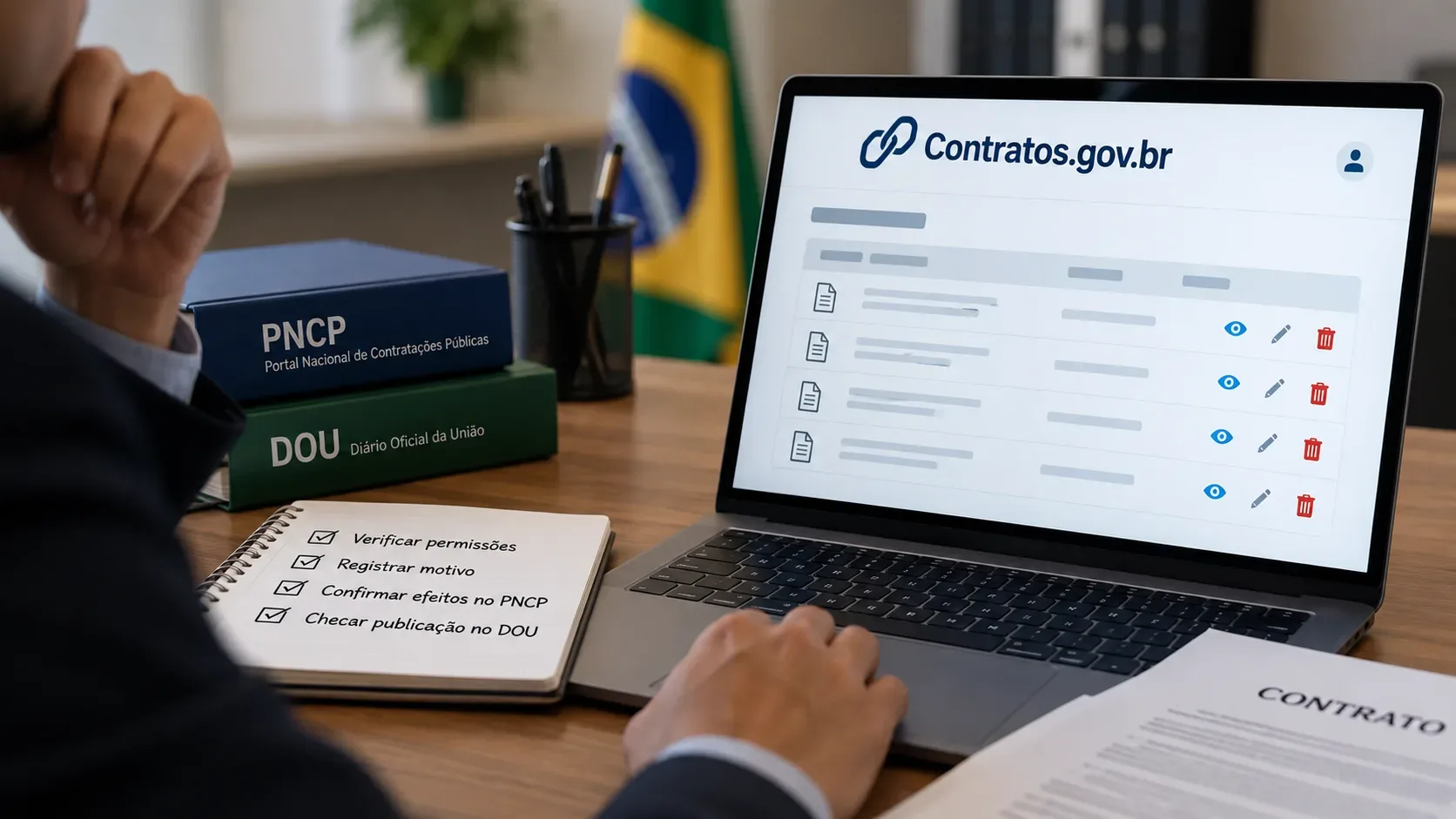
The same person may perform contract management and inspection activities in certain situations, but that does not make combined duties the general rule. Law 14.133/2021 requires segregation of duties whenever concentrating responsibilities increases relevant risks, and the decision must consider the concrete design of the process, not merely the titles assigned to the roles.
Within the direct, autonomous-agency and public-foundation branches of Brazil's federal public administration, Decree 11.246/2022 is particularly clear: Article 19, paragraph 1, allows management and inspection activities to be performed by public agents, by an inspection team or by a single public agent, provided that the activities remain distinct. At the same time, Article 12 prohibits designating the same agent to act simultaneously in functions that are more susceptible to risks. The correct reading is therefore conditional: duties may be combined, but controls cannot be concentrated in a way that empties the segregation required for the specific case of its substance.
What Law 14.133 actually prohibits
Law 14.133 includes segregation of duties among the principles that guide its application. The decisive point is Article 7, paragraph 1: the authority that designates agents must observe this principle and may not place the same public agent in simultaneous functions that are more susceptible to risks when doing so increases the possibility of concealing errors or committing fraud.
The law therefore does not contain a sentence stating that the contract manager and inspector can never be the same person. Instead, it creates a duty to design controls. That changes the practical question. Rather than looking for an abstract prohibition, the public body must identify which acts each function will perform and whether one person would end up producing, checking, validating or finally accepting their own work without a sufficient
counterweight.
Article 117 reinforces this logic by requiring performance to be monitored and inspected by one or more inspectors specifically designated in accordance with the requirements of Article 7. Inspection is not an honorary title: it includes recording occurrences, requiring corrections within the agent's authority and reporting situations that require action by a higher authority.
In the federal regime, a single public agent is an express possibility
Decree 11.246/2022 regulates the work of managers and inspectors in the direct, autonomous-agency and public-foundation branches of Brazil's federal public administration. Article 19 conceptually separates contract management, technical inspection, administrative inspection and sectoral inspection. Management coordinates inspection and prepares referrals related to extensions, amendments, economic and financial rebalancing, payment, penalties and termination. Inspection monitors performance of the contract object and the relevant administrative aspects according to the type of inspection.
After separating those activities, paragraph 1 of the same article allows them to be performed even by a single public agent, subject to an express condition: the distinction between the activities must be preserved. Paragraph 2 adds that this distinction may not impair the performance of management activities.
This rule prevents two simplistic conclusions. The first would be to say that the manager and inspector can never be the same person. The second would be to conclude that, because a single-agent arrangement exists, any contract may be handed entirely to one person without further analysis. Neither reading is supported by Article 12 of the same decree, which requires segregation to be assessed in the actual procedural situation and allows it to be adjusted according to the lines of defense, the value and the complexity of the procurement.
First test: which rule actually applies to your public body
Before discussing titles and organizational charts, the applicable legal basis must be identified. Law 14.133 has nationwide scope, but Decree 11.246 directly regulates the direct, autonomous-agency and public-foundation branches of Brazil's federal public administration. States, the Federal District, municipalities and other branches of government may have their own regulations that detail or restrict combined duties.
This means that saying "the federal decree allows it" does not conclude the analysis for a municipality or a state. Local regulations may require different agents, permit combined duties only exceptionally, require specific justification or distribute responsibilities differently. The designation must be compatible with the rules of the relevant governmental entity and with the public body's own internal acts.
Second test: will the person have to review or validate their own act?
Segregation of duties becomes especially sensitive when one step exists to control another. If the same agent performs a verification and then, in another role, performs the act intended to review or confirm that same verification, a self-review risk arises.
The useful question is not only "are the manager and inspector the same person?", but "what concrete decisions will that person make in each role?" If the inspector measures
performance, keeps records, identifies failures and performs provisional acceptance, while the manager analyzes those records, coordinates follow-up action and performs final acceptance, combining the roles may concentrate stages that were designed to provide a second look.
The greater the dependence between the first analysis and the second validation, the stronger the justification must be for keeping both roles with the same person or, alternatively, the more important it becomes to establish independent review by another agent, department or committee.
Third test: risk, value, complexity and workload
Decree 11.246 requires the designation decision to consider compatibility with the duties of the position, the complexity of inspection, the number of contracts assigned to each agent and the agent's ability to perform the activities. Article 12 adds value and complexity as relevant factors in applying segregation.
In practice, a simple, standardized, low-risk contract with few decision points may support a leaner structure. By contrast, a high-value procurement, technically complex performance, dedicated labor, disputed measurements, multiple units, frequent amendments or a history of problems tends to require greater separation.
Workload also matters. Even when combined duties do not create a serious structural conflict, they may be inappropriate if the agent cannot monitor performance, record occurrences, support payment processing, control deadlines and coordinate action with the required diligence.
Fourth test: are there lines of defense and compensating controls?
Article 12 of Decree 11.246 itself requires consideration of the consolidation of the lines of defense. This allows the analysis to go beyond the formal organizational chart. A process may distribute controls among inspection, management, the contracts unit, the competent authority, legal counsel, internal control and other units, depending on the matter.
Compensating controls, however, must be real. It is not enough to point to the existence of legal counsel or internal control if those units do not review the type of decision being concentrated. The question is whether someone has sufficient authority, information and independence to detect relevant failures before they produce effects.
Fifth test: is the designation reasoned and are responsibilities clear?
A defensible combination of duties must appear transparently in the administrative record. The designation act should clearly state which functions will be performed, which activities belong to the agent and who will serve as substitute. If roles that would normally be separated are concentrated, the reasoning should address the risk, the available structure, the complexity of the contract and the existing controls.
Decree 13.031/2026 reinforced this need for explicit design at the federal level. Article 7 requires public bodies and entities to establish an internal management model for monitoring contracts, identifying the agents responsible for management and inspection activities, their substitutes and the activities assigned to each one.
Documentation is not useful only to justify a choice after it is challenged. It makes it possible, before performance begins, to verify where each responsibility starts and ends.
Provisional and final acceptance are a critical point
The separation between provisional and final acceptance helps show why combined duties should not be automatic. In the consolidated wording of Decree 11.246, Article 25 assigns provisional acceptance to the technical, administrative or sectoral inspector and final acceptance to the manager, sectoral manager or designated committee.
Decree 13.031/2026 details this logic for Sistema Contratos.gov.br. For works and services, inspectors perform provisional acceptance through a detailed instrument. Final acceptance is formalized by the manager, sectoral managers or committee, taking into account, where applicable, the analysis produced during provisional acceptance.
When the same person occupies both roles, it is necessary to assess whether the process preserves an effective distinction between the initial finding and the final acceptance decision. In more sensitive contracts, separating the agents or using a committee for final acceptance may provide a more appropriate control than trying to compensate for self-review only with formal records.
When combined duties may be defensible
Combined duties tend to be more defensible when the applicable rule does not prohibit them, the contract has limited risk and complexity, the workload is compatible, responsibilities remain clearly distinct and sufficient controls exist to prevent one person from concentrating critical decisions without review.
It is also important for the choice to be reasoned and for the designating authority to be able to demonstrate why that structure satisfies the segregation-of-duties principle in the specific case. "Lack of staff" may explain an organizational constraint, but it does not eliminate the duty to analyze risks or authorize the removal of essential controls.
When it is better to separate the manager and inspector
Separation is the more prudent option when the contract involves high value, a technically complex object, significant measurements, acceptance decisions requiring judgment, high labor or financial risk, a history of noncompliance, many amendments, likely penalties or a need for a second independent analysis.
Caution is also warranted when the manager would have to confirm or formalize decisions based almost exclusively on checks the same person performed as inspector. In those cases, a difference in labels between "management" and "inspection" does not create real segregation.
What Decree 13.031/2026 changed in the analysis of the issue
Decree 13.031, dated June 17, 2026, established Sistema Contratos.gov.br within the direct, autonomous-agency and public-foundation branches of Brazil's federal public administration, regulated the conclusion and management of contracts electronically, and amended Decree 11.246/2022.
Among the changes, it introduced the concept of sectoral management, updated designation rules and adjusted provisional and final acceptance. It also began requiring an internal management model identifying the responsible agents and the activities assigned to each one.
The new decree did not turn segregation into a mathematical rule of "one person per function." The consolidated text continues to combine two ideas: a single public agent may perform management and inspection, provided the activities remain distinct, and simultaneous functions that are more susceptible to risk should not be concentrated in the same agent.
How to record the decision in the administrative file
A sound statement of reasons should show which rule was applied, which activities will remain with the manager and with the inspector, which control points could create self-review, the risk and complexity of the contract, the workload already assigned to the agent and which independent controls remain active.
If the conclusion favors combined duties, the administrative file should demonstrate why they do not eliminate relevant controls and how the distinction between activities will be preserved. If the conclusion favors separation, the reasoning can identify exactly which risks make a second agent necessary.
This record is more useful than a generic formula. It allows the choice to be audited and kept consistent with the segregation-of-duties principle.
Final answer
The contract manager and inspector may be the same person in certain arrangements, but Law 14.133 does not authorize automatic combination of duties and Decree 11.246 does not create a free pass. Under the federal regime, the possibility of a single public agent is expressly recognized, provided that the activities remain distinct and the concentration does not place simultaneous functions that are more susceptible to risk in the same agent.
A sound decision requires checking the rule applicable to the governmental entity, mapping concrete responsibilities, testing for self-review, risk, value, complexity, workload and lines of defense, and giving reasons for the designation. In contracts where the inspector produces the analysis that the manager should review or use for final acceptance, separating the roles tends to provide a more robust control.
For the direct, autonomous-agency and public-foundation branches of Brazil's federal public administration, the review should start with Law 14.133/2021, especially Articles 5, 7 and 117; Decree 11.246/2022 in its consolidated wording, especially Articles 8, 12, 19 and 25; and Decree 13.031/2026, especially Articles 7 through 10 and 15. In other governmental entities and branches, the applicable local regulation and current internal acts must also be checked.
This content is for informational and management-support purposes. Specific situations involving legal controversy, agent liability or material risk should be submitted to the competent review bodies of the relevant public authority.