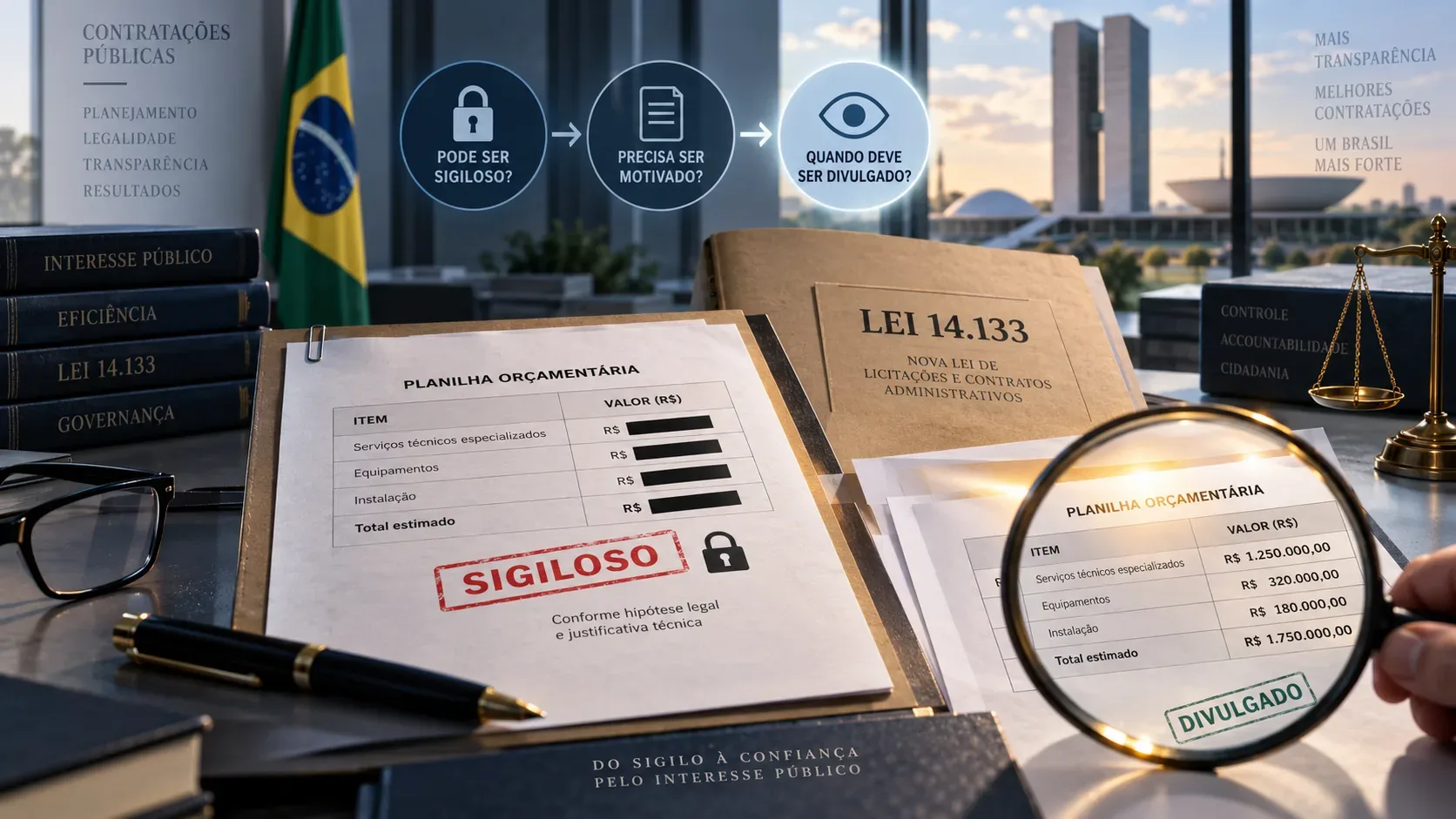
An estimated budget does not become confidential simply because the contracting authority would rather not reveal the figure before the competition. Brazilian Law 14,133/2021, Article 24, allows the estimated contract budget to be kept confidential provided that the choice is justified and without withholding the breakdown of quantities and other information needed by bidders to prepare their offers. In 2026, Brazil’s Federal Court of Accounts (TCU) reinforced this point: Decision 1635/2026-TCU-Plenary treated the use of a confidential estimated budget without an adequate justification showing an advantage for the procurement procedure as irregular.
Three questions: can it be withheld, must it be justified, and when must it be opened?
| Question | Practical answer |
|---|---|
| Can the estimated amount be withheld? | Yes. Article 24 permits confidentiality for the estimated budget, but the decision is not automatic: it must be reasoned in the case file and fit the specific circumstances of the procurement. |
| Must the authority justify it? | Yes. The reasons should explain why temporary restrictions on disclosure are expected to create an advantage in that specific case, rather than merely repeat generic statements about competition or avoiding price “anchoring”. |
| When must the amount be disclosed? | Article 24 does not establish one single disclosure moment for every procedure. However, Article 18, paragraph 1, item VI, allows the estimate and its supporting documents to remain in a classified annex until the procurement procedure is concluded. In Decision 662/2026-TCU-Plenary, the TCU treated the conclusion of the tender as the limit for maintaining confidentiality and found fault with the failure to disclose the budget after the procedure had ended. |
What Article 24 actually allows the authority to withhold
The subject of the confidentiality is the estimated contract budget. This does not authorize the contracting authority to turn the tender into a black box. Article 24 itself preserves disclosure of the breakdown of quantities and the other information needed to prepare bids. In other words, bidders must know enough about the object, scope, quantities, conditions and requirements to price their offers independently.
There are also two express limits. First, confidentiality does not apply against internal and external control bodies. Second, when the award criterion is the highest discount, the estimated price or maximum acceptable price must appear in the tender notice under the sole paragraph of Article 24. In that setting, hiding the reference value would conflict with the very mechanism used to calculate the discount.
Article 18, paragraph 1, item VI, completes the picture: the preliminary technical study must include the estimated contract value together with reference unit prices, calculation records and supporting documents. Those materials may remain in a classified annex if the authority chooses to preserve confidentiality until the procurement is concluded. Confidentiality therefore does not mean that there is no budget or that price research can be skipped; it means temporarily restricting external disclosure of a budget that must exist, be documented and remain auditable.
What an adequate justification should demonstrate
The most important practical lesson from the TCU’s 2026 position is that it is not enough to state that confidentiality “increases competition” or “prevents bidders from converging on the reference price”. The holding in Decision 1635/2026 requires an adequate justification that shows the advantage of the measure for the procurement procedure. The reasons need to connect the choice to the characteristics of that market, that object and that bidding strategy.
In practice, a robust statement of reasons will usually address questions such as:
- what market behavior the authority is trying to prevent or encourage by withholding the figure before bidding;
- why that risk is plausible for the object and the market that were researched;
- how confidentiality may improve competition, independent price formation or negotiation rather than simply reduce transparency;
- why the information that remains public is sufficient for bidders to calculate their offers;
- how the choice fits the bidding mode, award criterion and negotiation strategy.
These points are a practical drafting framework, not a closed statutory checklist. The core legal requirement remains a concrete explanation, placed in the record, of why confidentiality is useful in that procurement. Boilerplate copied from another tender or disconnected from the bidding mode is more vulnerable to challenge.
When a confidential estimated budget must be disclosed
The final text of Article 24 does not say that the budget must be opened “immediately after bid evaluation”. Such language appeared in the legislative process but was vetoed. It is therefore inaccurate to treat the end of proposal evaluation as an inflexible universal deadline for every tender.
At the same time, Article 18, paragraph 1, item VI, sets a clear outer limit: the documents supporting the estimate may remain confidential until the procurement is concluded. In Decision 662/2026, the TCU relied on that provision while examining an electronic auction that had already been approved in which the complete estimated budget, including price composition and reference prices, could not be located among the published records. The court’s reading was that publication must occur after the tender is concluded.
There is an important nuance during the competition. The TCU had already held in Decision 2190/2024-TCU-Plenary that, after the bidding stage, when offers remain above the reference prices, the authority should be able to lift confidentiality over the estimated cost in a public act and with a stated justification so that price negotiations are more effective and bidders receive equal treatment. This means confidentiality may end before the procedure is concluded when disclosure becomes useful for negotiation; what is not sustainable is allowing it to continue indefinitely after the tender has ended.
How Federal Normative Instruction SEGES/ME 73/2022 fits into the analysis
For electronic tenders based on lowest price or highest discount that fall within Federal Normative Instruction SEGES/ME 73/2022 — especially those conducted by Brazil’s direct federal administration, federal agencies and foundations — Article 12 repeats the requirement for justification and states that the estimated budget will not be made public before the result of proposal evaluation has been defined, subject to the negotiation rules in Article 30. The same regulation requires the reference value to appear in the tender notice when the award criterion is highest discount.
This regulation must be read within its own scope. States, municipalities, state-owned companies and other entities may be governed by their own regulations in addition to Law 14,133 and the case law that applies to them. An internal manual or local regulation may therefore provide more detail on how confidentiality is classified and lifted, provided it does not conflict with the statute.
Exceptions and limits that prevent common mistakes
- Highest discount: the estimated or maximum acceptable amount must appear in the tender notice; the reference value cannot be treated as confidential in the same way.
- Control bodies: Article 24 cannot be used to deny the budget to internal or external control bodies.
- Quantities and necessary data: bidders must continue to receive the information needed to prepare rational bids.
- Price research: it still has to exist and be documented. Hiding the budget does not cure weak market research, missing calculations or a poorly built estimate.
- End of the procedure: confidentiality should not survive the conclusion of the tender. The budget documentation must then become accessible under the applicable disclosure regime.
A workflow for deciding and documenting confidentiality
- Build the budget normally. Perform price research and record sources, parameters, calculations and reference unit prices.
- Identify the problem confidentiality is meant to solve. Avoid abstract language. Connect the measure to the market, the object and the design of the competition.
- Compare confidentiality with early disclosure. Record why revealing the figure in advance could reduce the expected benefit and why withholding it will not prevent bidders from preparing their offers.
- Check the exceptions. If the criterion is highest discount, the reference must be in the notice. Ensure full access for control bodies.
- Plan for negotiation. If revealing the amount could unlock negotiations where bids remain above the reference, document the reasons and disclose it publicly and equally.
- Lift confidentiality by the proper deadline. Do not keep the budget hidden after the tender is concluded; publish the estimate and the required supporting elements, subject only to any separate statutory confidentiality that may apply to specific information.
What the 2026 TCU case law added in practice
Two decisions help separate the questions. Decision 1635/2026-TCU-Plenary addresses “may I choose confidentiality?”: yes, but the reasons must demonstrate a concrete advantage; without adequate reasons, the choice is irregular. Decision 662/2026-TCU-Plenary helps answer “how long may the amount remain hidden?”: the reading of Article 18, paragraph 1, item VI, points to the conclusion of the tender as the outer limit for confidentiality of the estimate and its supporting documents.
These holdings do not make confidential estimated budgets prohibited, nor do they require disclosure at one identical moment in every procurement. They raise the standard for reasons and make clearer that confidentiality is instrumental and temporary: it must serve a demonstrable purpose and end when that purpose no longer justifies restricting disclosure.
Operational summary
| Situation | Safer course |
|---|---|
| The authority wants to withhold the estimated budget before bidding | Record specific reasons showing the expected advantage and preserve all information needed for bidders to prepare offers. |
| The award criterion is highest discount | Publish in the tender notice the estimated or maximum acceptable amount used as the reference. |
| Bids remain above the reference after the bidding stage | Consider lifting confidentiality for negotiation in a public act, with reasons and equal treatment, consistent with TCU case law. |
| The tender has been concluded | End confidentiality over the budget and make the estimate and supporting elements available, except for any independent statutory secrecy that applies to specific information. |
| A control body requests access | Provide the budget; Article 24 expressly removes confidentiality against internal and external control bodies. |
This article is informational and organizes the reading of Law 14,133/2021, the cited federal regulation and TCU decisions. Applying these rules to a specific case requires checking the relevant entity’s regulation, the tender notice, the procedural stage and the review of the competent legal or control office.