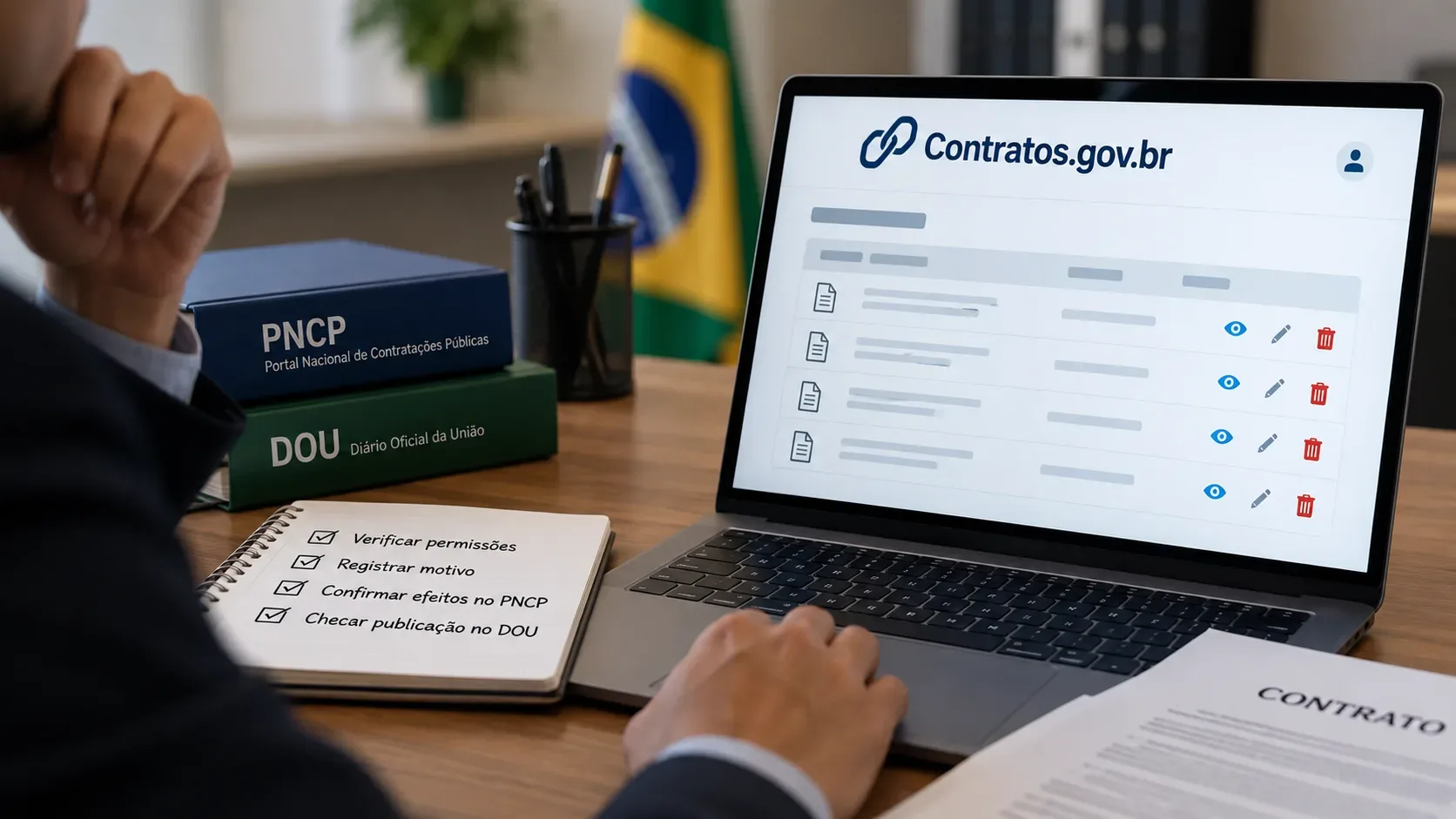
Consensus is not a shortcut. Before taking a contractual dispute to a consensual solution table, the Administration needs to demonstrate the public problem, the competence of the participants, the alternatives evaluated, the calculation memory, the verifiable benefit, the risks of precedent and the limits that cannot be negotiated.
The panel carried out by the Federal Audit Court (TCU) on July 30, 2026, with a report published on August 4, 2026, offers a concrete example. The discussion is part of a Consensual Solution Request presented by the Ministry of Mines and Energy regarding contracts for four Eneva natural gas thermoelectric plants, in Maranhão and Amazonas. The proposal under consideration is to replace inflexible generation obligations with a flexible capacity model, in which plants would be activated according to the needs of the National Interconnected System. The declared objective is to make better use of renewable generation, preserve supply security, avoid unnecessary costs to the consumer and maintain the economic-financial balance of contracts.
Panel is not a judgment
The reference panel is an instruction and participation stage. It does not approve changes to contracts, does not bind the final decision and does not replace the regulator's competence.The eventual solution must go through the Consensual Solution Committee, through technical and legal analyses, through formal manifestation of the parties and through deliberation by the TCU Plenary.
Current regulations determine that proposals are examined for legality, advantage and the ability to mitigate risks. The solution is only formalized by a self-composition agreement after plenary deliberation. The TCU itself stated, during the panel, that the table does not replace the role of the regulator nor does it make public principles more flexible.
On August 4, 2026, process TC 021.356/2025-4 remained ongoing. The summary form recorded the start of the commission on May 25th and the ordinary deadline was August 23rd, 2026. Therefore, the panel's statements should be treated as elements of context and instruction, not as a binding decision or concluded precedent.
Before the checklist: “re-agreement” can have different meanings
In Law 14,133/2021, renegotiation is a specific mechanism for maintaining economic-financial balance in continuous service contracts with exclusive dedication or predominance of labor, through analytical demonstration of cost variation. The same law allows conciliation, mediation, dispute resolution committee and arbitration in available property disputes, including those relating to the reestablishment of contractual balance.
In the case of thermoelectric plants, the TCU uses “renegotiation” in a broader sense, associated with the possible change in the contractual model in the regulated energy environment. The team responsible for instruction must not automatically transplant the concept of article 135 of Law 14,133. The first step is to identify the applicable legal regime and the correct instrument to formalize the solution.
The 7 questions before taking the case to the table
1. What public problem needs to be solved?
The instruction must begin with the problem, and not with the solution desired by one of the parties. Describe:
- the current situation;
- affected users and services;
- the observed cost, risk or inefficiency;
- the probable cause;
- the materiality of the problem;
- the expected public result.
In the thermoelectric case, the problem presented is the possible mismatch between continuous generation contracts and system operation with an increasing share of variable renewable sources. This does not authorize attributing every cut in renewables to thermal inflexibility. The ONS explains that curtailment can also result from excess supply at certain times, transmission limits and reliability requirements. The technical memory needs to isolate the portion effectively attributable to the analyzed contract.
2. Who has the competence to negotiate, decide and execute?
Map out who represents the granting authority, who administers or supervises the contract, who regulates the activity, who validates tariff effects and who has the power to assume each obligation. Also record skills that cannot be transferred to the table.
The TCU highlighted that consensus does not replace the regulatory agency. Aneel maintains responsibilities related to the generation and sale of energy, the economic clauses of regulated services, the economic-financial balance and the functioning of the market. The presence of everyone in the negotiation does not eliminate the need for each decision to be carried out by the competent authority.
A competency matrix must answer, at a minimum:
- who can propose;
- who can negotiate;
- who issues the legal opinion;
- who approves the change;
- who formalizes the instrument;
- who monitors and measures the results;
- who applies consequences for non-compliance.
3. Which alternatives were compared?
IN-TCU 91/2022, updated in 2025 and 2026, requires an exact description of the controversy, assessment of materiality, risk and relevance, technical and legal opinions, alternatives already considered and the obstacles that prevented obtaining a previous consensus.
The preferred proposal must be compared with real scenarios, such as:
- keep the contract unchanged;
- adopt general regulatory measure;
- use conventional contractual instrument;
- modify only part of the obligations;
- terminate or replace given solution;
- do not enter into an agreement.
The comparison must employ common criteria: total cost, deadline, legal risk, impact on the service, competitive effect, reversibility and implementation capacity. Without a reference scenario, “advantage” becomes just a statement.
4. Is the calculation memory auditable?
Every economic gain must be able to be reconstructed by a qualified third party. The instruction must present:
- source and date of data;
- formulas used;
- evaluation period;
- base scenario and counterfactual;
- operational assumptions;
- prices, taxes and indexers;
- discount rate;
- treatment of inflation;
- distribution of risks;
- sensitivity analyses.
In the panel, the TCU associated the possible flexibility with the need to accurately calculate operational and financial constraints and preserve the economic-financial balance. In a complex case, a single value is not enough: it is necessary to demonstrate ranges of results, adverse scenarios and who will bear each deviation.
Memory must also separate three dimensions that can be confused:
- operational savings for the system;
- economic effect on the contracting parties;
- benefit effectively transferred to the consumer.
5. Is the public benefit verifiable and reaches the recipient?
“Systemic gain” and “consumer benefit” are not automatic synonyms. The instruction must explain the chain between the contractual change, the cost reduction and the expected final effect.
For each benefit, indicate:
- indicator;
- baseline;
- meta;
- deadline;
- verification source;
- responsible for measurement;
- periodicity;
- form of disclosure.
Safeguards are also necessary if the result does not appear: parameter review, compensation, gain sharing, financial limit, reevaluation trigger or termination of the solution.
In the debate on thermoelectric plants, Aneel highlighted the need to prove benefits to the consumer and preserve the economic-financial balance. Representatives of consumers and sectoral entities defended the absence of additional tariff costs and the maintenance of legal certainty in contracts.
6. What precedent can the solution create?
An advantageous change to a contract can produce undesirable effects on the market as a whole. The analysis must verify:
- comparable contracts;
- conditions of the original competitive procedure;
- equal treatment;
- impacts on competitors;
- incentives for new renegotiation requests;
- effects on upcoming competitions;
- risks of undue transfer to public authorities.
Ask whether agents in an equivalent situation would have access to the same criteria and whether the solution transfers to the Administration a risk originally assumed by the contractor without proportional compensation.
The panel registered concern about the preservation of equivalent conditions between agents, the prevention of new tariff costs and the legal security of contracts in force.
7. Which points are non-negotiable?
Before opening the table, formalize the limits:
- legal jurisdiction;
- service continuity and security;
- user rights;
- tariff and regulatory rules;
- economic-financial balance;
- publicity and transparency;
- accountability;
- legal restrictions;
- minimum inspection conditions.
LINDB allows the administrative authority to enter into a commitment to eliminate irregularities, legal uncertainty or relevant contentious situations, after hearing from the legal body and, when applicable, public consultation. The solution must be proportionate, equitable, efficient and compatible with general interests.
The commitment cannot grant permanent relief from a duty recognized by general guidance. It must also clearly define the parties' obligations, deadlines and sanctions applicable in case of non-compliance. Consensus is choosing a lawful and demonstrably better solution, not departing from the applicable standard.
Textual flow of instruction and safeguards
Defined dispute → technical and legal opinions → alternatives and counterfactual → admissibility → Consensual Solution Committee → participation of interested parties, when applicable → documented proposal → formal manifestation of the parties → analysis of legality, advantage and risk mitigation → Plenary deliberation → self-composition term → monitoring of results.
The 2025 regulatory update reinforced advertising, social participation, request detailing and analysis of proposals by technical units. Parties outside the commission must formally express their opinion on the draft solution, supported by technical and legal opinions.
In April 2026, IN-TCU 102 began to determine that the decision not to admit the request by the Presidency — or not to ratify the admissibility by the rapporteur — be submitted to a Plenary referendum as a condition for the continuation of the process.
Reproducible checklist
- Is the public issue described with cause, effect, materiality and affected users?
- Do all necessary authorities have documented competence?
- Is there a comparison between alternatives, including not entering into an agreement?
- Can the calculation memory be reset by an independent third party?
- Does the benefit have an indicator, baseline, target, deadline and checker?
- Were equality, competition and precedent risks assessed?
- Are non-negotiables, triggers, sanctions and exit conditions defined?
The case of thermoelectric plants shows that the consensual solution can be useful for complex controversies, but its value depends on the quality of the instruction. The agreement should only move forward when there is sufficient competence, evidence, comparative advantage and safeguards to protect the user and the public interest.
Next step: copy this checklist into the technical note or instruction matrix. In contracts submitted to Law 14,133, complement the analysis with the guide “Contracting planning under Law 14,133” and the article “Additive above 25% in Law 14,133”, inserting the respective internal links in the CMS.