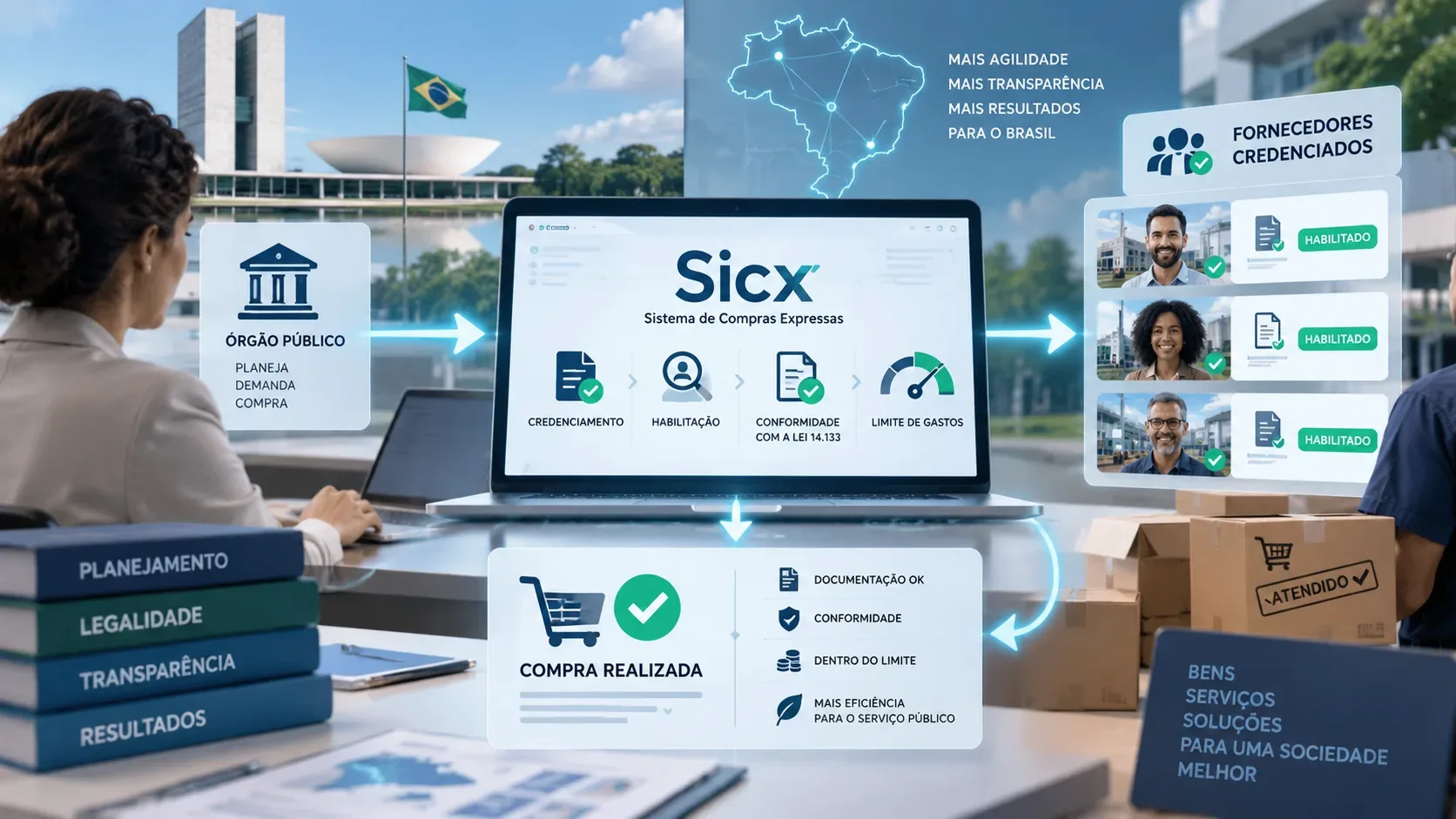
The Express Purchasing System (Sistema de Compras Expressas, or Sicx) received specific federal regulation through Decree No. 13,106 of August 24, 2026, which took effect on September 8, 2026. The system was incorporated into Law No. 14,133/2021 by Law No. 15,266/2025 to allow the electronic-commerce procurement of standardized common goods and services previously offered by accredited suppliers.
In practical terms, the model brings public procurement closer to an electronic catalog experience without turning it into an unregulated marketplace. It includes accreditation, object standardization, qualification, automated offer ranking, segregation of duties, acceptance procedures, and integrity controls. One point is especially important: the decree does not set one monetary ceiling for all Sicx purchases. The operational limit comes from the buyer's planning and reserved amount, in addition to the notice rules, the applicable legal regime, and the functions made available by the central authority.
What Sicx is and what Decree 13,106/2026 changed
Sicx is the electronic-commerce framework created for contracting standardized common goods and services: items that can be purchased repeatedly, compared with one another, and contracted without individual customization. Law No. 14,133/2021 now treats electronic commerce through Sicx as an accreditation scenario, and Decree 13,106/2026 details how that model must operate at the federal level.
The Secretariat for Management and Innovation within the Ministry of Management and Innovation in Public Services is the system's central authority. It is responsible for issuing complementary rules, providing the platform, and preparing accreditation notices. Those notices may remain in force indefinitely and may incorporate new standardized goods and services that follow the same rules.
Buyers obtain access through an accession process. Suppliers must have permanent access to seek accreditation through integration with the unified registration system. Qualification requirements are established in the notice according to the nature of the object, and an individual buyer may not add its own extra qualification requirements.
Who can use Sicx — and what may be purchased
| Profile | Status under the decree | Practical condition |
|---|---|---|
| Federal public-administration bodies and entities covered by Law 14,133 | Use is provided for at the federal level | They must be authorized to contract through Sicx and complete accession under the central authority's rules. |
| State, Federal District, and municipal bodies and entities | Sicx may be made available | Use depends on the central authority's conditions and must respect the buyer's governmental level and legal regime. |
| Public companies, mixed-capital companies, and their subsidiaries | Sicx may be made available | Planning, offers, payment, and sanctions must follow the applicable legal regime. |
| Autonomous social services | Sicx may be made available | They must follow the conditions of use and operational rules applicable to their regime. |
| Private nonprofit entities | Sicx may be made available | The decree allows access as an authorized private buyer; it does not make every private entity an automatic user. |
| Interested suppliers | May seek accreditation | They must comply with the notice, keep the required registration status current, and offer only items within their accredited line of supply. |
The object itself creates another boundary. Sicx is not a blanket authorization to contract any solution. The decree directs it to standardized common goods and services, and items entered in the system must follow the standardization established by the central authority so that they can be compared and priced consistently.
How supplier accreditation works
An interested supplier applies for accreditation electronically. Qualification requirements are set out in the notice and must be proven through the unified registration system. Until that integration is available, the decree requires suppliers to keep their data current in the Unified Supplier Registration System and requires the purchasing body to verify the documents required by the notice.
Once accredited, the supplier may register offers for standardized goods and services within its line of supply. For each location served, it may indicate price and delivery and payment conditions. Registration may also occur through integration with other platforms on which the supplier already offers its products or services. The decree also allows tiered prices based on quantity for the same object and delivery location.
Accreditation does not force a supplier to remain in the system indefinitely. A supplier may request removal at any time, but it remains responsible for performing contracts already entered into.
Practical flow: buyer → accredited supplier → transaction
- Standardization and notice: the central authority defines the parameters for the good or service and publishes the applicable accreditation notice.
- Accreditation: the supplier proves the qualifications required by the notice and becomes eligible to offer the corresponding items.
- Offer: the accredited supplier registers prices, locations served, and delivery and payment conditions; offers may be updated until they are selected.
- Buyer planning: the public buyer uses either a broad or a specific preliminary technical study. Under the broad model, it may reserve an amount and pre-authorize purchases up to that amount.
- Ranking: Sicx automatically ranks eligible offers according to the notice and system parameters. For public buyers, an offer from a supplier with restrictions in Cadin is not considered eligible.
- Selection and confirmation: the top-ranked offer may be selected without an additional justification. Selecting another offer requires a specific, objective justification. As a rule, in a public buyer organization, the person selecting the offer should not be the same person who confirms and completes the purchase.
- Completion, delivery, and acceptance: completing the purchase forms the contract with the supplier. Provisional acceptance occurs within up to two business days after delivery or service performance is recorded, and final acceptance within up to ten days afterward, unless the notice establishes a different period, subject to a 30-day maximum.
- Payment: once the function is available, payment is released upon final acceptance, whether express or tacit. During the transitional phase, the ordinary public-expenditure procedure applies, still subject to the statutory maximum of 30 days from acceptance.
Which limits actually matter
| Limit or control | How it works |
|---|---|
| No single overall ceiling in Decree 13,106/2026 | The decree does not set one standardized maximum value for every Sicx purchase. Financial control may be structured through a reserved amount in the buyer's planning. |
| Reserved amount | Under a broad preliminary technical study, the public buyer may use the preliminary estimate in its annual procurement plan to reserve an amount and pre-authorize contracts up to that limit. |
| Object boundary | Only standardized common goods and services that are repeatable, comparable, and non-individualized fit the model described by the decree. |
| Notice-based limits | Specifications, qualification, offer parameters, delivery, and other conditions depend on the notice and central-authority rules. |
| Maximum payment period | Law 14,133, as amended in 2025, requires payment conditions with a period no longer than 30 days from acceptance of the good or service. |
| Final-acceptance period | Normally up to ten days after provisional acceptance; the notice may set a different period, but the decree caps it at 30 days. |
| Offer eligibility for public buyers | An offer from a supplier with a Cadin restriction is not considered eligible for public buyers. |
| Buyer's legal regime | Planning, the form and value of offers, payment, and sanctions vary according to the buyer's legal regime and, for public buyers, governmental level. |
This design avoids a common misunderstanding: Sicx is not an “automatic direct award up to a certain amount.” Its core rule is different — electronic accreditation for standardized objects, with available offers, ranking, and specific controls. The value must fit the buyer's planning, authorization, and applicable legal regime.
Does the buyer stop preparing a terms of reference and a procurement notice?
The decree exempts the buyer from preparing a terms of reference and an individual procurement notice for a Sicx purchase. That does not mean the system has no rules or no notice. Accreditation remains based on a notice prepared by the central authority or a delegated accrediting body, containing the requirements and standards applicable to the goods and services.
The buyer remains responsible for selecting the goods or services and the characteristics that meet its need, carrying out the required planning, observing segregation of duties, monitoring delivery and acceptance, and justifying any selection of an offer that is not the top-ranked one.
It is also incorrect to reduce the ranking to “lowest price.” The decree provides for automated ranking using parameterized criteria, weights, and methodologies. Those models must be public and auditable, and they may be adjusted to obtain better offers, reduce market concentration, and promote equal treatment and transaction governance.
Acceptance, returns, integrity, and reputation
If a good or service is nonconforming, defective, different from what was contracted, or subject to another justified issue, it may be rejected or returned. As a rule, the supplier is responsible for collecting a returned item. If the buyer does not act within the acceptance deadlines, tacit acceptance may occur, and tacit final acceptance affects the buyer's reputation indicators.
Sicx must also maintain transparency, traceability, and control mechanisms, with oversight bodies able to access the records needed for supervision. Suppliers may be subject to preventive measures, temporary inactivation of their accreditation, and, when applicable, administrative sanctions under Law 14,133. The system also provides reputation mechanisms for suppliers, goods, services, and buyers; reputation is classificatory and informational and is not itself a sanction.
What still depends on implementation and complementary rules
Because the decree took effect on September 8, 2026, practical use must account for its transitional provisions. The text itself anticipates that certain automated features may not yet be available.
- Without integration with the unified registration system, the supplier must keep its data current in the supplier register, and the buyer checks the documents required by the notice.
- Until Sicx price estimates are available, the buyer must compare offers for the same product or service outside the platform, including the administrative cost of contracting outside Sicx.
- Until the electronic reserved-amount function and payment-release function are available, the ordinary public-expenditure process applies, subject to the 30-day maximum.
- The Secretariat for Management and Innovation may issue complementary rules and guidance, and effective use depends on accession, notices, system parameters, and functions made available.
Therefore, before treating Sicx as fully operational for a particular object, the buyer should confirm which notices are in force, which categories have been standardized, which integrations are active, and which complementary rules have already been issued.
Quick checklist for buyers and suppliers
For buyers
- Confirm that the body or entity is authorized and has joined Sicx.
- Check whether the object is standardized and covered by an accreditation notice.
- Choose the appropriate preliminary technical study and, where applicable, reserve the amount.
- Use the system ranking and objectively justify any selection outside the first position.
- Separate offer selection from purchase confirmation when segregation of duties applies.
- Track acceptance and payment deadlines to avoid tacit acceptance and reputation impacts.
For suppliers
- Keep the required registration current and monitor accreditation notices.
- Prove the qualifications required for the relevant line of supply.
- Register prices, locations, and delivery and payment conditions consistently with the notice.
- Update offers before selection and perform those already selected.
- Monitor compliance, contractual obligations, and reputation indicators.
In short, Sicx creates a shorter path for recurring and comparable purchases, but it does not eliminate planning, qualification, price controls, segregation of duties, or accountability. Its efficiency gain comes from centralizing accreditation and offers, automating ranking, and enabling more direct transactions for standardized objects within the safeguards defined by Law 14,133, Decree 13,106/2026, the applicable notice, and the buyer's rules.