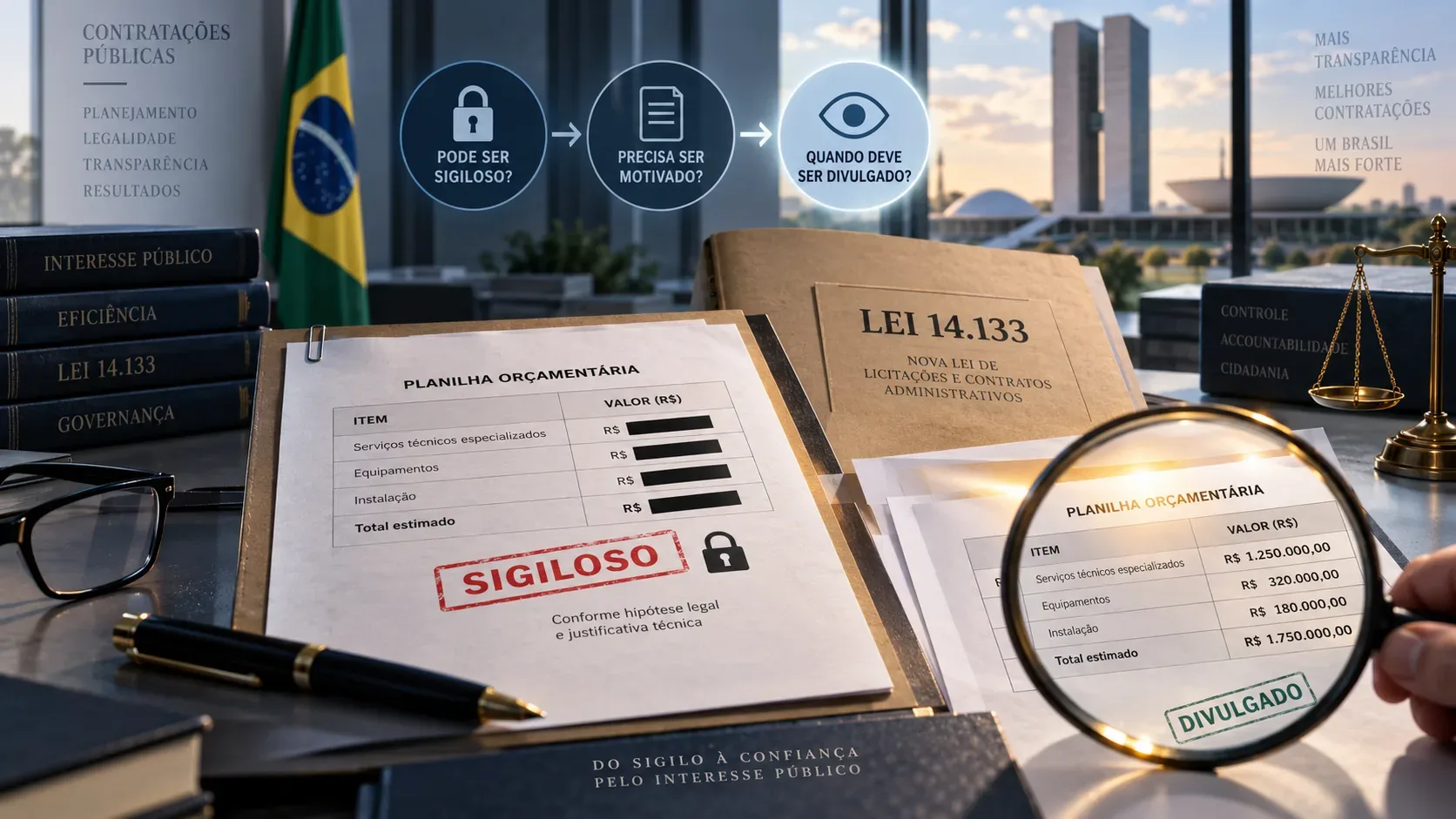
Direct answer: TCU Plenary Decision 1387/2026 treated as irregular a solicitation that allows a non-participating public body to join a Brazilian price registration record — the practice commonly called adesão or “carona” — when the solicitation does not contain an estimate of the quantities to be contracted. The reason is both practical and legal: without a quantitative baseline, the statutory caps on later adhesions cannot be checked objectively.
The decision does not amount to a blanket ban on piggybacking. It reinforces a planning sequence: first the solicitation and preparatory phase quantify the expected demand; then the managing body decides whether the price registration record may allow adhesions; finally, each requested adhesion must comply with the quantitative caps and the other legal and regulatory requirements.
What TCU decided in Decision 1387/2026
The case arose from a representation concerning Electronic Auction 90002/2025 of the Federal Institute of Education, Science and Technology of Rio de Janeiro (IFRJ), aimed at creating a price registration record for possible purchases of library materials. TCU found the representation partially well founded and identified, among other deficiencies, the absence of an estimate of the quantities to be contracted and the provision allowing non-participating bodies to join despite that absence.
In item 9.3.1.2, TCU stated that the lack of a quantity estimate conflicted with provisions of Law 14,133/2021 governing the terms of reference, preliminary technical studies, procurement planning and the price registration system. In item 9.3.1.3, it linked that missing estimate to the irregularity of allowing piggybacking. In item 9.4, TCU ordered IFRJ to definitively refrain from authorizing further adhesions to the price registration records arising from that auction.
Beyond the order in the specific case, TCU’s Jurisprudence Bulletin summarized the broader understanding: when a price-registration solicitation does not state estimated quantities, allowing adhesions by non-participating bodies is irregular under Articles 82(4) and 86(4)-(5) of Law 14,133/2021.
Why quantities come before the possibility of piggybacking
The logic follows the structure of Law 14,133/2021. Article 82 requires a price-registration solicitation to address, among other matters, the maximum quantity of each item that may be acquired. Paragraph 3 allows, in specific situations, registration by contracting units without stating the total quantity to be acquired: a first procurement when there is no prior demand history, perishable food, or a service integrated with the supply of goods. In those situations, paragraph 4 requires a maximum expenditure amount and bars another public body or entity from participating in the record.
Article 86, in turn, requires the managing body during the preparatory phase to run the public intent-to-register-price procedure so other bodies may participate and the total estimated quantities can be determined, subject to the statutory exception when the managing body is the sole contractor. The same article establishes two essential quantity caps for a non-participant’s adhesion:
- individual cap: each adhering body or entity may not contract more than 50% of the quantities of the relevant items registered for the managing body and participating bodies;
- aggregate cap: as a general rule, all adhesions combined may not exceed twice the quantity of each item registered for the managing and participating bodies.
Those caps need a numerical baseline. If the solicitation does not estimate the real quantities, the Administration lacks the parameter needed to verify what 50% represents and what the aggregate two-times ceiling is. That incompatibility is central to TCU Decision 1387/2026.
The correct flow: solicitation → quantities → possibility of adhesion
- Quantify the demand. The preparatory phase should estimate how much the managing body and participants expect to contract, supported by calculations and reasons appropriate to the procurement.
- Consolidate quantities. In the price registration system, the intent-to-register-price procedure is used to gather participating bodies’ demands and form the total estimate when applicable.
- Decide whether piggybacking will be allowed. An adhesion clause should not be automatic. It must be compatible with the way quantities were planned and with the applicable legal framework.
- Make the adhesion measurable. At the federal level, Decree 11,462/2023 requires a solicitation that allows adhesions to state the estimated quantities to be acquired by non-participating bodies or entities, subject to the regulatory limits.
- Review each adhesion request. A clause in the solicitation does not replace the instruction of the specific request. For the federal bodies covered by Decree 11,462/2023, the non-participant must justify the advantage of joining, demonstrate that the registered prices are compatible with market prices, and obtain prior acceptance from the managing body and the supplier.
When piggybacking becomes irregular because of quantities
| Situation | Practical consequence |
|---|---|
| The solicitation does not estimate quantities but still allows adhesions by non-participants. | The piggybacking provision is irregular under the understanding consolidated in TCU Plenary Decision 1387/2026. |
| The price registration uses the exceptional arrangement in Article 82(3), without a total quantity to be acquired. | Article 82(4) requires a maximum expenditure and blocks opening the record to another body or entity; it is therefore not a suitable basis for piggybacking. |
| Quantities are defined, but one adhesion exceeds 50% of the registered baseline. | The adhesion exceeds the individual cap in Article 86(4). |
| All adhesions combined exceed twice the quantity of each registered item. | The aggregate adhesions exceed the cap in Article 86(5), unless a specific statutory exception applies. |
| Quantities and caps are respected, but the federal process lacks an advantage justification, price-compatibility analysis or required approvals. | The problem is no longer only quantitative: the adhesion process may still be irregular for failure to comply with Decree 11,462/2023. |
Sample solicitation wording
The examples below illustrate structure only. They are not official clauses and do not replace legal review of the specific procurement.
When adhesion should not be allowed
“Adhesion to the price registration record by a non-participating public body or entity shall not be allowed, in view of the quantity-planning method adopted for this procurement and the restrictions applicable to the price registration system.”
This approach is especially consistent where no quantity estimate exists that can lawfully support later adhesions or where Article 82(4) applies.
When adhesion may be provided for
“Adhesion by a non-participating public body or entity may be allowed provided that the requirements of Law 14,133/2021 and the applicable regulation are met, including the quantities registered for the managing and participating bodies, the 50% cap per adhering body, the aggregate cap under Article 86(5), and any estimate allocated to potential non-participants when required by regulation.”
In practice, such a clause is coherent only if the file contains numbers that make those limits verifiable. Repeating statutory percentages in a solicitation whose demand was never quantified is not enough.
What the decision does not mean
- It is not a general ban on joining price registration records. Law 14,133/2021 continues to allow adhesions by non-participants when the legal conditions are met.
- An estimate is not an obligation to purchase the full amount. A price registration record creates a supply commitment under the registered conditions, but it does not force the Administration to contract the entire estimated quantity.
- Quantity caps are not the only requirements. Advantage, price compatibility, approvals, validity of the record and the applicable regulation still matter.
- Item 9.4 was directed to the records created by Electronic Auction 90002/2025. The broader relevance for other procurements comes from TCU’s stated legal interpretation and the statutory provisions, not from automatically extending that case-specific order.
- Local regulations must be checked. Decree 11,462/2023 regulates the system for Brazil’s direct federal administration, federal agencies and foundations. States, the Federal District, municipalities and other regimes may have their own rules, subject to Law 14,133/2021.
Checklist before allowing piggybacking in the solicitation
- Does the procurement file contain an item-by-item consumption estimate and a justification for the quantities?
- Have the managing body’s and participants’ quantities been consolidated?
- Does the solicitation state the maximum quantity per item, unless a statutory exception applies?
- If adhesions are allowed, can the 50% individual cap and the two-times aggregate cap be calculated objectively?
- Under the federal regime, does the solicitation state the estimated quantities for non-participants when adhesions are permitted?
- Does the draft avoid allowing adhesions where Article 82(4) is incompatible with them?
- Will each adhesion request be reviewed for advantage, price, record validity and required acceptances?