
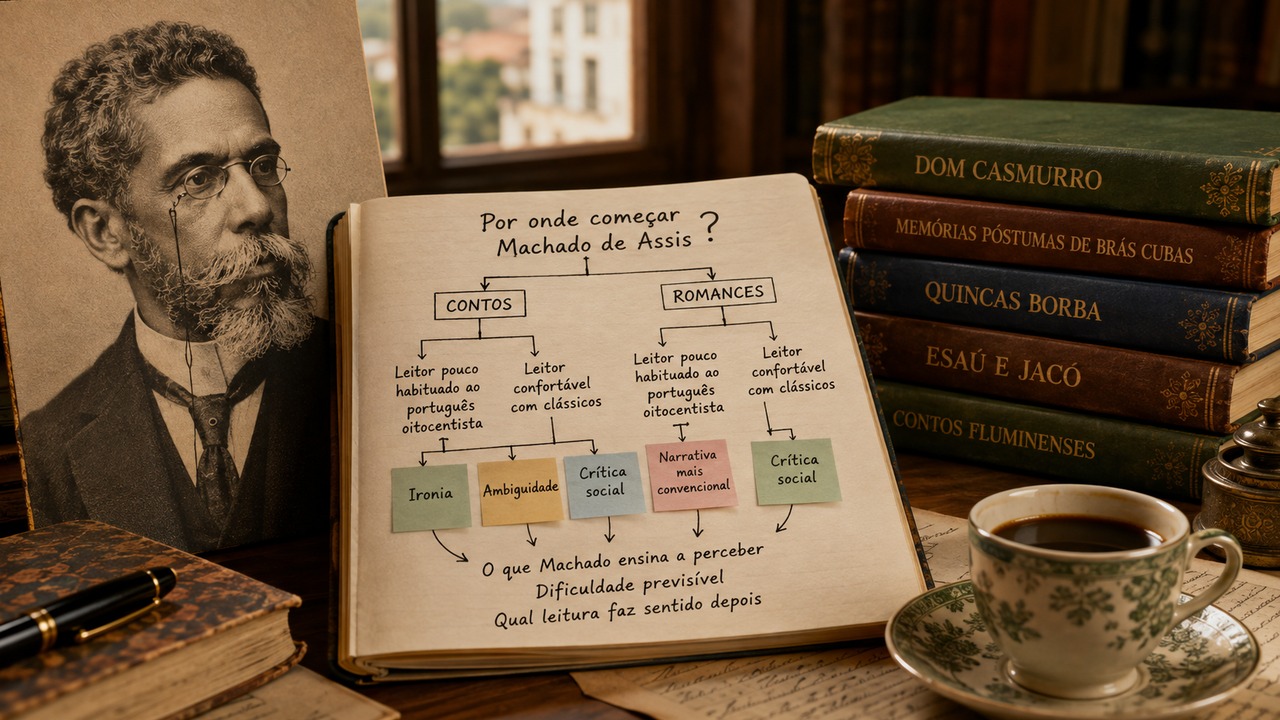
If you've never read Machado de Assis and don't know where to enter, short stories are usually the safest door. They allow you to experience the author's irony, ambiguity and social criticism in a few pages, without requiring the breath of an entire novel. But that doesn't mean every beginner should follow the same order. Those who already read classics comfortably or prefer to follow characters for a longer time can start directly with a novel.
The question, therefore, is not just “which is the best book by Machado de Assis?”. It’s “which aspect of Machado do you want to find first and what kind of difficulty are you willing to face now?” In April 2026, an article published by the Brazilian Academy of Letters brought together different recommendations precisely because there is no single correct entry. Hélio de Seixas Guimarães and Ieda Lebensztayn pointed out short stories as a great gateway; Maria Valéria Rezende said that she started very young with A Mão e a Luva, Helena and Iaiá Garcia; and Cláudio Soares suggested a path that passes through Missa do Galo, Dom Casmurro and Memórias Póstumas de Brás Cubas. The divergence doesn't get in the way: it helps to create a journey per reader profile.
If you are in doubt, start with short stories
The story reduces the risk of turning the first experience with Machado into a test of endurance. Instead of having to adapt to the 19th-century vocabulary, narrator, and rhythm of a novel all at the same time, you can look at one feature at a time. It's also easier to reread. And rereading Machado is especially useful, because many stories change their meaning when the reader realizes that the narrator has omitted, distorted or ironized something.
This does not mean that short stories are synonymous with simple text. Some are short and very direct in plot, but demanding in what they imply. Others have a heavy theme, less familiar vocabulary or a structure that demands attention. The gain is in the size: if
a short story doesn't work for you, just change doors without concluding that “Ax is difficult”.
For a light first contact: The Fortune Teller
The Fortune Teller is a good choice for those who want a recognizable story, with romantic conflict, suspense and a strong ending. The plot progresses clearly, but the narrator already shows one of Machado's hallmarks: he seems to talk to the reader while leading the interpretation and preparing expectation traps.
What this story teaches you to understand is the distance between what the characters want to believe and what the facts allow us to conclude. It's an efficient first contact with Machado's irony because the story works even before the reader grasps all the layers.
If The Fortune Teller works for you, the next step might be Midnight Mass, which reduces the external action and increases the ambiguity, or Dom Casmurro, if you want to carry this suspicion about narrative into an entire novel.
To learn to read what is not said: Midnight Mass
Missa do Galo is short, but it doesn't provide a closed answer about what exactly happened in a nighttime conversation between two characters. The strength of the story lies in the narrator's memory, gestures, hesitations and subsequent interpretation. The reader needs to observe more than simply follow facts.
It's a great gateway for those who like psychological texts, scenes of contained tension and stories in which ambiguity is not a defect to be resolved, but a central part of the experience. After him, Dom Casmurro tends to make more sense as a choice, because the novel also demands attention to the difference between what the narrator claims and what he actually manages to prove.
To see social satire at work: Medallion Theory
Medallion Theory presents a father teaching his son how to achieve social prestige through appearance, the repetition of accepted ideas and calculated prudence. The form of dialogue helps, but the fun depends on realizing that the advice is serious for the characters and satirical for the reader.
This short story is especially good for anyone interested in criticizing respectability, status and social conventions. He shows that Machado's irony often does not appear as an explicit joke. It arises from the distance between the discourse and the judgment that the text invites the reader to make.
After him, Memórias Póstumas de Brás Cubas is a natural step for anyone who wants to see this irony amplified in a novel. Quincas Borba also makes sense later on, when the reader is already accustomed to the way Machado mixes ideas, social interest and self-deception.
For harsher social criticism: Father versus Mother
Father against Mother is also short, but it is not a light read. The tale places slavery, violence and economic precariousness at the center of the moral conflict. Therefore, it can be an excellent entry for those who want to understand how Machado works with concrete social structures, but perhaps it is not the best choice for those who are just looking for a comfortable introduction to the style.
The benefit of this reading is in observing how the narrator describes brutal practices with a coldness that increases discomfort. The short form focuses on the clash between individual need, social convention and historical violence. Afterwards, the reader can move on to O Caso da Vara, another story in which power relations and slavery cross personal decisions, or move on to Memórias Póstumas de Brás Cubas.
When is it worth starting straight with a novel
Starting with a novel is neither a mistake nor “skipping a step”. The reading trajectory reported by Maria Valéria Rezende shows that early novels such as A Mão e a Luva, Helena and Iaiá Garcia can function as an entry. The question is choosing the type of novel that suits your repertoire.
Machado's work is usually divided, with all the precautions that this type of division requires, between an initial period and a phase marked by the turning point of Memórias Póstumas de Brás Cubas, published as a book in 1881. The Biblioteca Brasiliana at USP records this division as a traditional way of reading the author's career, and the National Library highlights Memórias Póstumas as the work that gave a new direction to his literary career. This helps to understand why the novels don't all have the same sense of difficulty.
If you prefer a more conventional narrative: Helena
Helena, from 1876, belongs to the set of novels prior to Memórias Póstumas. For a reader who likes family relationships, secrets, emotional conflicts and a plot progression closer to the traditional nineteenth-century novel, it may be a less abrupt entry than Brás Cubas' experimentation.
The predictable difficulty lies more in the language and social conventions of the time than in a radical narrative form. At the same time, there is no need to treat Helena as a “minor Ax” or just as a warm-up. Reading allows us to understand themes that will continue to be important in the work: social position, interest, appearance, calculation and conflict between desire and norm.
If you like it, you can go to A Mão e a Luva or Iaiá Garcia to stay a little longer at this stage, or jump to Dom Casmurro to compare how the narrator and the ambiguity become more decisive.
If you want a strong plot and a narrator to distrust: Dom Casmurro
Dom Casmurro tends to attract those who prefer to have a clear emotional story to follow. There is childhood, friendship, marriage, jealousy and memory. This narrative line gives the reader a fulcrum. At the same time, the novel does not work well if it is reduced to the popular question about Capitu's guilt or innocence.
The most interesting difficulty lies with Bentinho, who narrates his own story after the events and tries to organize the past in a convincing way. Reading the novel well requires asking not just “what happened?”, but “how does this narrator want me to understand what happened?”.
For those who have read Midnight Mass, this stance tends to come more naturally. After Dom Casmurro, Memórias Póstumas is a good way to understand that the unstable relationship between narrator and reader appears in Machado in very different ways.
If you like books that play with form itself: Memórias Póstumas de Brás Cubas
Memórias Póstumas de Brás Cubas could be the first Machado for a reader accustomed to classics, unreliable narrators, dry humor or fragmented novels. The starting point already breaks expectations: the person telling the story is a dead person. The chapters can be very short, the narrator talks to the reader, interrupts the narrative, comments on the book itself and alternates verbal lightness with bitter observations.
Novel is not necessarily more difficult because of vocabulary. For many people, short chapters set the pace. The requirement is to accept that the book does not always want to move forward in a straight line. The National Library itself treats its publication in 1881 as a change of direction in Machado's career, while the Biblioteca Brasiliana uses the novel as a conventional landmark between two periods of the work.
Whoever likes this game can go to Quincas Borba, which takes up a character from Memórias Póstumas and develops criticism of interests, ideas and human vulnerability in a different way. Afterwards, Dom Casmurro shows a more concentrated form of narrative ambiguity.
Machado's difficulty is not just one thing
Many people ask if Machado de Assis is “difficult”, but that word mixes different problems. A reader can understand the vocabulary perfectly and still not notice the irony. Another might get the satire but tire of the syntax or historical references. A third party may find Helena fluid and Posthumous Memoirs strange not because of the language, but because they expect a more linear novel.
The first layer is language. Some words, syntactic constructions and references belong to Portuguese and the 19th century repertoire. An annotated edition helps, especially when it explains old uses without turning reading into a sequence of interruptions.
The second layer is the narrator's voice. Machado frequently asks the reader to be suspicious of the most obvious explanation, notice contradictions and note the interest of whoever is telling the story. When this key appears, several texts stop looking just “old” and start sounding much closer.
The third layer is historical. Slavery, favor relationships, social position, marriage, work, press and cultural prestige are not just scenery. In many texts, they are part of the mechanism that moves the characters. Understanding everything before you start isn't necessary, but recognizing when historical information is altering the conflict helps a lot.
The fourth layer is formal. Some texts are more linear; others interrupt, divert, comment on the reading and refuse closed answers. Therefore, a reader comfortable with Old Portuguese may still find Memórias Póstumas more demanding than Helena, while another may prefer precisely the fragmentation and humor of Brás Cubas.
Four possible routes, without turning Machado into a checklist
I want to try the author before taking on a novel
Start with The Fortune Teller. Then read Midnight Mass. If both work, head to Dom Casmurro. This path leaves a short story with a more immediate plot, passes through a short narrative of ambiguity and arrives at a novel in which the narrator's interpretation is the center of the experience.
I want to get to social criticism and irony quickly
Start with Medallion Theory and then read Father against Mother. Then go to Posthumous Memoirs of Brás Cubas. If you want to continue seeing how ideas, ambition, vulnerability and social relationships mix, Quincas Borba is a good next step.
I prefer novels and I don't want to start with short stories
Enter Helena if you like a more conventional progression and want to get used to the language before tackling the more experimental phase. Then, choose Dom Casmurro if you prefer psychological conflict and ambiguity, or Memórias Póstumas if you prefer humor, fragmentation and a more direct relationship between narrator and reader.
I already read classics and I want to find the most audacious Machado soon
Start with Posthumous Memoirs of Brás Cubas. Then read Quincas Borba and Dom Casmurro. Only then return to the stories of Single Papers, Stories without Date, Various Stories and Collected Pages. Along the way, short stories stop being simple “preparation” and start to function as a concentrated laboratory of techniques that you have already recognized in novels.
Do not read in chronological order just out of obligation
Chronology is great for studying a writer's transformation, but it's not necessarily the best strategy for getting to know him or her. Starting with Ressurreição and following book by book until Memorial de Aires can make sense for research, for a complete reading project or for those who have already decided to follow the entire career. For a first approximation, however, the chronological order may delay precisely the encounter with the aspect of Machado that best suits you.
There is also no need to “beat” a book that didn’t fit. If Posthumous Memoirs seems too fragmented, try Dom Casmurro. If Dom Casmurro seems too caught up in the interpretative dispute about Bentinho and Capitu, go for a satirical tale. If Father versus Mother is too heavy for the moment, change it to The Fortune Teller or Midnight Mass. Changing doors is not abandoning the author.
How to choose your first edition
For the first reading, choose an edition that preserves the text and offers discreet notes for vocabulary, historical references and allusions that really hinder understanding. The Ministry of Education's digital collection brings together Machado's novels and collections, and the National Library also maintains digitized works. This allows you to test a text before purchasing a print edition, if that is your preference.
Avoid turning the footnote into the protagonist. If a word doesn't stop you from following the scene, it's often worth following and checking later. Machado rewards continuity and rereading. A second pass through a ten-page story can teach you more about your storytelling than stopping at each line to resolve everything at once.
So, short stories or novels?
If you still don't know which Machado you'll like, start with the stories. The Fortune Teller is a direct entry; Midnight Mass trains the reading of ambiguity; Medallion Theory presents social satire; Father versus Mother shows the harshest face of historical and moral criticism.
If you already know you prefer romance, choose the experience you want. Helena offers a narrative closer to the conventional nineteenth-century novel. Dom Casmurro combines an affective plot with a narrator who demands distrust. Posthumous Memoirs of Brás Cubas is the choice of those who want to immediately enter into the author's most inventive and self-conscious form.
The best start is not the work that appears first on a list of “essentials”. It is the work that teaches you to listen to Machado's voice without asking you to master the entire repertoire before the first page. Once this voice becomes recognizable, the journey stops seeming like a school obligation and begins to open up in different directions.