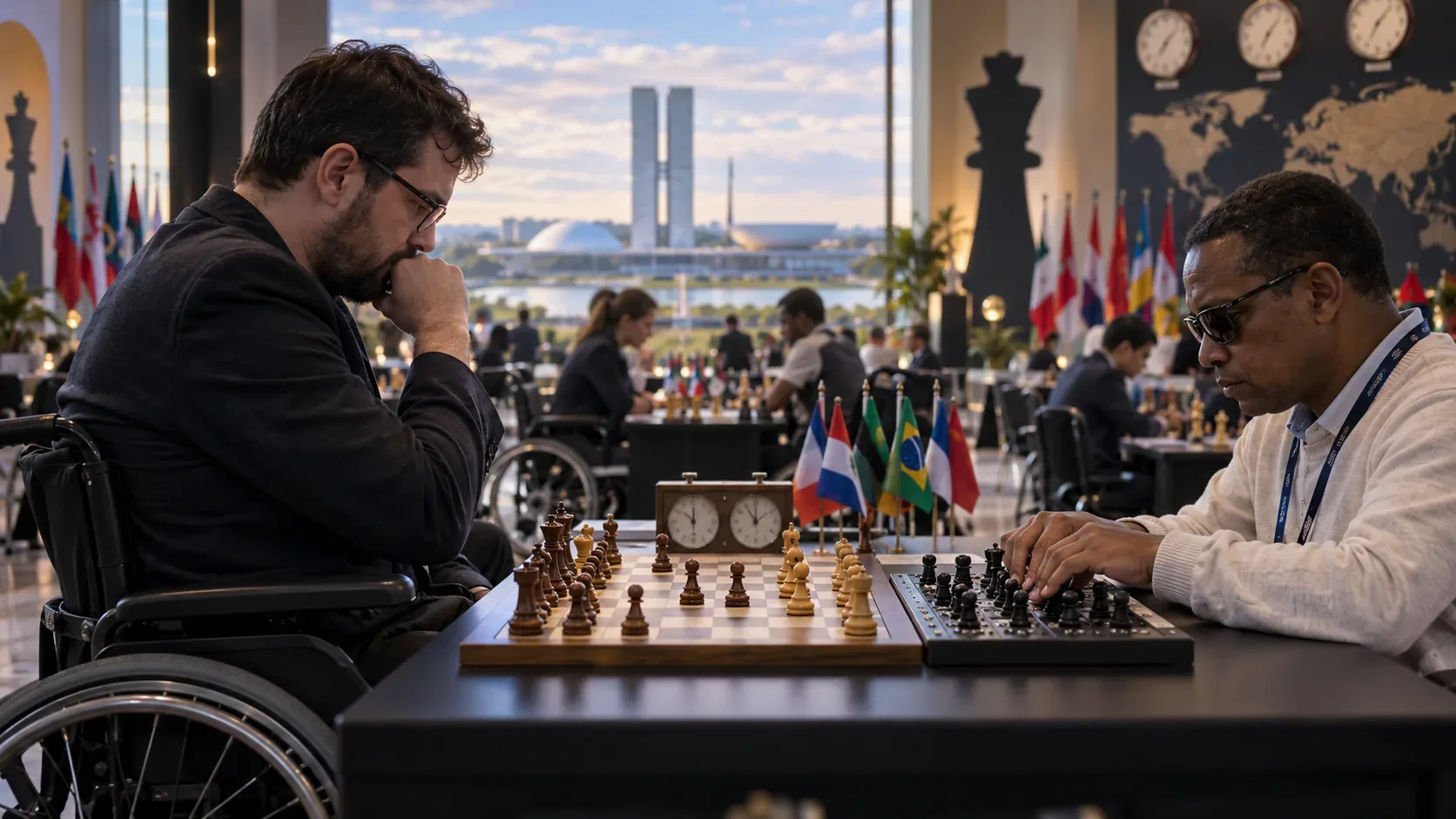

Two players can finish a tournament with the same score and still appear in different positions. That happens because the standings do not depend only on total points: the competition regulations define an ordered sequence of tie-break criteria. Among the best-known are Buchholz, Sonneborn-Berger and Direct Encounter.
Under the FIDE tie-break regulations in force since March 1, 2026, these criteria measure different things. Buchholz looks at opponents' final scores; Sonneborn-Berger combines opponents' strength with the result scored against each one; and Direct Encounter considers the games among the tied participants themselves. The order is not universal: it must be established by the tournament regulations.
Why the same score does not always mean the same place
Imagine that Ana and Bruno both finish a five-round Swiss tournament with 4 points. The primary score tells us only that each earned 4 points. It does not tell us whether they faced stronger opposition, against whom they scored, or what happened if they played each other.
That is where tie-breaks come in. FIDE requires organizers to choose an ordered list of criteria. The first criterion is applied to the tied players; if a tie remains, the next criterion is used only for the subgroup that is still tied. If the list is exhausted without resolving every tie, the regulations may provide another method, including drawing of lots, according to the competition rules.
Buchholz: the sum of opponents' scores
Buchholz (BH) is calculated by adding the final scores of all opponents a player faced. In practical terms, it tries to measure the strength of the opposition that appeared on each participant's path.
Mini Buchholz example
Suppose Ana and Bruno both finish with 4 points. Ana's five opponents end the tournament on 4.0, 3.5, 3.0, 2.5 and 2.0 points. Ana's Buchholz is 15.0.
Bruno's opponents finish on 4.5, 3.0, 2.5, 2.5 and 2.0 points. Bruno's Buchholz is 14.5. If Buchholz is the applicable criterion at that point, Ana ranks higher because the sum of her opponents' scores is greater.
There are variants such as Buchholz Cut-1, which excludes the least significant value from the sum. Under the current FIDE rules, Buchholz and its variants also have specific treatment for unplayed rounds in Swiss tournaments. FIDE also states that Buchholz must not be used in round-robin tournaments.
Sonneborn-Berger: how much the opponents you scored against were worth
Sonneborn-Berger (SB) uses each opponent's final score but also accounts for how many points the player scored against that opponent. With the traditional 1 point for a win and 0.5 for a draw, this is equivalent to adding the full final score of each defeated opponent and half the final score of each opponent who was drawn with. A loss contributes zero.
Mini Sonneborn-Berger example
Ana scores 4 points with three wins and two draws. She beats opponents who finish on 4.0, 3.0 and 2.5 points, and draws with opponents who finish on 3.5 and 2.0. Her Sonneborn-Berger is 4.0 + 3.0 + 2.5 + 1.75 + 1.0 = 12.25.
Bruno also scores 4 points with three wins and two draws. He beats opponents who finish on 3.5, 3.0 and 2.0 points, and draws with opponents who finish on 4.5 and 2.5. His Sonneborn-Berger is 3.5 + 3.0 + 2.0 + 2.25 + 1.25 = 12.0.
In this example, Ana ranks ahead on Sonneborn-Berger. The difference is not the tournament score, which is the same, but the combination of whom she faced and the results she achieved against those opponents.
Direct Encounter: what happened among the tied players
Direct Encounter (DE) creates separate standings using only the encounters among the tied participants. When two tied players have faced each other once, the reading is usually simple: if Ana beat Bruno and Direct Encounter is the next criterion in the list, Ana ranks ahead.
Mini example with three players
Suppose Ana, Bruno and Carla all finish on 6 points. In the games among them, Ana beats Bruno and draws with Carla, scoring 1.5 points in this mini-table. Bruno loses to Ana and beats Carla, scoring 1.0. Carla draws with Ana and loses to Bruno, scoring 0.5. Direct Encounter ranks them Ana, Bruno and Carla in that order.
FIDE's rules are more detailed when several participants are tied. If all have played each other, the separate standings among them determine the positions that can be resolved, and the criterion is reapplied to any subsets that remain tied. In Swiss tournaments, even when not all tied participants have met, Direct Encounter can resolve a place if one player is mathematically guaranteed to stand alone at the top of the internal standings regardless of the missing encounters.
Buchholz, Sonneborn-Berger and Direct Encounter measure different things
| Criterion | What it considers | Practical interpretation |
|---|---|---|
| Buchholz | Sum of opponents' final scores | Rewards a schedule of opponents who finished with higher scores |
| Sonneborn-Berger | Opponents' final scores multiplied by the points scored against them | Rewards positive results against opponents who finished higher |
| Direct Encounter | Results among the tied participants themselves | Compares performance within the tied group |
Which tie-break comes first?
There is no universal order in which “Buchholz always comes first” or “Direct Encounter always decides.” Under the current FIDE rules, the specific competition regulations must publish an ordered tie-break list. That list can vary according to the event's format and purpose.
A Swiss tournament may, for example, choose Buchholz Cut-1 before Buchholz and then Direct Encounter; another event may use a different sequence. Round-robin competitions generally use criteria suited to that format, and Buchholz must not be used in them under the current regulations.
Byes, forfeits and unplayed games can change the calculation
In Swiss tournaments, it is not safe to recalculate Buchholz or Sonneborn-Berger by automatically treating every bye, forfeit or unplayed round as an opponent with zero points. FIDE has specific rules for adjusting the scores used in tie-break calculations in these situations, including different categories of unplayed rounds.
For that reason, the official standings published by the arbiters or tournament software should take precedence over an informal calculation based only on the visible cross-table. If there is any doubt, check the event regulations and the section on unplayed-round management in the FIDE rules.
How to check a tie-break in practice
- Confirm the primary score of the tied players.
- Open the tournament regulations and identify the exact order of tie-break criteria.
- For Buchholz, add opponents' final scores according to the specified variant.
- For Sonneborn-Berger, multiply each opponent's final score by the points scored against that opponent and add the products.
- For Direct Encounter, consider only the games among the tied participants and apply the rules to that group.
- Check for byes, forfeits or other unplayed rounds, because they may require regulatory adjustments.
In short, two players with the same number of points can finish in different places because a tie-break asks a second question: not only how many points each player scored, but also against whom, with what results and, in some cases, what happened among the tied players themselves.
Sources: FIDE Handbook — Play-Off and Tie-Break Regulations, effective from March 1, 2026; FIDE notice on the 2026 update.