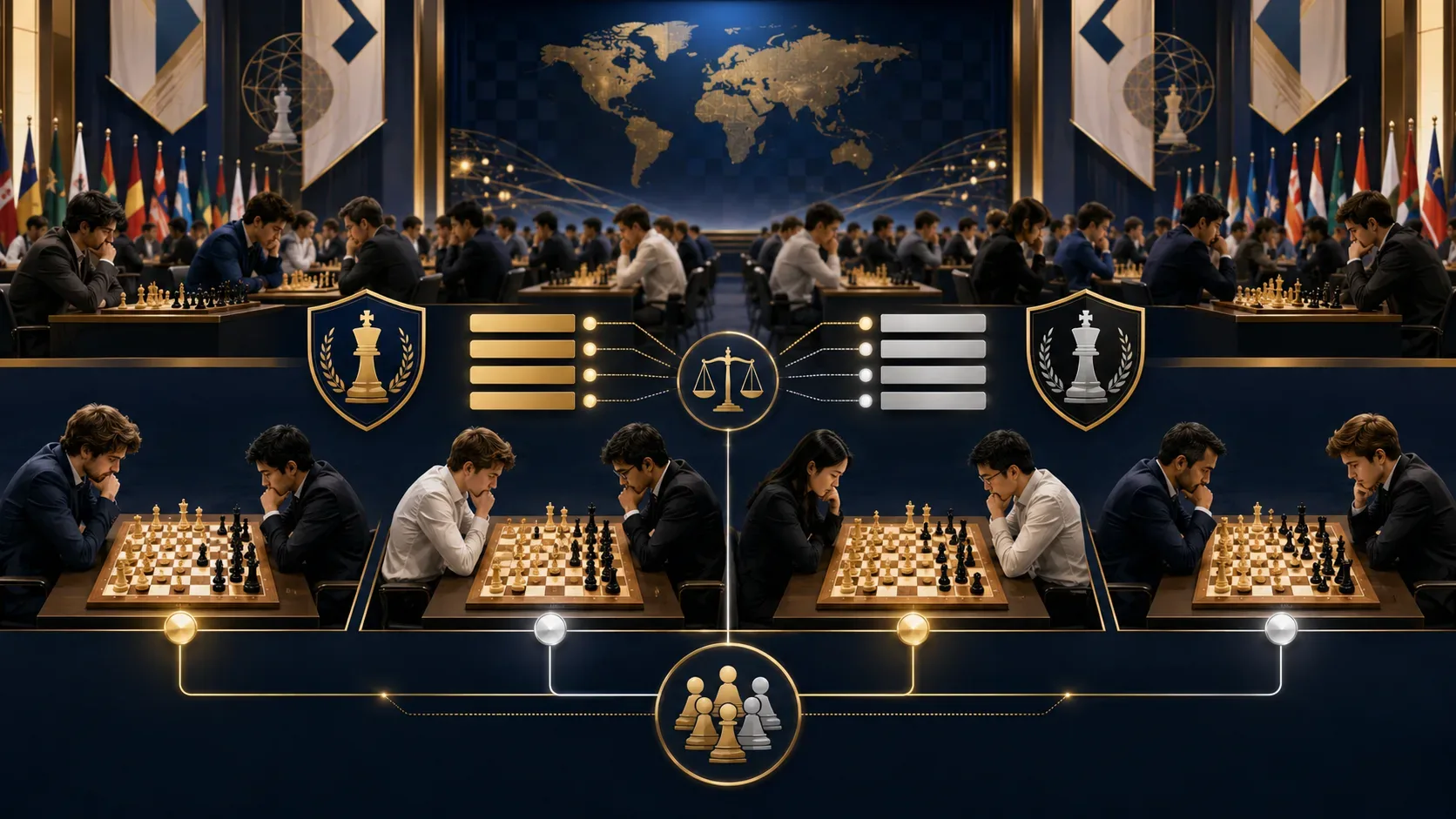
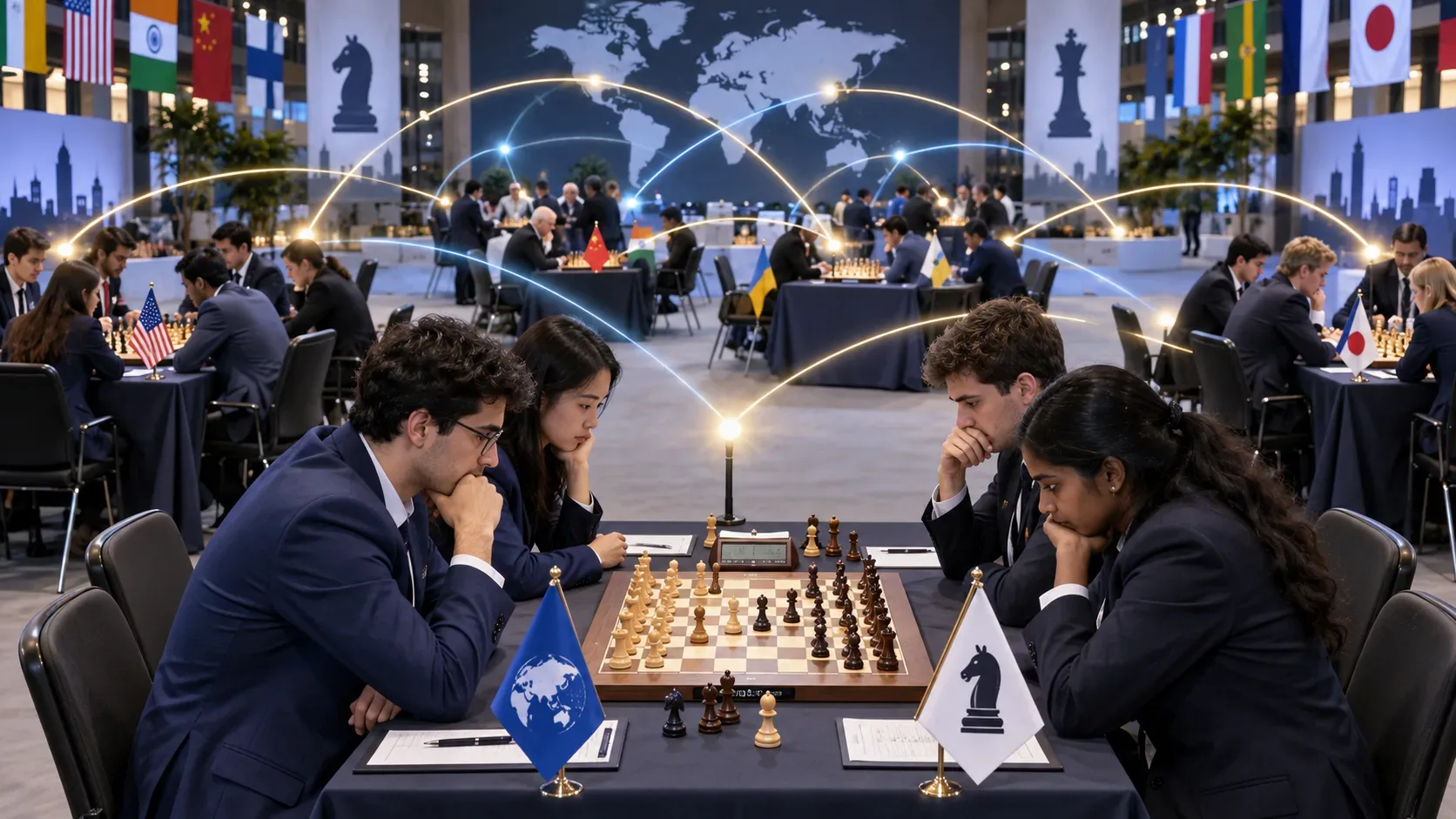
At the Chess Olympiad, the next opponent is not set in a complete table before the tournament begins. Pairings are recalculated after every round using the results already scored, the pairing order and the history of previous opponents. That is why the schedule can list all 11 rounds even though a national team cannot know in advance whom it will face in round 5, 8 or 11.
For the 2026 edition in Samarkand, the main competition is scheduled for September 15-27, with round 1 on September 16. The 2026 Olympiad regulations specify an 11-round Swiss system in the Open and Women's sections, with four players in each match and one reserve per team. The same regulations explicitly state that pairings are governed by the FIDE Olympiad Pairing Rules. This distinction matters because FIDE also has, since February 1, 2026, a general Swiss Team Pairing System for team competitions; the two documents share concepts, but they should not be treated as the same procedure.
What actually determines the next opponent at the Olympiad
For pairing purposes, the Olympiad starts from match points, not from a fixed bracket. A team win is worth 2 match points, a drawn match 1 and a loss 0. After each round, teams are reordered for the next pairing.
- Before round 1: each team receives an initial pairing number. The order is based on the average rating of its four highest-rated players, then the rating of the fifth player and, if still tied, alphabetical order.
- In later rounds: teams are ranked for pairing by descending match points and then by the initial pairing number.
- No rematches: two teams may not play each other more than once in the tournament.
- Close scores: the match-point difference between paired teams should be zero or, when that is impossible, as small as possible.
One useful detail is that, under the Olympiad-specific pairing rules, game points scored across the four boards do not appear as the second criterion in the ordering used to pair later rounds; after match points comes the initial pairing number. Game points remain important elsewhere in the event, but they do not replace that pairing-order rule.
How score groups become matches
The rules call the set of teams with the same number of match points a group. The system works through these groups and, as far as possible, keeps teams with equal scores playing each other.
There is also a median group: the group containing the median team in the standings. The pairing procedure works from the top group downward until just before the median group, then from the bottom upward until just before the median group, and finally handles the median group. Within a group, the initial attempt is, as far as possible, to pair the top half in sequence against the bottom half.
This already explains why “they are 12th, so they play 13th” is not a valid rule. The visible standing is only part of the situation. The algorithm must respect scores, avoid rematches and still find a complete solution for every team in the round.
What floaters are and why a team can leave its score group
When a group contains an odd number of teams or cannot be solved internally, a team may be moved to a neighboring group. In the Olympiad-specific rules, groups above the median group can produce downfloaters, while groups below the median can produce upfloaters.
For an odd group above the median, the rule starts by trying to move the lowest-ranked team down to the group immediately below. Below the median, it starts by trying to move the highest-ranked team up to the group immediately above. If the candidate has already faced all available opponents or the choice makes the remainder of the group unsolvable, the procedure tests another candidate. The aim is not to reward or punish a team, but to complete a legal pairing for the round.
An 8-team simulation
Consider eight fictional teams after an intermediate round. The example is designed to make the logic visible; a real pairing also depends on opponent history and colour conditions.
| Place | Team | Match points | Initial number |
|---|---|---|---|
| 1 | A | 6 | 1 |
| 2 | B | 6 | 2 |
| 3 | C | 5 | 3 |
| 4 | D | 4 | 4 |
| 5 | E | 4 | 5 |
| 6 | F | 4 | 6 |
| 7 | G | 3 | 7 |
| 8 | H | 2 | 8 |
With eight teams, the central places are 4 and 5; under the Olympiad rules, the lower-ranked of the two is taken as the median team. The 4-match-point group is therefore the median group in this example.
- The 6-point group contains A and B. If they have not already met and the other conditions allow it, A vs. B completes the group.
- The 5-point group contains only C and sits above the median group. Because it is odd, C must move down. The first attempt is to pair it with the highest-ranked compatible team in the 4-point group; in the simple scenario, C vs. D.
- E and F remain in the 4-point group, allowing E vs. F if it is not a rematch.
- At the bottom, H is alone in the 2-point group, below the median. H moves up to the 3-point group and can form G vs. H if that match is allowed.
The teaching example therefore produces A vs. B, C vs. D, E vs. F and G vs. H. But add one fact — for example, C has already played D — and the path changes. The system tests another compatible option and checks whether the remainder still has a solution. This is exactly why the next opponent depends on the full field of results and histories, not only on your team's score.
What about colours on the four boards?
The team pairing first decides which teams meet; colours are assigned afterwards. At the Olympiad, the colour reference is team board 1. The rules seek to avoid a colour difference greater than two and three consecutive occurrences of the same colour on board 1, while also prioritizing equalization and alternation. There is, however, a specific caveat: if those restrictions would make it impossible to pair a group without introducing floaters, they may be disregarded to make the round possible.
The 2026 regulations add that the team listed first in the pairing has White on the odd-numbered boards and Black on the even-numbered boards; the other team receives the reverse. A team's “colour” is therefore a convention for distributing colours across the four boards, not one colour shared by every player.
General 2026 team rules vs. the Olympiad-specific rules
| Topic | General Swiss Team Pairing System | Olympiad |
|---|---|---|
| Reference | FIDE rule C.04.6, applied from February 1, 2026. | The 2026 regulations expressly refer to the FIDE Olympiad Pairing Rules. |
| Scores and groups | Defines scoregroups and brackets and, by default, uses match points as the primary score. | Forms groups by match points and orders teams by match points and initial pairing number. |
| Floaters | Selects upfloaters through prioritized quality criteria, including minimizing their number and score differences. | Uses its own upfloater/downfloater procedure relative to the median group. |
| Colours | Uses Type A colour preferences by default unless competition rules specify otherwise. | Has its own rules based on board-1 colour and alternating colours on the other boards. |
The practical takeaway is straightforward: scoregroups, compatibility and floaters help explain the wider family of team Swiss systems, but for the 2026 Olympiad the operational reference named by the event regulations is the Olympiad-specific rule set. It is not safe to transplant the general system's C4-C10 criteria mechanically and present them as the Olympiad algorithm.
How to follow the next round without looking for a fixed table
- Check the match points after the round is complete.
- Use the initial pairing number to understand the order of teams tied on match points for pairing purposes.
- Check whether candidate teams have already played each other; rematches are prohibited.
- Expect floaters when a group is odd or cannot be solved internally.
- Treat the published pairings as the output of the whole field, not as a simple crossing of adjacent places.
At the Olympiad, the Technical Administration Panel (TAP) produces each round's team pairings and its output must be approved by the Chief Arbiter. Captains then submit their team compositions and the individual board pairings are produced. That sequence also separates two different questions: first, which national team plays which national team; then, which players actually sit on each board.
For the official source, consult the Olympiad Pairing Rules chapter, the 2026 Main Competition regulations and, for conceptual comparison, the Swiss Team Pairing System in force since February 2026.