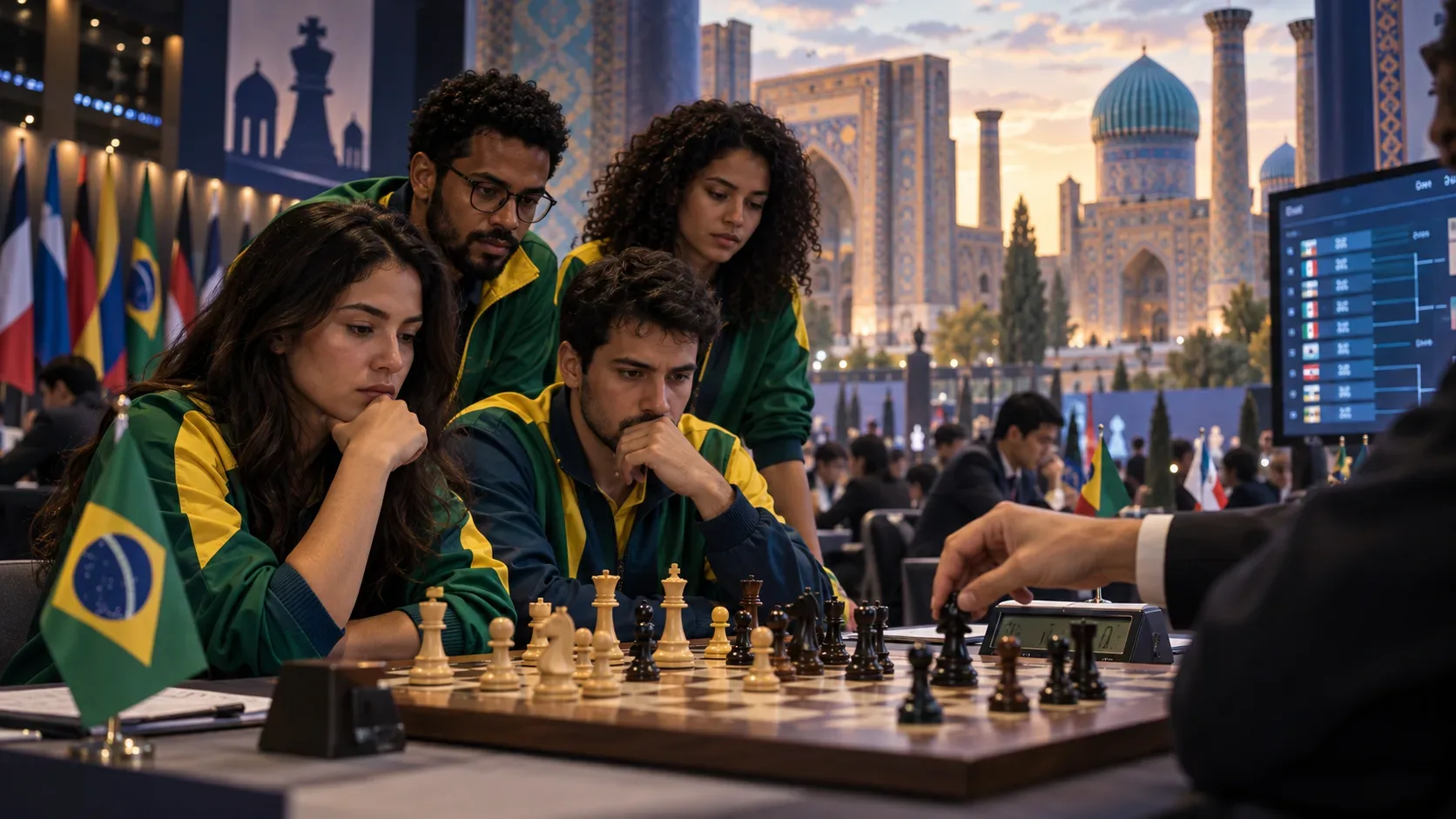
At the 2026 Chess Olympiad, team standings are not decided by the raw sum of individual game scores. The primary score is match points: a team match win is worth 2 points, a draw 1, and a loss 0. Game points — the sum of the scores on the four boards — determine the result of each match and also matter in the tie-breaks, but they do not replace match points as the primary standings criterion. The 46th FIDE Chess Olympiad is scheduled for Samarkand, Uzbekistan, from September 15 to 27, 2026, with 11 Swiss-system rounds in the Open and Women’s sections. The opening ceremony is on September 15 and round 1 on September 16, according to the official FIDE invitation.
How the four boards on each team work
Each federation registers a team of four players plus one reserve. Every team match consists of four simultaneous games, one on each board. The Technical Administration Panel (TAP) establishes the fixed board order and receives the lineup submitted by captains for each round in order to produce the individual pairings. In practical terms, the squad has five names, but a match is played on four boards.
The 2026 regulations also define the color split: the team listed first in the pairing list has White on the odd-numbered boards, 1 and 3, and Black on the even-numbered boards, 2 and 4. The opponent gets the opposite colors. The Olympiad pairing rules treat “board 1” as a team board position, not as a synonym for one specific player. See the Olympiad Pairing Rules and the 2026 main competition regulations.
Match points vs. game points: the distinction that changes how you read the table
In each individual game, a win is worth 1 game point, a draw 0.5, and a loss 0. Adding the four boards gives the match score. The team that scores more game points in that match receives 2 match points; if the four-board score is level, each team receives 1 match point.
| Board | Team Aurora | Team Atlas | Aurora game points |
|---|---|---|---|
| 1 | Win | Loss | 1 |
| 2 | Draw | Draw | 0.5 |
| 3 | Loss | Win | 0 |
| 4 | Win | Loss | 1 |
| Total | 2.5 game points | 1.5 game points | 2.5 |
In this fictional example, Aurora wins the match 2.5–1.5 and earns 2 match points. Atlas earns 0. If Aurora had won 4–0, it would still receive 2 match points. That is why a landslide on the boards does not directly increase the primary standings score; it can, however, improve game-point totals and tie-break calculations.
What determines the standings after 11 rounds
In the Open and Women’s sections, the team with the most match points ranks highest. The specific 2026 regulations are explicit: 2 points for a match win, 1 for a draw, and 0 for a loss. Only when two or more teams finish with the same number of match points do the Appendix 2 tie-breaks come into play.
This prevents a common mistake when following the Olympiad: looking only at the cumulative scores on the four boards. A team may have more game points and still rank behind another team that collected more match points. Game points become decisive only within the tie-break order set by FIDE.
TB1: performance against the ten best counted opponents
The first tie-break is TB1, described by FIDE as the sum of IS(10) for the ten best counted team opponents. For each opponent i, the calculation is:
ISi = GPi × FMPi
- GPi is the number of game points your team scored in the match against opponent i.
- FMPi is the opponent’s final number of match points.
If a team had a pairing-allocated bye, that round is excluded from the TB1 set. If it had no bye, the opponent with the fewest final match points is excluded; if more than one opponent is tied for the lowest match-point total, the lowest IS contribution among them is removed. In practical terms, TB1 rewards both how much you scored in a particular match and how strong that opponent proved to be by the end of the event.
A simple contribution example: if Aurora scored 2.5 game points against a team that finished with 16 match points, that opponent contributes 2.5 × 16 = 40 to TB1. The full TB1 is the sum of the ten counted opponent contributions. The formula and exclusion rules are in Appendix 2 of the 2026 Olympiad regulations.
TB2: total game points
If TB1 does not separate the teams, TB2 is applied: the total number of game points scored in the tournament. Here the margin of team-match victories matters directly. A 3.5–0.5 win earns the same 2 match points as a 2.5–1.5 win, but it leaves the winning team with one extra game point for TB2.
This helps explain why every board result still matters even after a team has already mathematically secured the match win.
TB3: sum of the opponents’ match points
If the tie remains after TB1 and TB2, TB3 is used: the sum of the final match points of ten opponents, excluding the opponent with the lowest number of match points. It is a strength-of-schedule measure within the Swiss system: among teams that are still tied, an advantage goes to the team whose counted opponents collectively finished with better match-point totals.
If the tie still remains after TB3, the 2026 regulations state that the teams remain tied and are assigned the top ranking of that tied set. There is no fourth tie-break at that point for team standings within the Open or Women’s section.
Fictional example: how TB1, TB2 and TB3 are applied in sequence
Suppose Team Aurora and Team Boreal both finish the 11 rounds on 18 match points. The comparison is always sequential: TB1 first; only if that is tied do you move to TB2; and only if the tie still remains do you use TB3.
| Scenario | Aurora | Boreal | Who ranks higher |
|---|---|---|---|
| Different TB1 | TB1 = 214.5 | TB1 = 211.0 | Aurora; the process stops here |
| Equal TB1 | TB1 = 212.0; GP = 25.5 | TB1 = 212.0; GP = 25.0 | Aurora on TB2 |
| Equal TB1 and TB2 | TB1 = 212.0; GP = 25.5; TB3 = 146 | TB1 = 212.0; GP = 25.5; TB3 = 143 | Aurora on TB3 |
These figures are purely illustrative, but the order is the real one in the regulations. The key point is that the criteria are not added together to create one combined index. Each tie-break is consulted only if the previous one has failed to resolve the tie.
Individual board standings and team standings are different things
Individual board prizes follow a different system. The regulations say that players assigned to the same board number compete for individual board medals and must play at least eight games to be eligible. Board medals are awarded according to tournament performance rating (TPR); if TPRs are equal, the first tie-break is the greater number of games played and the second is drawing of lots.
There is also a combined classification across the Open and Women’s sections, based on the sum of the two team placings for each federation, with its own tie-break sequence. Therefore, the TB1, TB2 and TB3 explained in this guide are specifically the tie-breaks for team standings within each section.
What to watch when following the 2026 Chess Olympiad
- Start with match points: they determine the primary standings.
- Then check TB1 when teams are level on match points.
- TB2 is total game points and is used only if TB1 is also tied.
- TB3 measures the sum of the match points of the counted opponents and is used only after TB1 and TB2.
- Do not confuse a bigger four-board win with more match points: every team-match win is worth 2.
- Remember that the 2026 Olympiad has 11 rounds: opening ceremony on September 15, round 1 on September 16, rest day on September 22, and round 11 plus closing ceremony on September 27.
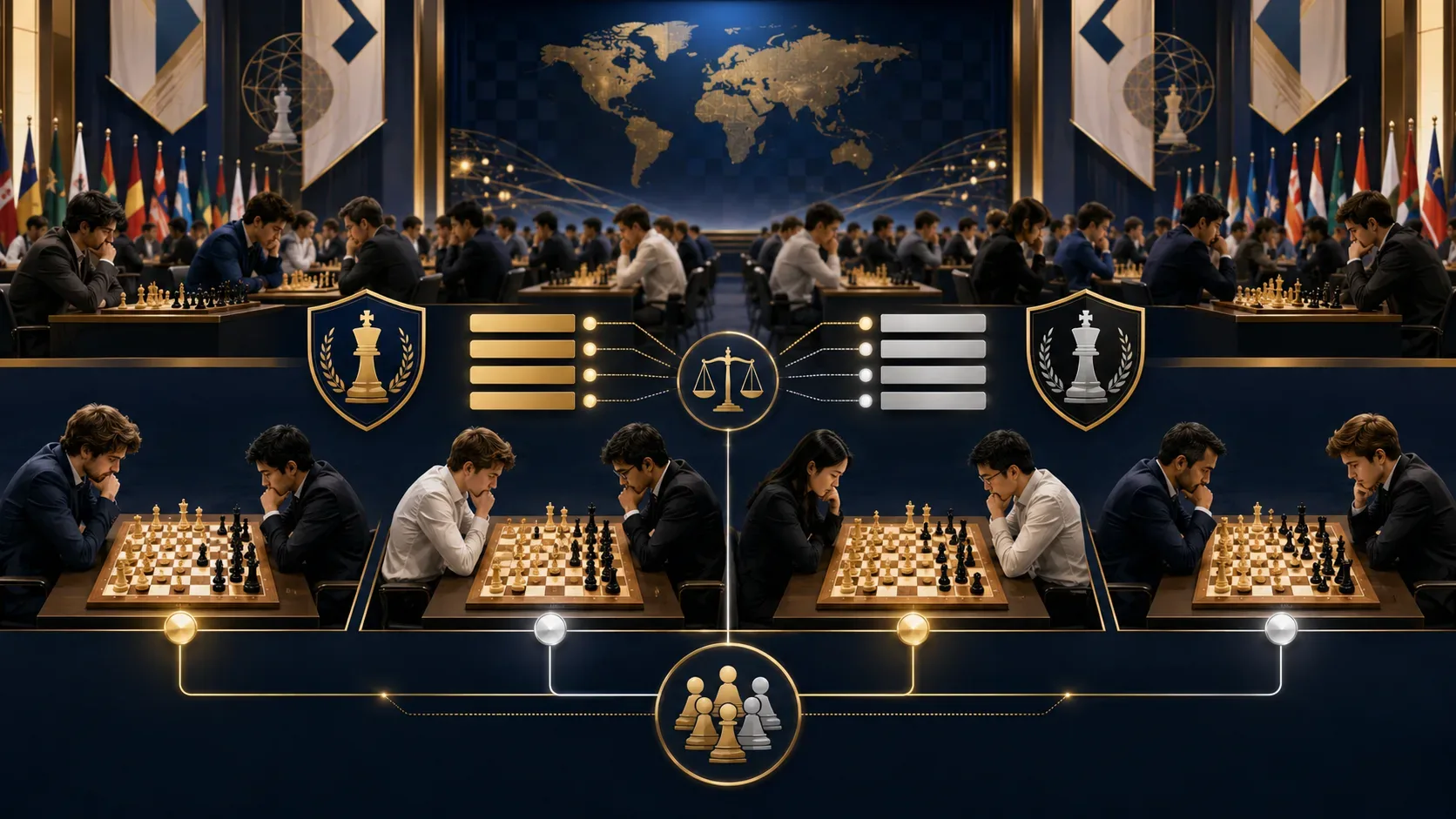
The most efficient way to read the standings is therefore: match points → TB1 → game points (TB2) → opponents’ strength (TB3). That is the ranking hierarchy FIDE has set for Samarkand 2026. For the general definitions of match points and game points in team events, FIDE also publishes the tie-break regulations effective from March 2026.