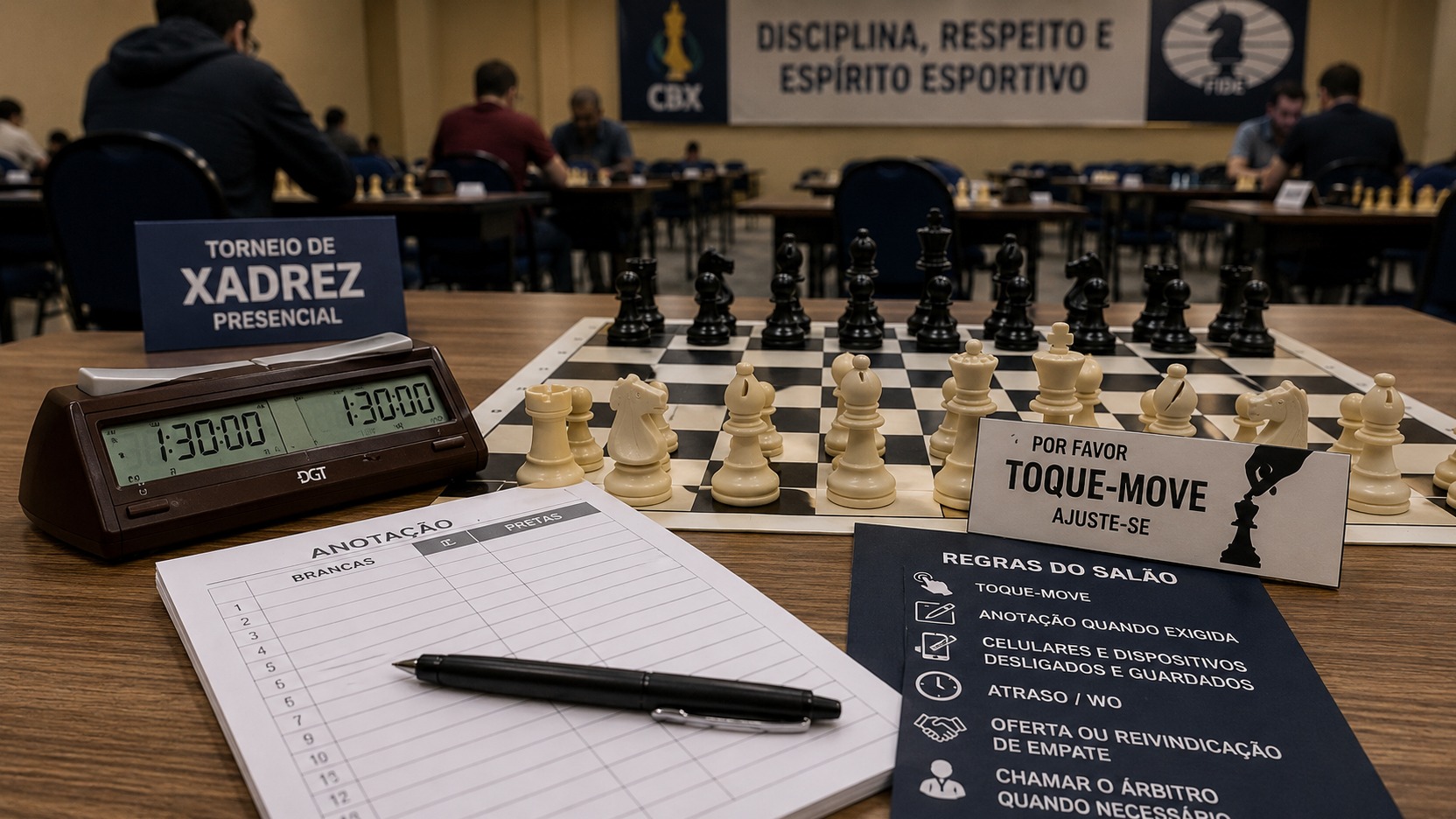
You don't need to wait to reach a specific online rating to play your first in-person tournament. There is no universal number that tells when someone is “ready.” What really changes when you leave the screen is the procedure: you start to deal with the event regulations, physical clock, real pieces, annotation sheet, touch-move, hall rules and arbitration decisions. If you know these routines before the first round, much of the anxiety disappears.
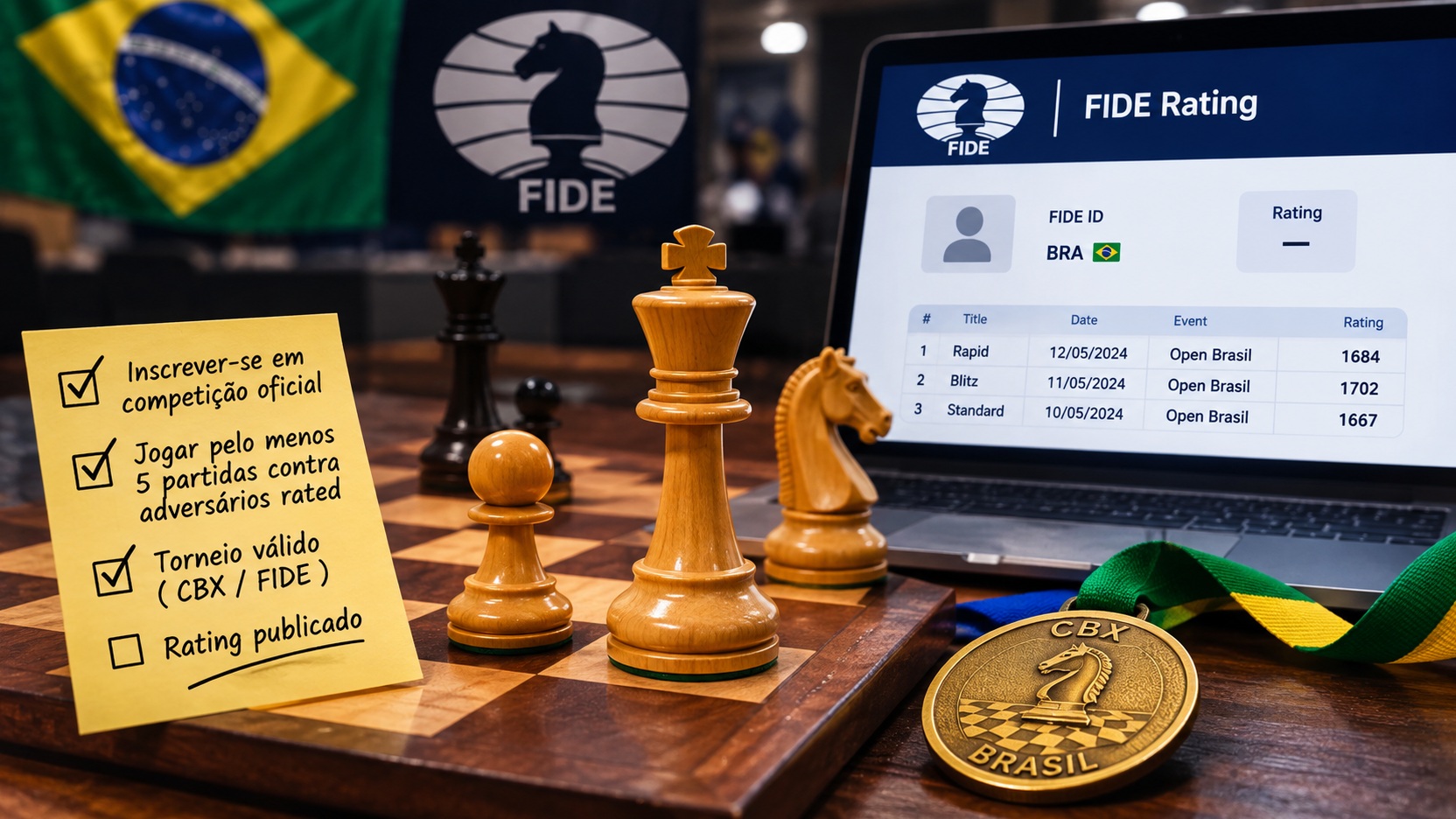
In Brazil, CBX itself maintains a calendar and register of tournaments with events of different rhythms and levels. In 2026 there will be amateur competitions, events for beginners, tournaments valid only for CBX rating and others valid simultaneously for CBX and FIDE. This shows why the first question should not be “is my online rating enough?”, but rather “what are the rules of this tournament and what does it require of me?”.
Before signing up, find out what type of tournament it is
A practical way to separate events is to think of them in three groups. The first is the recreational or local unranked tournament. He can use FIDE rules as a reference, but registration, format, prizes and procedures depend mainly on the organizer. It is often a simpler entry point for those who have never played in person.
The second group is the tournament valid for CBX rating. It enters the national system and must follow the registration and approval requirements of the Brazilian Chess Confederation. The third is the tournament valid for FIDE rating, normally also listed by CBX when held in Brazil. For a match to count towards FIDE rating, FIDE Laws are the mandatory basis for in-person play.
In practice, the same event may be valid for CBX and FIDE, while another may only change the national rating. The CBX calendar shows both types. Therefore, do not assume that every “official” tournament produces the same ratings nor that every event requires the same registrations.
Rating is not the same thing as eligibility
Having or not having a rating does not alone answer whether you can participate. Some tournaments are open; others limit by age, category, rating range, previous classification, team connection or other condition provided for in the regulations. The CBX Specifications for 2026, for example, treat the Campeonato Brasileiro Rápido and the Brasileiro Blitz as events open to players regularly registered with CBX, while other competitions have their own criteria.
For the first tournament, confirm your registration before paying the registration fee. If the event asks for a CBX ID, make sure you already have one to avoid creating a duplicate registration. If there is a requirement for regularity, annual fees, FIDE ID or other documentation, follow the event regulations exactly. Don't assume that the rules for a quick tournament will be the same as those for a classic tournament.
The regulations are your first piece of equipment
In online chess, the platform solves almost everything silently: it creates the pairing, positions the pieces, counts the time, prevents illegal moves and records the game. In person, part of this responsibility returns to the player. The regulation is the document that transforms general rules into concrete procedures for that event.
Before leaving home, confirm the pace of play, the number of rounds, the times, the dispute system, the tolerance for delay, the bye policy, the participation criteria, the material you need to bring, the rules for cell phones and smartwatches, how to record the result and any appeal procedures. In 2026 CBX tournaments there are regulations that ask the player to bring a watch and pen, while others inform that the organization will have material. There are also real differences in the tolerance of W.O. and how to store electronic devices.
This variation is not a detail. FIDE Laws themselves determine that the event regulations inform in advance the grace period for arrival. If this time is not specified, FIDE's general rule is zero tolerance. In Brazilian events, however, there are regulations with tolerances of a few minutes in the blitz, around fifteen minutes in the rapid or longer periods in the classic. The correct number is always that of the tournament you are going to play.
Train your physical clock before the tournament
This is one of the biggest differences for those who come from online. On the screen, the clock changes automatically after the bid. On the board, your move only enters the normal cycle when you move the piece and start the clock.
Under FIDE Laws, the player makes the move on the board and then presses his side of the clock to stop his own time and start the opponent's. The interval between releasing the piece and pressing the watch remains part of your time. Additionally, you must press the clock with the same hand you used to make the move. Keeping your finger on the button or “hovering” over it is not allowed.
This procedure seems simple until the first tense game. So, play some complete games at home with a board and physical clock. Use, if possible, the same rhythm as the tournament. Get in the habit of thinking, moving with one hand, releasing the piece, pressing the watch with the same hand and only then looking at the position again.
If the watch is defective, incorrectly configured or behaves strangely, do not try to resolve it yourself by changing the buttons in the middle of the game. Call the referee. FIDE assigns the referee to correct settings, times and move counters when necessary.
Touch-move: in person, touching can compromise your move
Online, you can click on a piece and change your mind before confirming the destination, depending on the platform. In person, physical contact with the item has regulatory consequences.
If it is your turn and you deliberately touch one of your pieces with the intention of moving it, you must move the first piece touched that has a legal move. If you deliberately touch an opponent's piece with the intention of capturing it, you must capture the first piece touched that can be legally captured. The rule also has specific procedures when pieces of both colors are touched.
The important exception is tuning. If a piece is crooked or poorly centered and you just want to put it back in place, announce your intention to adjust first, using an expression like “adjustment” or “j’adoube”, and do so when it’s your turn. The warning needs to come before contact that could be interpreted as intent to move.
It is also useful to practice a simple posture rule: only extend your hand when the decision has been made. This reduces impulsive touching and avoids unnecessary arguments. If there is a real controversy about touch-move, don't turn the board into a debate. Call the referee and explain objectively what happened.
Notation: when the worksheet is mandatory and when it is not
In matches under standard FIDE competitive rules, each player must record his own moves and those of his opponent, move by move, in algebraic notation, on the spreadsheet provided for the competition or on certified electronic media when the event adopts this solution. The scoresheet must remain visible to the referee.
The rule also prohibits writing down future bids as if the spreadsheet were an analysis block. It serves to record the match, times, draw offers, claims and other relevant information. If there is a draw offer in a match with a scoresheet, it must be marked with the equality symbol.
In rapid chess, the situation changes: under current FIDE rules, players do not need to write down moves. In blitz, when the special conditions of full supervision do not apply, the same logic applies as in rapid and annotation is also not required. Still, the tournament regulations may have their own procedures, so read the document before assuming whether or not there will be a scoresheet.
In the classic, there is also a time crunch exception. If the player has less than five minutes in a given period and does not receive an increment of at least thirty seconds per move, he is no longer obliged to keep the note for the remainder of that period. With an increment of thirty seconds or more, this exemption does not apply in the same way.
For your first classic tournament, it's worth practicing notation along with the clock. Play games in which you write down each move and avoid playing a second time without recording the move
previous. The difficulty is not learning the alphabet on the board; is to maintain the routine when the position gets complicated.
Cell phones, smartwatches and headphones: treat them as risky items
This is an important change compared to online. FIDE Laws prohibit, during the match, the player from having an electronic device in the playing area that has not been specifically authorized by the referee. The regulations may allow the device to be completely turned off inside a bag placed in the location indicated by the referee, but may also adopt a more restrictive rule.
Brazilian regulations show this difference in practice. There are CBX tournaments that allow cell phones to be completely turned off inside the bag, under arbitration conditions, and there are events that simply prohibit carrying cell phones, smartwatches, headphones or other devices in the playing area. Therefore, putting the device on silent is not a universal solution.
If the regulations are not clear, ask the organization before the round and follow the referee's guidance. The safest decision is not to come to the table with a device on your body without knowing if it is allowed. A mistake like this can cost you the game regardless of your position on the board.
Delay and W.O.: don’t trust “a few minutes”
Online, entering late can just mean wasting a few seconds or not being able to match at all. In person, the round time has regulatory effect. FIDE determines that the regulations establish the tolerance time; if it does not establish, the default tolerance is zero. Anyone who arrives after the limit may lose due to absence, unless the referee decides in the foreseen cases.
This explains why two tournaments can have different procedures without one of them necessarily being “wrong”. One regulation may provide three minutes for blitz, another fifteen minutes for rapid and another sixty minutes for classic. The only number that matters to you is the one published for your test.
Plan to arrive early enough to confirm attendance, locate the pairing, find your table and color, put away your cell phone according to local rules and listen to the referee announcements. Arriving on time for the round, but not knowing where to sit or what to do with your belongings, is already starting the match under unnecessary pressure.
A draw offer and a draw claim are not the same thing
Online, a button resolves the draw offer and the platform usually checks repetition automatically. In person, the procedure is part of the rule.
If the regulations allow draw deals, FIDE's standard way is to bid after making the move on the board and before pressing the clock. The offer cannot have a condition and remains valid until the opponent accepts, rejects verbally, rejects by touching a piece with the intention of playing or the game ends in another way. Repetitive and inconvenient offers can be treated as distractions.
A claim for position repetition or the fifty-move rule is not simply a proposal to the opponent. It is a regulatory complaint that involves the arbitrator and needs to follow the correct procedure. In certain situations, the player
must indicate the intended move on the scoresheet before executing it and declare the intention to the referee; in others, the necessary position has already occurred. A formal claim should not be improvised in the middle of an argument between players.
If you believe you are entitled to a draw by rule, stop playing and call the referee in accordance with the applicable procedure. FIDE provides that on a repeat claim or fifty moves, the clock will be paused by the player or referee and the claim will be verified.
When to call the referee
A habit of those who come from online is waiting for the system to correct everything. In the hall, the referee fulfills this role. He supervises the competition, applies the Laws of Chess, decides irregularities, protects the playing environment and can explain specific points of the rules when requested.
Call the referee when there is a problem with the clock, a dislocated piece that cannot be safely reconstructed, an illegal move already completed, a touch-move dispute, doubt about the result, behavior that is disrupting the match, a situation with an electronic device, the need for promotion without the piece available, or a draw claim that depends on verification.
The general FIDE rule allows pausing the clock to seek assistance from the referee when there is a valid reason. Do not use this possibility to interrupt the match due to any strategic doubt. If the referee understands that there was no legitimate reason to stop the clock, he can impose a penalty.
The most important point is not to try to “solve it with your arm”. Don't move pieces back on your own after an irregularity, don't change the clock setting without authorization, and don't get into a long argument with your opponent. Pause when the rule allows, call the referee and describe the facts.
How your first round should work
Arrive early and confirm that your registration is correct. Consult the pairing to find out the table, opponent and color. Go to the board and check the starting position of the pieces, the orientation of the board, the clock and the required material. If the organization asks for a signature, confirmation of presence or data verification, resolve this before the start.
Store your cell phone, smartwatch and other electronics exactly as the regulations require. Keep a pen and spreadsheet ready if note-taking is necessary. When the round starts, follow the referee's instructions about the clock. During the game, move with one hand, press the watch with the same hand, respect touch-move and keep the notes updated when it is mandatory.
When finished, confirm the result with your opponent and follow the tournament procedure to record it. In FIDE competitive rules, at the end of the match, players indicate the result by signing the scoresheets or approving the result on an electronic spreadsheet. After that, whoever finished the match is treated as a spectator and must not interfere in games that continue.
The best training before the in-person session is not to study more openings
If you already play online, you probably know the movement of the pieces, tactical notions and some repertoire. To avoid basic mistakes in the first tournament, the most efficient training is operational.
Set up a real board, use a physical clock and choose a rhythm similar to the event. Play two or three complete games following touch-move, using one hand, pressing the clock with the same hand and noting when the format requires it. Leave your cell phone out of reach. Even simulate the routine of getting up only when allowed and calling a “referee” in case of doubt, instead of correcting the position yourself.
Also read the regulations the day before. Confirm time, address, check-in method, material, registration, delay tolerance and electronics policy. This review is worth more for your first experience than memorizing yet another opening variant the night before.
You are ready when you know how to play and know how to stop
The online player does not need to become an arbitration expert to enter an in-person tournament. You need to know enough not to create a problem due to procedure and, above all, recognize when you should stop and call the referee.
If you can use a physical watch without thinking, understand touch-move, know when annotation is required, read the regulations and know that cell phone, delay and draw have specific procedures, you have already eliminated most of the surprises from the premiere. The rest come with salon experience.
The first tournament is not a test to prove that your online rating “deserves” to exist in person. This is the first time that your chess has come to live with physical rules, real time, silence, spreadsheets and arbitration. Preparing this operational part allows, when the round starts, your attention to return to what really matters: the position on the board.