
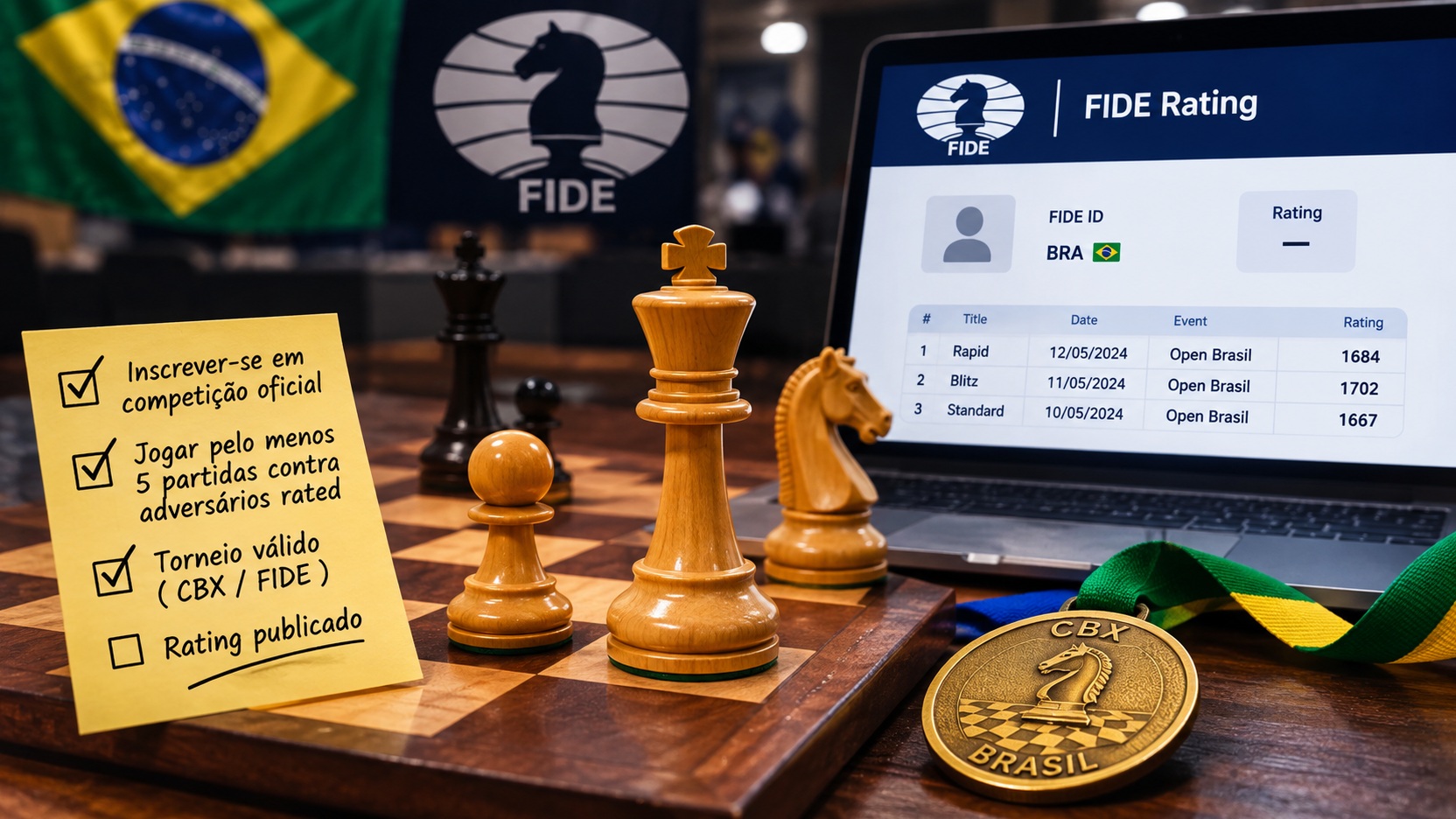
Getting your first FIDE rating does not simply mean playing five rounds. Under the rules in force in 2026, an initial rating is published only when there are at least five valid games against opponents who already have a rating, the results can be considered within the permitted window, and the final calculation reaches at least 1400 points. In Brazil, you also need to enter an event that is actually registered for FIDE rating and have your data correctly linked to CBX and FIDE.
First, choose which rating you want to establish
FIDE maintains separate rating lists for Standard, Rapid and Blitz chess. Therefore, a rapid tournament does not complete the required count for a first Standard rating, and a blitz competition does not replace games in another time control. The path is similar in all three lists, but each one uses its own events and rating rules. When someone says “FIDE rating” without specifying the format, the question usually concerns the Standard rating, also called classical.
The current Standard and Rapid/Blitz rules use the same central requirement for a player who has not yet appeared on the list: at least five games against rated opponents and an initial rating of at least 1400. Rapid and Blitz have one particularity: if the player already has a Standard rating at the start of the tournament, that rating may be used in the calculation for the faster format.
Five games do not mean five rounds
The simplified claim “play five games and get a rating” hides the most important point. For the initial publication, FIDE requires at least five games against rated opponents. If you play a seven-round Swiss but face only three rated opponents, those three are the games that help build the five-game requirement for your first rating.
The five games do not have to take place in the same tournament. FIDE allows results from different tournaments to be grouped, as long as they fall within consecutive rating periods that, taken together, do not exceed 26 months. This means, for example, that you can leave a first event with three eligible games and complete the remaining two in a later event.
Not every result recorded in the pairings counts as a rated game either. Games not played because of absence, walkover or forfeit do not enter the rating calculation. Under the current rule, when both players actually make at least one move, the game is in principle rated, subject to exceptions related to force majeure or Fair Play rules.
There is another important caveat for a player who is completely unrated. If the player scores zero points in their first event, that result is disregarded for the initial calculation. Therefore, five losses in a debut event do not automatically mean the rating will be published the following month.
The publication floor is now 1400
Another common source of confusion is older material that still mentions 1000 points as the minimum. The regulations in force in 2026 establish that a new rating appears on the list only if the calculated value is at least 1400. If the player has already accumulated five eligible games but the initial calculation does not reach that floor, the player still does not appear with a published rating.
The calculation is also not simply the average rating of the five opponents. Under the current rules for an initial rating, FIDE considers the average of the rated opponents together with two hypothetical opponents rated 1800, both treated as draws, and then applies the performance conversion set out in the regulations. The initial rating is rounded to the nearest whole number and cannot exceed 2200.
This explains why two players with the same number of games can receive different initial ratings. The strength of the opponents, the results obtained, and all eligible games accumulated before the first publication matter.
How to know whether a tournament really counts for FIDE rating in Brazil
In Brazil, the most practical check starts on the tournament page of the Brazilian Chess Confederation. The CBX listing distinguishes events marked only as “Rating: CBX” from those identified as “Rating: CBX and FIDE.” That difference is decisive: a tournament that counts only for the national rating does not, by itself, help establish a first FIDE rating.
In addition to the listing, open the event regulations. FIDE itself requires the regulations of a rated event to make clear that it will be submitted for rating. In CBX records, many tournaments also display a code or link to the FIDE Rating Server, which helps confirm that the event was pre-registered in the international system.
The commercial name of the tournament is not enough. A poster with “FIDE,” “IRT” or “international” in the title may be an indication, but verification should be made through the official record. Before paying the entry fee, look for the tournament's time control, the “CBX and FIDE” indication, the regulations and, when available, the event number on the FIDE server.
It is also worth checking the tournament's status after the competition. The CBX page uses statuses such as pre-officialized, officialized and, in some cases, held with a pending issue. This matters because playing the event does not end the administrative process: the report still has to be checked and submitted correctly.
Registration, CBX ID and FIDE ID
To appear on the FIDE list, a player must be registered through an affiliated national federation. In Brazil, that path goes through CBX. The Confederation's own database has separate fields for CBX ID and FIDE ID and advises players to avoid duplicate registrations, because duplication can cause identification and rating-calculation problems.
If you do not yet have a FIDE ID, do not try to create a second registration on your own. Issuing and managing the international identifier goes through the federation and the registration process on the FIDE Rating Server. Before your first rated tournament, confirm with the organizers that your name, date of birth, CBX ID and any existing FIDE ID are correct in the registration that will be used in the report.
The practical point is simple: for the rating to be created correctly, the result has to be linked to the right person. A name error, duplicate registration or incorrect ID can turn a simple sporting matter into an administrative correction after the tournament.
What happens after the final round
The rating does not appear instantly when you finish your fifth eligible game. In a registered tournament, the chief arbiter prepares the event report file and sends it to the Rating Officer of the responsible federation. After checking it, the Rating Officer submits the report to the FIDE Rating Server.
FIDE publishes the official list on the first day of each month. For a competition to enter a given list, there is a cutoff three days before the list date. The regulations also provide that, when five days or fewer remain between the end of the tournament and the end of the month, processing may be deferred to the next list.
Therefore, completing the requirement on a Sunday does not necessarily mean you will appear on FIDE the following week. The event has to be processed, and the result has to fit into the monthly cycle. If the report has a pending issue, publication can take longer. The current rule also states that if the report is not submitted in time to be included by the third rating list after the end of the tournament, the event will not be rated.
How to track your progress without guessing
Before the tournament, confirm on CBX that the event is marked as valid for FIDE and read the regulations. During the competition, note how many of your opponents already have a rating in the corresponding format. After the event, follow the tournament status on CBX and, if you already have a FIDE ID, check your profile in the rating system after the monthly update.
If you played seven rounds but only three were against rated opponents, treat your progress as three eligible games, not seven. If you face two more rated opponents in another tournament, you may complete the minimum of five, provided the results are within the regulatory window and the calculated rating reaches 1400.
If there is doubt about a specific round, the best information is not the event's total number of rounds, but the combination of opponent, that opponent's rating, format, result, and submission of the tournament to FIDE. That is what makes it possible to verify the path to the first publication.
The safest path to your first rating
Before registering, choose the format whose rating you want to establish and confirm that the event appears as “CBX and FIDE.” Check the regulations and your registration details. Do not simply count the rounds: count the games actually played against rated opponents.
When you complete five eligible games, remember that this is only the documentary minimum. The initial rating still has to reach 1400 and the tournament must be properly reported. If the five games do not come in a single event, the results may be accumulated within the FIDE window of up to 26 months.
Then follow the next monthly list and the tournament status. A first FIDE rating is less a “reward after five games” and more the result of a verifiable sequence: valid event, correct registration, eligible games, sufficient performance, report submitted, and publication on the list.