
If you have 1,800 on Chess.com, 2,000 on Lichess and 1,550 on FIDE, the difference does not mean that a platform is “giving more points” nor that there is a simple calculation capable of transforming one number into another. Rating is a relative measure: it gains meaning within a system, a group of players and a type of match.
The practical consequence is important. Adding or subtracting 100, 200, or 300 points may produce a casual approximation for some people in a specific range, but it is not a conversion. The same adjustment may malfunction on another track, at another tempo, or a few months later.
The error starts when treating rating as a universal unit
A rating does not work like centimeters or kilograms. It is a strength estimate constructed from results against other players who belong to a reference population. If the population changes, the distribution of numbers may change. If the calculation method changes, the reaction to wins, losses and periods of inactivity may also change.
This is why two “1800” players in different environments do not automatically carry the same performance expectation. The number is only fully interpretable when one knows in which pool it was produced, at what rate and by which system.
Lichess itself is explicit about this in its rating systems documentation: ratings from different servers cannot be directly compared and are used to compare players within the same pool. The page also reminds us that even using the same mathematical method would not make two pools automatically equivalent, because the populations would still be different.
What changes between FIDE, Chess.com and Lichess
FIDE: an Elo scale applied to regulated competitions
FIDE uses an Elo-based system and publishes official lists based on results from approved competitions. The regulation defines how results are converted into expected scores and how the development coefficient, K, affects the speed of rating change.
In the FIDE system, for example, the expectation table associates a difference close to 200 points to an expectation of approximately 76% score for the highest ranked player. That meaning belongs to the scale and rules of that system. It does not authorize the conclusion that a difference of 200 points
between FIDE and Lichess, or between FIDE and Chess.com, represents the same strength distance.
FIDE also maintains different ratings for disciplines and rhythms. The standard rating arises from face-to-face matches subject to the corresponding rating rules; rapid and blitz have their own regulations. Therefore, even within the FIDE ecosystem it is necessary to say which rating we are talking about.
Chess.com: Glicko and confidence in numbers
Chess.com reports that it uses the Glicko system. In addition to the visible rating, the method works with an uncertainty measure called rating deviation, or RD. The lower the confidence in the current rating, the greater the variation after a match.
This explains why a new account can gain or lose many points in a few games and why a player who has been inactive for a long time can experience greater fluctuations again. Chess.com itself reports that RD increases with inactivity, because the system becomes less certain that the old number still represents current strength.
In July 2026, Chess.com also reinforced in its help center that Rapid, Blitz and Bullet are separate ratings, calculated independently. A Rapid result does not change the Blitz, and each tempo has its own pool.
Lichess: Glicko-2, drift and volatility
Lichess uses Glicko-2. In addition to the rating and the deviation representing uncertainty, Glicko-2 adds a volatility component to more flexibly model changes in performance.
The platform starts new ratings at 1500 and marks as provisional the numbers whose uncertainty is still high. This helps to understand why a newly created 1500 should not be read as a statement that the player has already demonstrated strength equivalent to a stable 1500. The starting number is a starting point for the system, not a level certificate.
Lichess also states that its values can often appear above ratings in other environments without this, in itself, characterizing “inflation”. The difference may simply be a consequence of different scale, method and population.
The player pool changes the meaning of the number
Imagine two clubs that adopted exactly the same formula, but never played each other. A club could have many beginners; the other, a greater concentration of experienced players. Even with the same mathematics, the numbers would be calibrated by each group's internal results network.
Chess sites are much bigger versions of this problem. Chess.com and Lichess do not have the same user composition, the same rhythm distribution, the same frequency of activity, nor the same history of players joining and leaving. FIDE, in turn, measures results from approved competitions, under different conditions than online matches.
Therefore, the question “how much is 1800 worth?” needs a complement. 1800 where? At what pace? With how many matches? Is the rating stable or provisional? The answer changes depending on these conditions.
The rhythm of the game creates different ratings even within the same platform
Rapid, Blitz and Bullet require overlapping but not identical skills. More time favors in-depth calculation and position evaluation. Short rhythms increase the weight of pattern recognition, decision speed, clock management, and practical ability in time-sensitive situations.
Chess.com officially recognizes that large differences between the ratings of these rhythms are normal. The reason is not just psychological: each category is monitored separately and has its own pool. Thus, a player can be relatively stronger in Rapid than in Blitz, even without having “lost strength” in chess in general.
The same caution applies when crossing standard FIDE with Chess.com Rapid or Lichess Blitz. In this case, the comparison mixes system, population and rhythm at the same time. The final number may seem accurate, but the basis for treating it as a conversion is weak.
Why “add 200 points” is not a conversion
A rule like “Lichess is 200 points above Chess.com” usually arises from averages observed in some group of players. This can be useful as a limited description of a sample, but it loses validity when it becomes a universal formula.
The average difference may vary depending on the rating range. Beginner players may show a pattern; intermediaries, other; very strong players, another. The effect can also change between Rapid, Blitz and Bullet, in addition to depending on how each platform adjusts its systems over time.
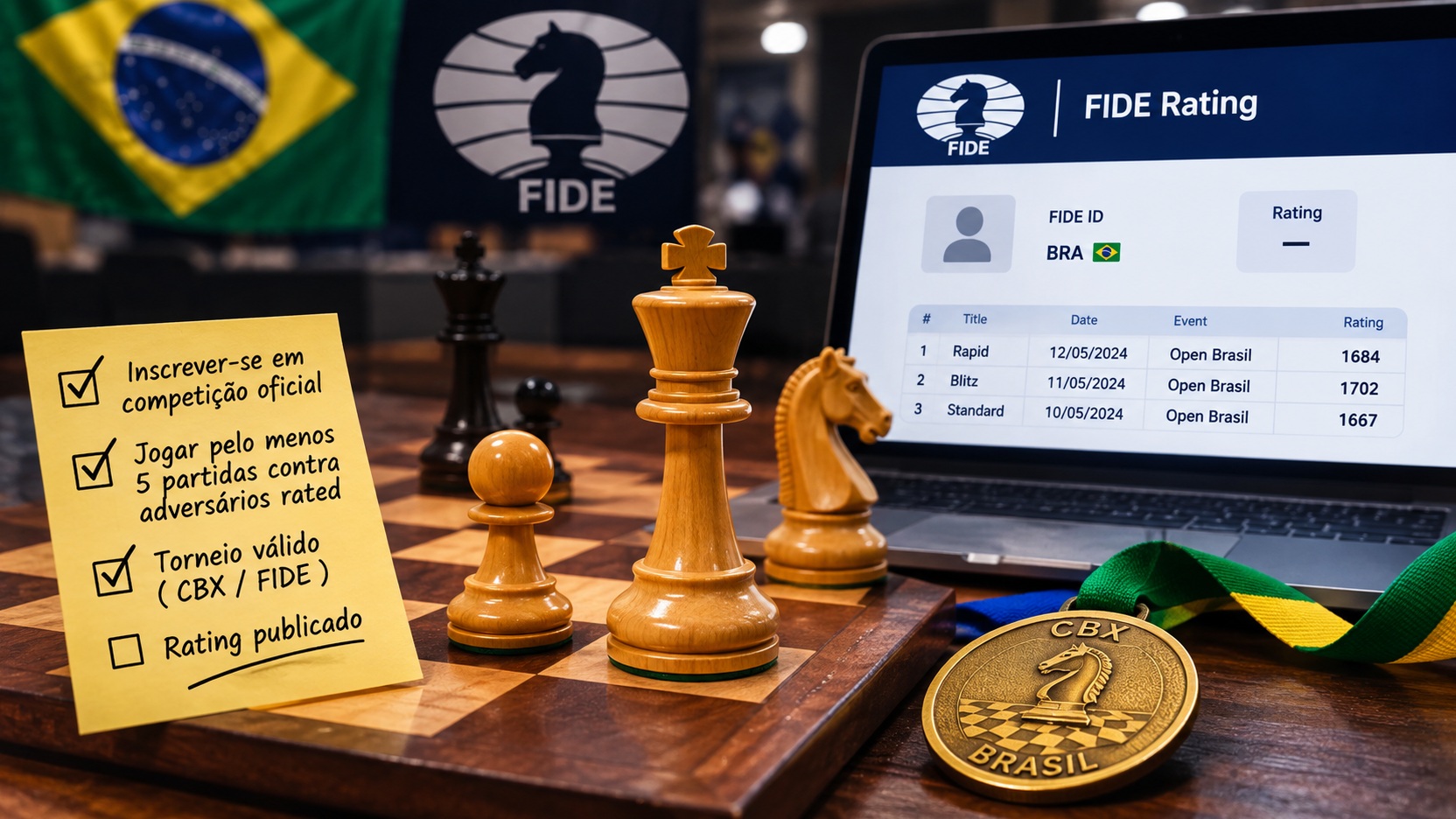
The numbers used on the cover of this article illustrate exactly this problem: 1824 on Chess.com Rapid, 1560 FIDE standard and 2006 on Lichess Rapid do not form an equation. They represent three measurements in different contexts. It is not correct to conclude, just by looking at these values, that 1824 on Chess.com “equals” 1560 FIDE or that 2006 on Lichess always corresponds to a certain value on the other scales.
What is a valid comparison
Compare first within the same pool
To monitor your evolution, the cleanest comparison is with yourself in the same environment and at the same pace. If your Chess.com Rapid has stabilized and risen from 1500 to 1650 over many games, there is a much more interpretable sign of improvement in that pool than a one-off comparison with your Lichess Blitz.
The same goes for FIDE. A sequence of results in approved events and the evolution of the official rating say more about your strength in that competitive context than an automatic conversion from online matches.
When crossing platforms, choose lanes and uncertainty
If you really need to estimate a bridge between two environments, the most defensible method is to use a sample of players who have stable ratings on both sides, separate by pace and strength range, and treat the result as a range, not an exact point.
Even so, the estimate describes an empirical relationship between that group and that moment. It does not transform the scales into one. A good comparison should inform sample size, date, rating range and expected error. The broader the promise of accuracy, the greater the chance that the “calculator” is hiding uncertainty.
To estimate FIDE strength, the best data is to play FIDE
Online ratings can help form expectations and indicate trends, especially when there is a large volume of matches. But the most reliable way to find out your FIDE rating is to play FIDE rated matches.
This does not diminish the value of online ratings. They are excellent for pairing, monitoring evolution and comparing within their own environments. The problem appears when an equivalence is demanded from them that the system was not designed to provide.
Examples of valid and invalid readings
Valid reading: “my Rapid on Chess.com went up and remained stable”
If the rating was built with many matches, the RD is lower and the improvement is maintained over time, it makes sense to interpret the trend as evidence of better performance in that Rapid pool.
Invalid reading: “I'm 2000 in Lichess, so I'm 1800 FIDE”
Without knowing pace, stability, competitive history and a comparable sample of players, this conclusion turns an approximate correlation into mathematical identity. Lichess even explicitly rejects direct comparison between servers.
Valid reading: “players who look like me tend to fall into a lane”
An analysis that looks at players with established ratings in two environments can generate a useful range
for expectation. The result should be read as probability and context, not a guaranteed conversion.
Invalid reading: “200 points difference means the same thing everywhere”
Within a specific scale, rating differences can have a probabilistic interpretation. Between different scales and pools, the same numerical difference does not automatically carry the same meaning.
How to track your level without getting lost in the numbers
Choose one or two key indicators and keep the context constant. For online chess, follow the same site and the same pace for a long enough period to reduce noise from a few games. If the site signals a provisional rating or high uncertainty, wait for the number to stabilize before making any strong conclusions.
Also observe the quality of the results, not just the absolute value. Maintaining performance against stronger opponents, reducing serious errors, managing time better and sustaining a trend for dozens of matches provides information that a single rating peak does not provide.
If the objective is in-person competition, use online as training and additional reference, but give more weight to in-person results at the pace and conditions in which you really intend to play.
The rule of thumb for FIDE x Chess.com x Lichess
Use rating as a relative position within a context, not as a universal currency. FIDE, Chess.com and Lichess use systems, pools and rhythms that do not form a fixed conversion table.
Comparisons can be useful when they maintain the same environment, the same pace and a sufficiently stable rating. When crossing platforms, they must work with ranges, samples and margin of uncertainty. What is not valid is turning an average displacement, like “plus 200” or “minus 300”, into a 1:1 rule for any player.