
When someone says “I'm 1800 at chess”, the incomplete question is: 1800 where and at what pace? A rating is not a universal ruler of strength. It is an estimate produced within a specific system, fed by matches against a specific population and separated by modalities that may require different skills. Therefore, 1800 on Chess.com, 1800 on Lichess and 1800 on the FIDE list do not automatically mean the same level of play.
The difference does not arise from a single factor. FIDE, Chess.com, and Lichess use different rating mechanisms, initialize players in different ways, update numbers at different rates, and work with populations that are not identical. Furthermore, blitz, rapid and classical chess do not measure exactly the same combination of calculation, repertoire, time management, stamina and decision making.
First: rating measures relative performance, not absolute strength
The most important principle is this: the number makes sense within the scale on which it was calculated. Rating systems attempt to estimate the relative strength of participants from the results. If two players belong to the same rating population and face each other regularly, the difference between their numbers helps estimate who tends to score more. This does not transform the value into a physical unit that can be transported intact to another player base.
A useful comparison is to think about different currencies. The numbers may seem similar, but there is no reason to assume that one unit on one scale is worth exactly one unit on the other. In chess, this “exchange rate” still varies by rating range, pace of play, player activity and population composition.
FIDE itself describes its scale as arbitrary and uses rating differences to estimate outcome probabilities. The number, therefore, gains meaning mainly through its relationship with other numbers in the same system.
FIDE, Chess.com and Lichess don't use exactly the same engine
FIDE: Link, official list and update by period
FIDE continues to use an Elo-based system. Under current rules, eligible matches are included in official lists prepared monthly. For players already rated, the variation depends on the expected result against each opponent and a development coefficient, K, which changes depending on experience, age and rating level.
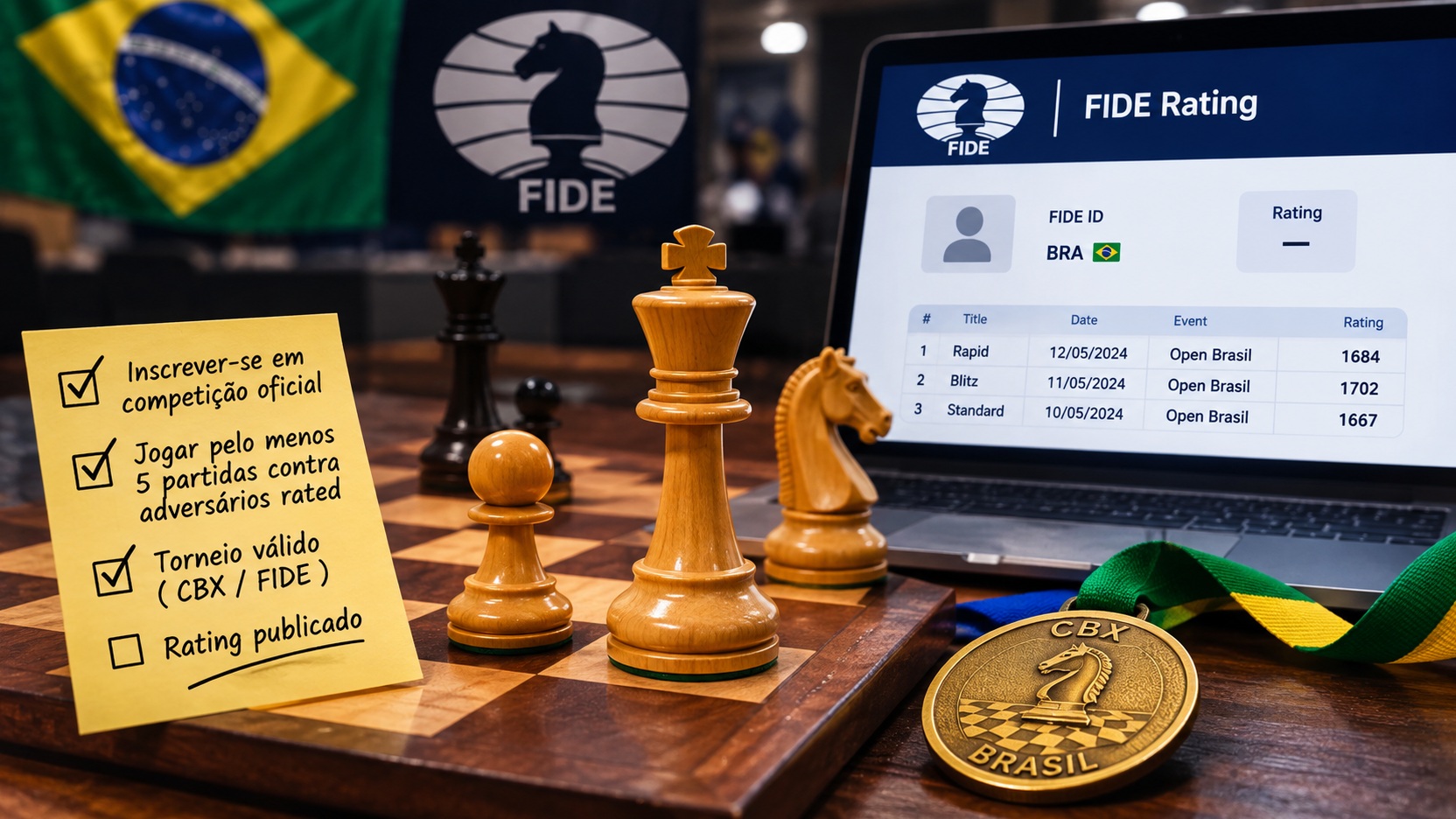
The entry into the scale is also private. A new player needs to gather results against rated opponents to have their first rating published, and FIDE sets a minimum for publication. This already differentiates the FIDE scale from online platforms where any account can immediately start with a provisional rating and play dozens of games in the same day.
There is also not just “the FIDE rating”. There are separate lists for standard, rapid and blitz. A player's performance can be different on each of them, just as it happens on online platforms.
Chess.com: Glicko and an explicit measure of uncertainty
Chess.com reports that it uses the Glicko system. In addition to the visible rating, the method maintains a measure of uncertainty called rating deviation, or RD. The greater the uncertainty about the player's current strength, the greater the rating movement may be after a match. With more games and greater stability, the changes tend to become smaller.
This explains why new accounts or players who have spent a long time without playing may experience stronger variations. The system is not just asking “what is your rating?”, but also “how confident can we be that this number represents your current strength?”.
Chess.com still maintains independent ratings for Bullet, Blitz, Rapid, Daily and other disciplines. The platform's own documentation states that differences of hundreds of points between rhythms can be normal, because each pool is calculated separately and requires different skills.
Lichess: Glicko-2, initial rating at 1500 and volatility
Lichess uses Glicko-2. Like Glicko, the system incorporates uncertainty, but adds a volatility parameter to represent changes in the player's performance pattern. The Lichess documentation states that new ratings start at 1500 and then adjust based on results.
This point is important because the starting value helps anchor the scale. If one platform starts players around one point and another uses another starting process, the numbers can settle into different regions even when both do a good job of ordering players by strength within their own environment.
Lichess also separates pools by pace and publishes rating distributions by modality. Therefore, a Lichess Rapid rating should first be read in relation to the Lichess Rapid population itself, not as a direct translation of the Chess.com Rapid or FIDE standard rating.
Player population changes scale
Even if two platforms used exactly the same formula, their ratings could still differ. The reason is the population.
Imagine two groups of players who never face each other. In each group, the system can reasonably order who is stronger and who is weaker. But without games connecting the two groups, there is no automatic calibration that forces “1800” in one group to represent exactly the same performance as “1800” in the other.
Chess.com and Lichess have their own bases, with differences in size, frequency of play, distribution by level, preference for rhythms and behavior of new users. FIDE, in turn, depends on evaluated tournaments and players registered by federations. These cuts produce different statistical environments.
This is why a conversion formula built with a sample of players may work reasonably well for one specific range and fail at another. The relationship between scales does not need to be a straight line, and the sample itself may have biases: players who maintain active accounts on both platforms and also compete in in-person tournaments do not necessarily represent all chess players.
The rhythm of the game can change as much as the platform
Compare FIDE standard with Chess.com Blitz already mixes two changes at the same time: rating system and game mode. This makes the conclusion even more fragile.
In slower chess, there is more time for calculation, planning and checking. In blitz, pattern recognition, quick decisions, use of the clock and the ability to play imperfect positions gain greater weight. In the bullet, the operational speed can change the result even more.
The time classifications themselves are also not identical in all environments. FIDE defines specific rules for rapid and blitz considering available time and increment, while Chess.com classifies its games by estimating duration based on an average number of moves. Near the boundaries between categories, two similar controls may even be given different labels depending on the rule used.
Therefore, the most defensible comparison begins with equivalent modalities. Rapid with Rapid is better than Rapid with Blitz. Still, “equivalent” does not mean “identical.”
The same player can have three numbers without there being a contradiction
Consider a completely hypothetical example. A player can have 1620 FIDE standard, 1810 on Chess.com Rapid and 1980 on Lichess Rapid. These three numbers can coexist without any of them being “wrong”.
The 1620 FIDE reflects eligible tournament matches and an official scale updated by periods. Chess.com's 1810 reflects that player's results against the platform's Rapid pool, using Glicko and its uncertainty measure. Lichess's 1980 reflects another pool, another startup, and Glicko-2.
If this player improves a lot online during a few months without playing in-person tournaments, his online ratings may go up while his FIDE rating stays the same. If you then return to tournaments, the FIDE number will only begin to incorporate the improvement as new rated matches are recorded. The difference, therefore, can also be temporal.
The example does not say that “Lichess = FIDE + 360” or “Chess.com = FIDE + 190”. It shows exactly the opposite: the observed distance is the result of that player, in that range and
at that moment.
Why the “200 or 300 points” rule fails
It is common to find comparisons saying that a Lichess rating is usually a certain number of points above Chess.com, or that the online rating usually beats FIDE by a fixed margin. These observations may describe a trend in a given sample, but they are no longer reliable when they become a universal rule.
The difference may be smaller in one range and larger in another. You can switch between Rapid and Blitz. It can change when the platform changes entry processes, matchmaking or internal parameters. It may change as the population grows. It can also vary from player to player because online and in-person gaming skills are not perfectly equal.
Furthermore, Glicko and Glicko-2 explicitly address uncertainty. Two players with the same visible number may have different levels of statistical confidence in that rating. A newly stabilized rating and one sustained over hundreds of matches do not have exactly the same context, even though they show the same value on the screen.
How to compare ratings in a more useful way
Compare first within the same environment
The safest question is “where does this rating place me among players of the same sport?”. On Chess.com, the stats page may show percentile by game type for eligible accounts. On Lichess, the distribution pages allow you to see where a rating falls within the weekly pool for each modality.
Percentile answers a different question than conversion. Instead of trying to figure out what number on another platform would be “equivalent,” it shows what portion of that population is below or up to that level. This is often more informative for understanding relative position.
Still, percentiles from different platforms are also not interchangeable, because the populations are not the same. They serve as context, not as a certificate of equivalence.
Use stabilized ratings and comparable rhythms
If the objective is to compare your own accounts, use similar modalities and avoid drawing conclusions after a few games. A rating with high uncertainty can fluctuate quickly. The more stable the history, the more useful the comparison.
It also makes sense to look at a range, not an exact point. Saying that your online level is usually in a certain region is more realistic than saying that “1750 here is worth 1583 there”. The apparent accuracy of a conversion with tens of points is often greater than the evidence allows.
For tournament strength, prioritize tournament results
If the real question is “how will I do in FIDE tournaments?”, the best indicator is not an online conversion formula. These are the matches themselves under tournament conditions, especially against players with a known FIDE rating and at a similar pace to the event you intend to play.
Your online rating continues to be useful for monitoring progress, finding opponents and measuring performance within the platform. He just doesn't need to pretend to be anything else.
So can you convert or not?
You can estimate a range based on samples, as long as the estimate is accompanied by the context: platform, modality, rating range, period and profile of the players used in the comparison. What does not exist is an exact, universal and permanent conversion between FIDE, Chess.com and Lichess.
If you see a calculator telling you that one number exactly matches another, treat the result as a statistical approximation, not a mathematical identity. A good comparison recognizes the margin of error and makes it clear which population the data came from.
In the end, the best use of the rating is to monitor your position and evolution within the environment in which it was calculated. To compare environments, choose context, range, percentile, game pace and history. The number alone is simple; It is the correct interpretation of it that requires care.