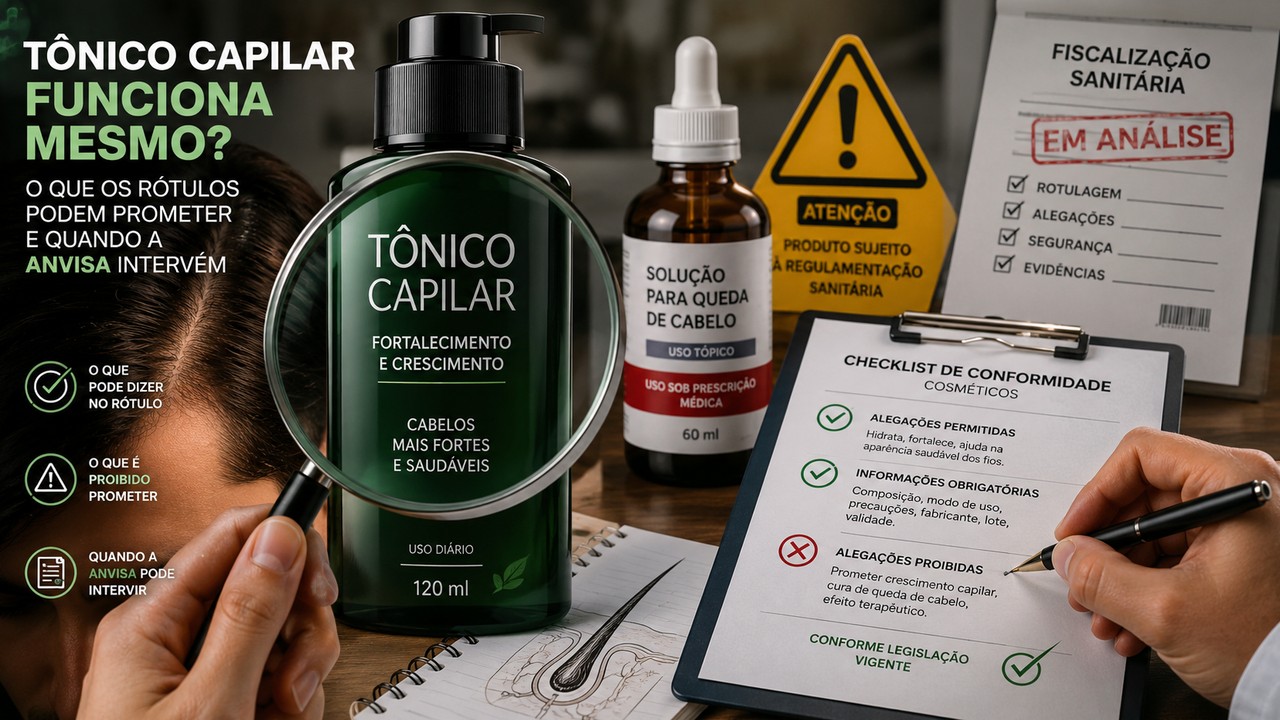
The short answer is: you cannot conclude that a tonic makes hair grow just because the label uses words such as "growth," "strengthening" or "anti-hair-loss." Health regulations require the company to support the quality, safety, efficacy and truthfulness of the label statements, but the way the cosmetic is regularized and the type of claim matter. For many tonics, regularization occurs through notification, without an individual prior review by Anvisa before the product is marketed. That is why "regularized product" and "hair-growth effect proven by Anvisa" are not synonyms.
The most useful approach for consumers is to separate four questions that are often mixed together: is the product regularized; is the wording on the label compatible with a cosmetic; is there support for the promised benefit; and is there any substance or indication that pushes the product into the medicine category. Anvisa's actions against hair tonics in 2018, 2025 and 2026 show exactly these differences.
What a cosmetic can do under the current rule
The central rule today is RDC 907/2024, which replaced RDC 752/2022. It defines personal hygiene products, cosmetics and perfumes as preparations for external use whose main purpose is to clean, perfume, alter appearance, correct odors, protect or keep parts of the body in good condition. This definition creates an important boundary: a cosmetic should not be presented as treatment for a disease or carry therapeutic claims.
The same RDC requires labeling to be legible, clear and truthful and not to mislead consumers about properties, composition, purpose or safety. It also prohibits therapeutic claims attributed to the product or its ingredients. This means that choosing an attractive marketing phrase is not enough. The claim must remain within the purpose allowed for cosmetics and must be true in the context of the specific product.
The rule also requires technical responsibility for claims. The holder responsible for the product's regularization must have data demonstrating quality, safety and efficacy, as well as the reliability of the labeling statements. When the nature of the declared benefit justifies substantiation and that benefit appears on the label, the regularization process must contain a summary of the efficacy data, and the company must keep the complete data available to the health authority.
Therefore, wording related to growth should be treated neither as a free pass nor as an automatic
prohibition. Context, the declared cosmetic purpose and the available evidence make a difference. The enforcement history shows that Anvisa may question both a claim that is not supported and a presentation that comes close to a medicinal indication.
"Growth" on the label is not the same as efficacy proven by Anvisa
This is where label reading can be misleading. The existence of an active process at Anvisa indicates that the product is regularized in the corresponding category. For cosmetics subject to notification, however, there is no individual prior review of all documentation before the product reaches the market. The company is responsible for meeting the requirements and remains subject to monitoring, audits, complaints and later enforcement actions.
Anvisa itself distinguishes registration from notification. Under registration, there is prior review of the documentation for categories that require this procedure. Under notification, marketing does not depend on that prior review, although the company is still required to comply with the law. Anvisa's current cosmetics consultation page also states that products outside the list of categories requiring mandatory registration are exempt from registration and follow the notification procedure. Hair tonic or hair lotion appears in the general cosmetics classification and, as a rule, is not among the categories currently listed as requiring mandatory registration.
This changes how phrases such as "approved by Anvisa" should be understood. For a notified tonic, consumers should not read that expression as if the Agency had reproduced a clinical trial and individually certified that the bottle makes new hair grow. What the public database allows people to verify is the product's sanitary regulatory status. The truthfulness of the claim remains the company's responsibility and may be subject to enforcement.
The 2018 case: when the claim was not supported by the tests
In December 2018, Anvisa suspended the distribution, advertising, marketing and use of one presentation of Sanctio Tônico Capilar and also ordered a recall. The product carried a claim that it stimulated hair growth.
According to the Agency, efficacy tests found that the product did not stimulate hair growth, contradicting the wording used on the label. The official notice itself made a decisive distinction: presentations that did not contain that information on the label could continue to be sold without the restriction applied to the version with the problematic claim.
This episode does not prove that every hair tonic is ineffective. It proves something more specific and more useful: an efficacy claim can be scrutinized and can fail if the product data do not support what is being promised.
The 2025 case: when a cosmetic approaches medicine-like language
In December 2025, Anvisa ordered the recall and suspension of Tônico Capilar Minoxi Turbo Glammour Professional. The Agency stated that the product had been regularized as a cosmetic, but its label suggested indications similar to those of the medicine minoxidil, including stimulation of beard, hair and mustache growth.
Here, the problem is different from the 2018 case. The issue was not only whether a claim had been proven by a test. The product's classification as a cosmetic came into conflict with the way it was presented to consumers.
RDC 907/2024 prohibits therapeutic claims in cosmetics. When the label adopts language that turns a cosmetic care product into something presented as a pharmacological treatment, regularization as a cosmetic may no longer be compatible with the purpose being advertised.
What if minoxidil appears in the formula or product name?
Minoxidil is a signal that requires a different reading. The substance and its salts appear on the list of substances that may not be used in personal hygiene products, cosmetics and perfumes, maintained by RDC 529/2021 and its updates. In June 2026, RDC 1.030 updated that list; minoxidil remains listed among substances prohibited in cosmetics.
This does not mean that minoxidil is prohibited as a medicine. It means that a product containing minoxidil should not be treated as a simple cosmetic. Medicines follow a different regulatory pathway, with their own registration, indications, package insert and conditions of use.
For consumers, the practical distinction is simple: if a bottle sold as a "cosmetic tonic" declares minoxidil as an ingredient or tries to present itself as equivalent to a minoxidil medicine, that is a sign of incompatibility that deserves immediate verification in Anvisa's database. This is not a situation in which "more active ingredient" automatically means "more effective." It may mean that the product has been framed irregularly.
The August 2026 case: sanitary irregularity is not the same as a failed efficacy test
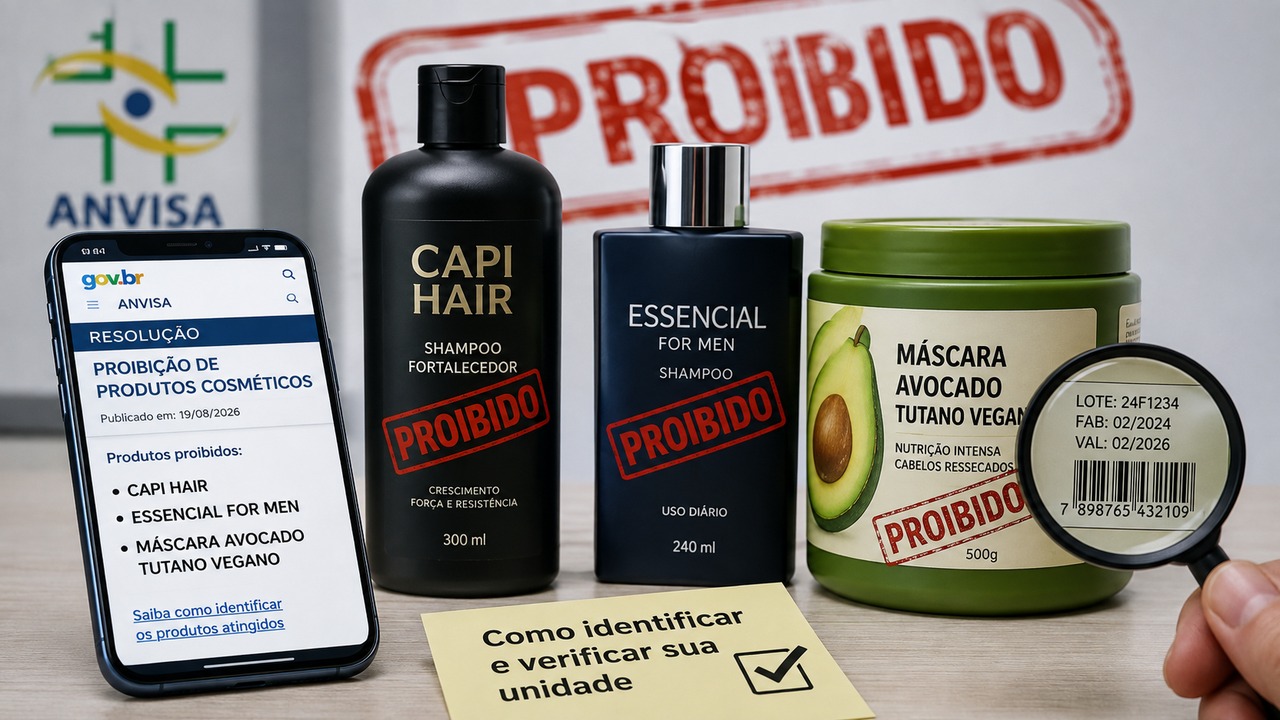
On August 19, 2026, Anvisa published a new action against cosmetics without regularization. Among the products affected was Capi Hair, described as a "hair-growth activating tonic." The measure prohibited manufacture, distribution, sale, advertising and use of the listed products.
The reason given for this group of products was the lack of regularization with Anvisa. This matters because it would be wrong to turn the notice into a conclusion such as "Anvisa tested this tonic and proved that it does not work." The 2026 action addressed the product's sanitary status, not a conclusion announced by the Agency about the efficacy of the growth claim.
This distinction helps readers understand enforcement news without mixing up causes. A product may be targeted because a claim was not supported, because the language is incompatible with a cosmetic, because it contains a prohibited substance, because it lacks regularization or because of other sanitary problems. The final measure may look similar to consumers, but the legal basis is not the same.
How to assess a hair tonic before believing the claim
First, identify what the product actually promises
Read the exact wording, not just the eye-catching name of the product line. "Helps keep hair strong," "reduces breakage," "strengthens" and "stimulates growth" are not equivalent expressions. The more specific and measurable the promise, the more important it is to ask what supports it.
Also notice whether the text talks about the appearance and care of the hair or starts promising treatment of a condition, reversal of a cause of hair loss, pharmacological action or a result typical of a medicine. The second situation calls for greater caution because it may cross the boundary of a cosmetic.
Then check the composition without turning an ingredient into a guarantee
Plant extracts, vitamins, caffeine and other components may appear in cosmetic products, but the presence of a familiar ingredient does not, by itself, prove that the final formula produces the advertised effect. Concentration, vehicle, stability, method of use and evidence for the finished product also matter.
The reverse is also true. The absence of a famous ingredient does not prove that a product is useless. What should be avoided is the logical leap from "it contains ingredient X" to "it will make hair grow." The law requires the company to be responsible for the benefit attributed to the product, not merely for the reputation of an isolated ingredient.
Check the product's status at Anvisa
Anvisa maintains a public database of regularized cosmetics. Searches can be made by product name, process number or the company's CNPJ. The process number usually begins with 25351 and must appear on the label.
In the result, check whether the status is active and whether the product and company details match the bottle being sold. An inactive result indicates that the product is no longer regularized. It is also possible to consult irregular products and associated enforcement measures.
This check answers the question "is the product regularized?" It does not replace the question "is the specific growth claim well supported?" They are complementary checks.
Be skeptical of shortcut phrases
Phrases such as "approved by Anvisa," "same effect as minoxidil," "guaranteed result," "treats hair loss" or "makes new hair grow" require critical reading. Some may be advertising exaggerations; others may signal that the product's presentation is moving into a therapeutic purpose.
Also do not confuse a consumer testimonial, before-and-after images, sales volume or presence on a marketplace with sanitary substantiation. Those elements can influence perception, but they do not replace the technical documentation that must support an efficacy claim when substantiation is required.
So, does hair tonic work for growth?
The category "hair tonic" is too broad for a universal answer. There are different formulas, different claims and different levels of evidence. The responsible conclusion is neither "every tonic works" nor "no tonic works." It is to evaluate the specific product and the specific promise.
If the label promises growth, the wording should not be read as proof by itself. The company must be responsible for the truthfulness of the claim and keep supporting documentation when the nature of the benefit requires it. At the same time, finding the product as active in Anvisa's database confirms its sanitary regularization, but, especially for notified products, it does not mean that the Agency previously validated every marketing claim in an independent test.
The three enforcement episodes leave a simple method. In 2018, the growth claim failed because tests did not support it. In 2025, a cosmetic was suspended for approaching medicinal indications, and Anvisa reinforced that minoxidil is not permitted in cosmetics. In August 2026, another tonic became the subject of an enforcement action because it lacked regularization. The practical outcome may be a recall or prohibition, but the cause must be understood before drawing conclusions about efficacy.
When the discussion stops being only about cosmetics
If the goal is simply to care for the appearance and condition of the hair, analyzing the cosmetic, its label and its regularization is the starting point. If a person is trying to treat substantial, persistent hair loss or a health condition, the problem should no longer be reduced to choosing the tonic with the strongest promise. In that situation, a professional assessment can help determine the cause and which treatment options make sense.
For ordinary purchases, the safest rule is less impressive than the advertising but much more useful: look up the product at Anvisa, read the exact claim, check whether the presentation remains within the cosmetic field, and treat "growth" as a promise that needs support, not as an automatic seal of efficacy.