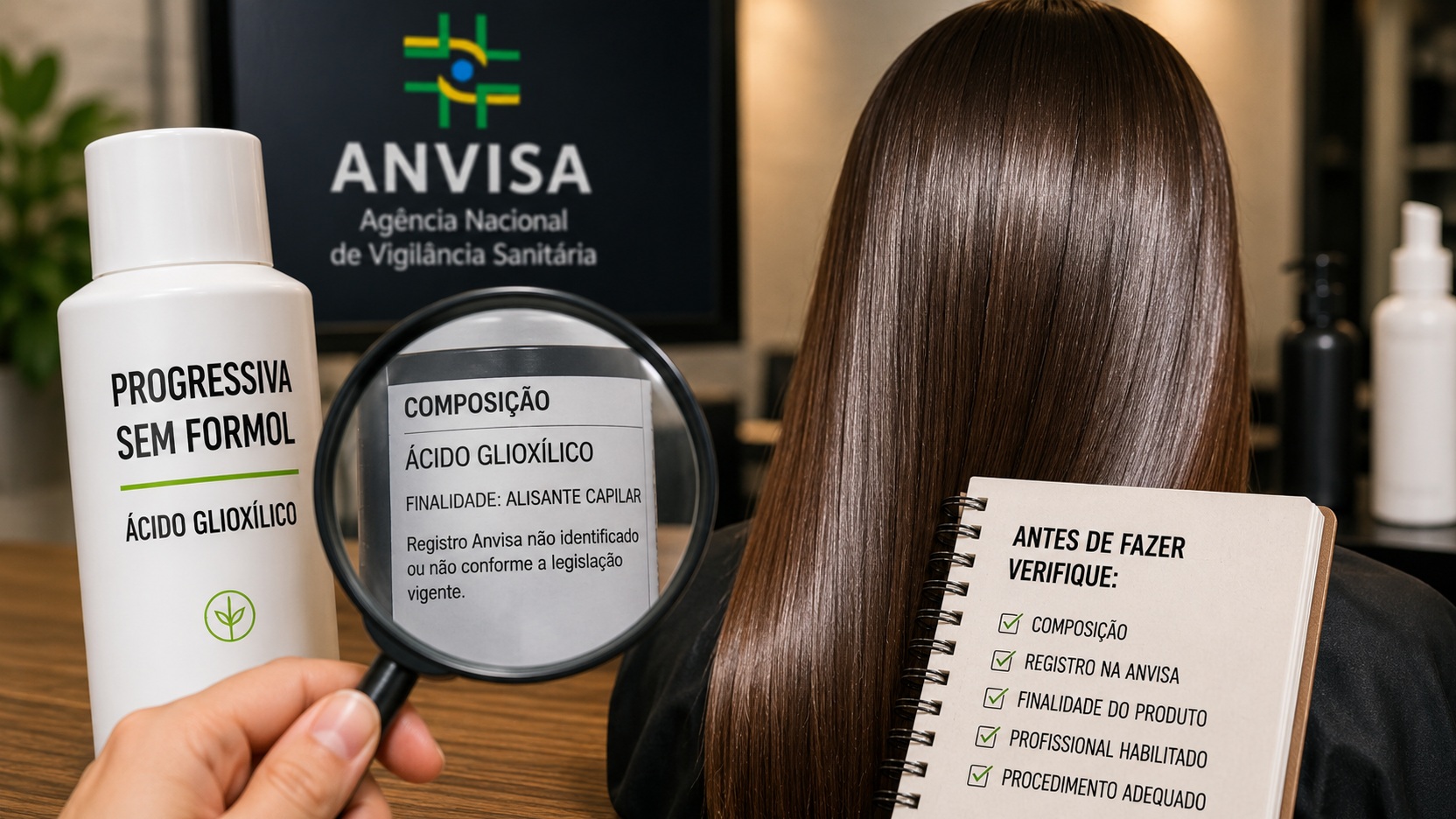
Finding a product in the Anvisa database does not end the verification. In the case of hair straighteners, you need to know how that cosmetic was regulated.
The current rule is straightforward: products intended to straighten hair require registration. The notification is an existing regularization route for other cosmetics, but does not replace the registration required for a straightener. Anvisa itself states that unregistered or only notified straighteners are irregular.
This difference helps to avoid misleading interpretation: a process number on the label or a result located in the system does not, in itself, mean that the product is authorized as a straightener.
“Notified” and “registered” are not synonymous
Notification is a simplified procedure used in the regularization of cosmetic products exempt from registration. Anvisa's official service for this modality informs that it is intended precisely for products that are not part of the categories required to obtain registration.
Registration follows another logic. For categories such as straighteners, Anvisa requires a prior analysis of the information presented by the company before approving the product for sale. In an inspection carried out in 2025, the Agency expressly highlighted that the simplified route of “notified” products cannot be used for straighteners.
| Criteria | Notification | Registration |
|---|---|---|
| Regulatory purpose | Regulate cosmetics exempt from registration | Regulate categories for which registration is mandatory |
| Procedure | Simplified route | Involves prior evaluation of data presented to Anvisa |
| Does it work as a hair straightener? | No | Yes |
| Straightening agent found only in this condition | It remains irregular for this purpose | It may be regular, as long as the registration is active or valid |
The distinction does not mean that the notification is an irregular form of regularization in itself. It is valid for the products to which it applies. The problem arises when a product that should be registered, such as a straightener, is only placed in the notification mode.
The process number on the label can cause confusion
One of the most important points is on the label itself.
According to Anvisa, the process number is mandatory on the labeling of cosmetics. This number may appear on both registered and notified products. The registration number is not necessarily printed on the label.
Therefore, finding a sequence starting with “25351” is not enough to conclude that a certain straightener is registered.
Anvisa specifically draws attention to this problem: straightening products can be wrongly notified and, with the resulting process number, appear to be regularized. Verification needs to confirm that the product is in the correct modality — registered, not just notified.
This is precisely where reading the query result becomes as important as locating the product.
What to look for after finding the product
For straighteners and curlers, Anvisa maintains a specific list of authorized products and guides the search by product name, process number or details of the company holding the registration. This list is continually updated.
If the straightener appears as registered and with active or valid status, this is the expected health status for the category. Anvisa explains that active or valid results indicate that the product is regularized.
If the product appears only among cosmetics notified or exempt from registration, its presence on the base does not solve the problem: for a product that effectively has a straightening purpose, this is not the form of regularization required.
Similarly, an inactive or invalid result should not be interpreted as valid authorization. The official guidance is that these states mean that the product is not regularized at that time.
In other words, the correct question is not only “does the product appear on Anvisa?”, but also “does it appear as registered for the category that requires registration?”.
Irregularity has practical consequences
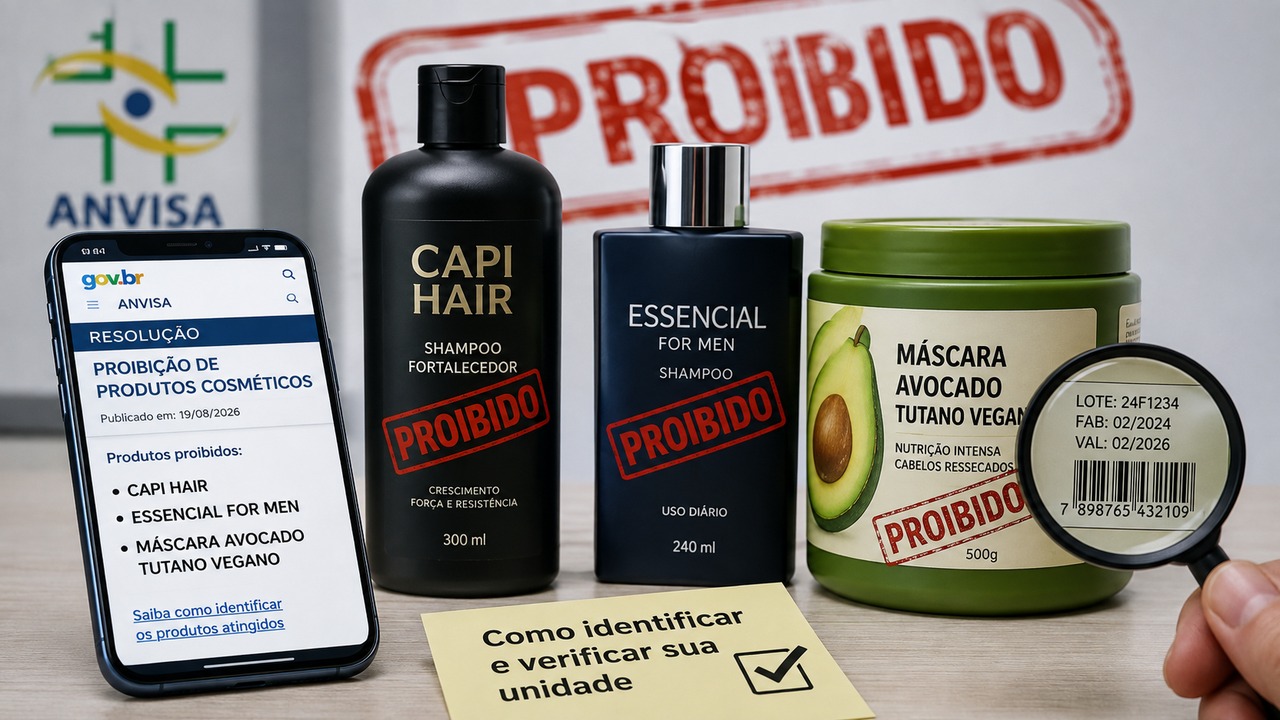
This distinction is not just bureaucratic. On January 6, 2026, for example, Anvisa ordered the recall of two straighteners and prohibited their sale, distribution, manufacture and use because, although they needed registration, they had only been notified. Another straightener mentioned in the same action also suffered measures due to lack of registration.
The episode shows why “notified by Anvisa” should not be treated as equivalent to “straightening agent regulated by Anvisa”.
The registration requirement is related to the risk profile of the category. The Agency itself classifies straighteners among the cosmetics for which registration is mandatory and informs that straightening or curling products modify the chemical structure of the hair.
This also does not make registration a guarantee of risk-free use. Even a regulated product must be used according to the label, purpose and manufacturer's instructions. Anvisa advises specific care during application and warns that the inappropriate use of straighteners can cause reactions to the hair, scalp, skin, eyes and respiratory tract.
For consumers and professionals, the difference changes the decision
For anyone who buys a straightener or receives the product in a salon, the word “notified” should not act as a seal of peace of mind.
If the declared purpose is to straighten, relax or produce an equivalent effect by chemical modification of the hair structure, the verification must lead to the corresponding registration. If the product is only notified, it does not meet the regularization required by Anvisa for straighteners.
For the professional, this means not relying solely on commercial information, the process number on the packaging or the statement that the product “is listed on Anvisa”. For the consumer, this means that asking which product will be applied and confirming the health situation before the procedure can prevent an irregular straightener from being confused with a registered product.
The consultation continues to be the tool. The next step is to correctly interpret what it shows: for smoothing, notification does not replace registration.