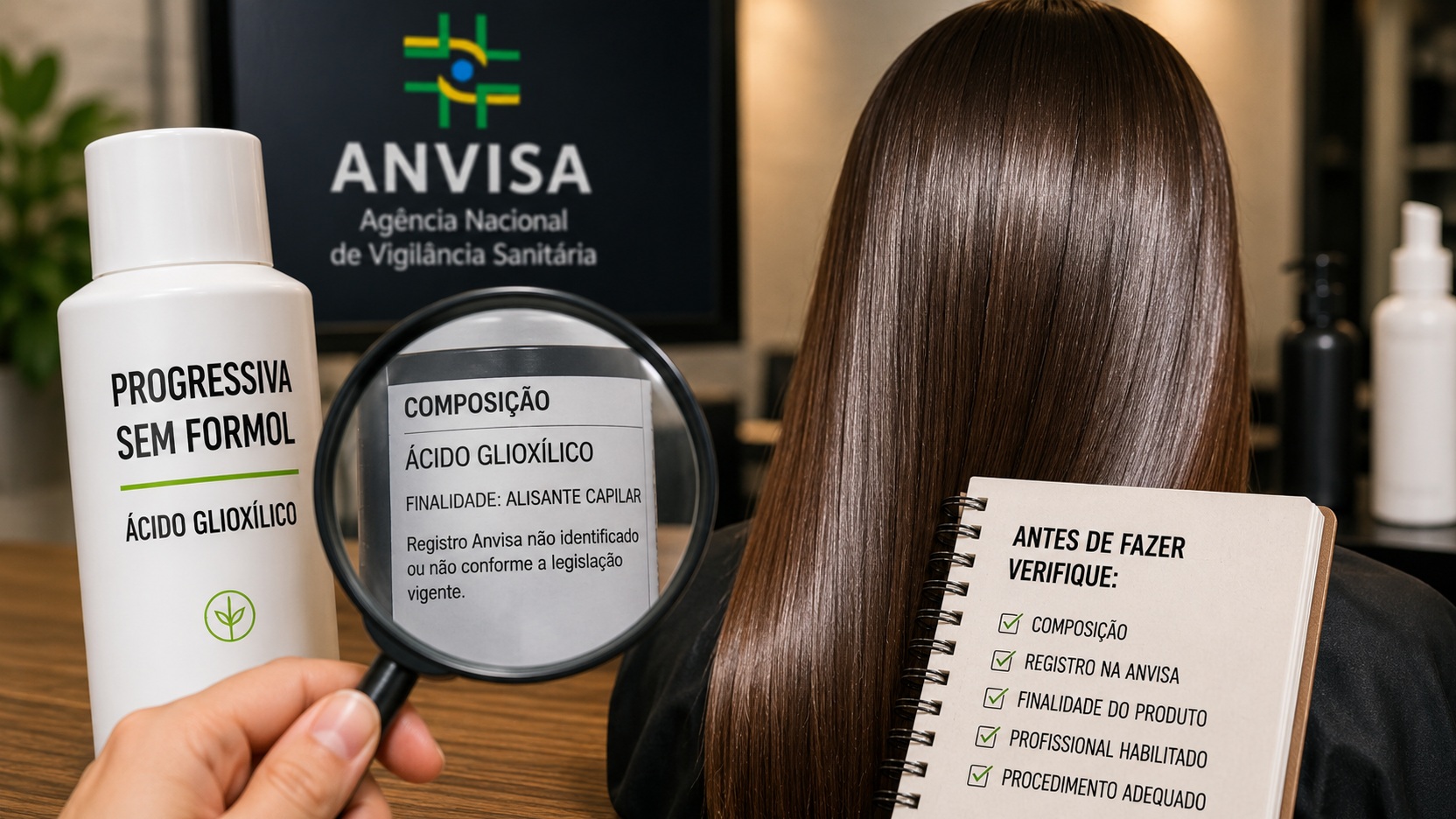
“Formaldehyde-free” is not synonymous with “safe,” “compliant,” or “approved by Anvisa.” The phrase answers only part of the question: the product claims not to use formaldehyde as an ingredient. To decide whether it is worth buying or having the procedure, you need to cross-check three things: which active ingredient actually produces the straightening effect, whether that product is registered as a hair straightener, and whether the proposed use matches what was authorized.
That distinction matters because Anvisa prohibits formaldehyde as a hair-straightening agent, but this does not automatically make every alternative a safe option. In 2025, the Agency itself reinforced its warning about irregular straightening products and cited glyoxylic acid among ingredients not permitted for the straightening function. At the same time, there is a regulatory nuance: some older products with active ingredients that are still under reevaluation may retain a valid registration. For that reason, the correct answer cannot be reduced either to “it has glyoxylic acid, so every product is illegal” or to “it has a registration, so the ingredient has been definitively cleared.”
What “formaldehyde-free” really says - and what it does not say
In Brazil, formaldehyde cannot be used for the purpose of straightening hair. In cosmetics, Anvisa allows formaldehyde at very low concentrations as a preservative, up to 0.2%, and in nail hardeners, up to 5%. Adding formaldehyde to a finished formula to cause hair straightening is irregular and exposes consumers and professionals to significant risks.
This makes it reasonable to be wary of straightening procedures that cause intense burning, an irritating smell, tearing, or difficulty breathing. But the absence of formaldehyde does not settle the safety assessment. A product can be “formaldehyde-free” and still use an active ingredient that is not authorized for straightening, be regularized in the wrong category, have only a notification when it should have a registration, or be used differently from the conditions evaluated by Anvisa.
There is also no sanitary approval seal built into expressions such as “organic,” “BTOX,” “hair botox,” “smart brush,” or “amino-acid straightening.” Anvisa does not register the salon method name; it registers the cosmetic product. The commercial name may describe the experience marketed to the customer, but it does not replace identification of the active ingredient and the regulatory status of the bottle that will actually be applied.
If the effect is straightening, the product category must make sense
For Anvisa, hair straighteners and waving products are cosmetics that modify the chemical structure of the hair to straighten, relax, or wave it with an effect that remains after rinsing. These products require registration, including imported ones. They cannot be treated as an ordinary cosmetic simply to go through a simplified regularization process.
This is important for anyone who looks only at the number printed on the package. A process number is mandatory on cosmetic labels, including notified products. Therefore, finding a sequence that begins with 25351 does not, by itself, prove that a straightening treatment is compliant as a hair straightener. The official query needs to show the corresponding product in the proper status as a registered and authorized straightener.
Anvisa has warned that companies may improperly notify products with straightening action in order to create the appearance of compliance. That is precisely why the useful question is not merely “does it have an Anvisa number?” but “is this product listed among the straighteners registered for that purpose?”
Glyoxylic acid: why the answer requires nuance
Glyoxylic acid gained commercial space as an alternative to formaldehyde in hair-straightening and volume-reduction products. Under the current Brazilian regulatory framework, however, it is not on Anvisa’s list of active ingredients authorized to straighten or wave hair. The Agency states that new registrations using this active ingredient for that purpose are not permitted and that its safety remains under reevaluation.
At the same time, Anvisa recognizes that older products may still be regularized, arising from registrations granted before the current framework and now subject to reevaluation. This creates a situation that may look contradictory at first: the ingredient is not on the current list of active ingredients authorized for new straighteners, yet a specific older product may still appear with a valid registration while the regulatory process has not been concluded.
That legacy registration should not be read as a declaration that glyoxylic acid has been definitively considered safe. Safety Notice GGMON 03/2025 recommends caution and states that the ingredient is not authorized for straightening or waving. During an inspection carried out in 2025, Anvisa again stated that glyoxylic acid is not authorized for use as a straightening agent and identified stocks of the raw material at companies investigated for irregularities.
There is also a relevant safety signal outside Brazil. In 2025, the French agency ANSES concluded that there was a highly probable relationship between the use of straightening products containing glyoxylic acid and cases of acute kidney injury, and recommended avoiding those products. In April 2026, the European Commission asked its Scientific Committee on Consumer Safety to formally assess the safety of glyoxylic acid in hair-straightening cosmetics. As of August 2026, that assessment appears as an ongoing mandate, not as a final European conclusion that can be automatically applied to Brazil.
For consumers, the practical consequence is simple: “formaldehyde-free, with glyoxylic acid” is not a substitution that can be presumed safer just because of the marketing phrase. The composition and regulatory status need to be checked, and the presence of the ingredient deserves additional caution in light of the current warnings.
The label should help identify the active ingredient, not hide it
Labels for hair straighteners must include the indication “ACTIVE INGREDIENT(S):” followed by the name of the active ingredient in INCI nomenclature, in addition to the warnings required for the category. This makes it possible to move beyond vague expressions such as “acid blend,” “organic complex,” or “amino-acid technology” and identify the ingredient that actually supports the straightening effect.
If the salon does not show the original package, transfers the product to another container, or cannot say which active ingredient is used, the decision is missing one of the basic pieces of safety information. The same applies to a product bought on a marketplace with incomplete labeling, a poorly identifiable manufacturer, or a promise that does not match the category shown in the sanitary query.
The strand test and the directions for use are also part of the safety logic for regularized straighteners. They do not make an irregular product compliant, but they help reduce risks when the product and the procedure are within the intended conditions of use.
Anvisa registration is a regulatory filter, not a guarantee of zero risk
A valid registration means that the product went through the procedure applicable to hair straighteners and may be marketed within the authorized conditions. This is very different from a simple notification or a process number used out of context. For consumers, registration is an indispensable minimum filter.
Even so, registration does not mean total absence of risk. Hair straighteners act chemically on the hair fiber and can cause burns, irritation, breakage, and hair loss, especially when they are used incorrectly, combined with other procedures, or applied without respecting the warnings. Anvisa itself recommends a strand test and attention to the label instructions.
What happens in the salon also matters. The establishment must comply with local health surveillance requirements, and the professional should not alter formulas or add substances to “boost” the effect. If the promised result depends on mixing in another product or adding a substance outside the original package, the registration of the bottle no longer represents what will actually be applied to the hair.
How to interpret a “formaldehyde-free straightening treatment” before booking
Start with the commercial claim, but do not stop there. If the service says “formaldehyde-free,” find out which product will be used and ask for the exact name, manufacturer, and a photo of the original package. The next question is which active ingredient appears in the active-ingredient field on the label. If the answer is only “it’s organic,” “it’s BTOX,” or “it’s a blend,” the information is still insufficient.
Next, confirm whether the product appears in the official query as a registered and authorized hair straightener. Do not use only the existence of a process number as a shortcut. If you need the step-by-step query instructions, use the site’s existing guide dedicated to checking cosmetics with Anvisa; for this decision, the central point is how to interpret the result, not how to repeat the tool navigation.
Once you locate the registration, compare the product name, the company, and the intended purpose with what the salon or seller is offering. If the formula highlights glyoxylic acid or derivatives and the justification is simply “it’s safe because it has no formaldehyde,” an important simplification is being made. The current situation requires checking the specific registration and considering that Anvisa does not authorize glyoxylic acid as a straightening active ingredient for new registrations and maintains a safety warning regarding its use.
If the product is not listed as a registered hair straightener, if it appears only as notified, if the label does not identify the active ingredient, if the container is not the original one, or if there is a promise to add substances during application, it is better not to proceed until the situation is clarified.
So, is a formaldehyde-free straightening treatment safe?
You cannot answer “yes” based only on the phrase “formaldehyde-free.” At most, that claim excludes one of the declared substances of concern, but it does not say which active ingredient takes its place, whether the product is properly regularized as a hair straightener, or whether the procedure follows the authorized conditions of use.
The safer reading is this: formaldehyde cannot be used as a straightening agent; glyoxylic acid is not on the current list of active ingredients authorized for that purpose and is under warning and reevaluation; straighteners require registration, and the query must confirm the specific product, not merely a number on the label. Terms such as “organic” and “BTOX” remain commercial names, not sanitary certificates.
If you experience significant burning, irritation, shortness of breath, or other unusual symptoms during or after the procedure, stop the exposure and seek a health assessment. Adverse reactions to cosmetics can also be reported through Anvisa’s cosmetovigilance channels.